Showing posts with label Assyria. Show all posts

Wednesday, 29 November 2017

Visit to London - part 3

My last day in London was spent at the magnificent British Museum. Well, actually, it wasn't a full day, so a lot of things I didn't have time to revisit (like the section that has a crazy amount of Egyptian sarcophagi). It was just as well that a royal visit was expected in another area that was closed off, as I didn't have time for it anyway!


My favourite parts of the museum include the rooms that have the Celtic, Norse, and Anglo Saxon treasures (especially the items from the Sutton Hoo find). Other favourites are the Assyrian statues and the rooms of relief carvings.


Though the royal lion hunt looks barbaric, the carvings are amazing.


The Assyrians were incredibly adept at portraying lions in agony.


It is interesting that the figures look so emotionally cold while the animals are so lifelike and detailed in their wounded demeanor.


A view of another mural, that had a large amount of cuneiform writing. Perhaps I just missed it, but I was surprised that there was no translation of all the writing (even if just a synopsis of the story).


The "man bags" were an item of curiosity! Apparently they are part of rituals of purification  and/or fertility as magical objects.


Again, it is the detailed lifelike forms of the animals which intrigue me the most.


I also spent a fair bit of time in the money room, which contained a whole history of barter, historical coins, etc. As a long time Dr Who fan, I was drawn to the fake ten pound note that was created for a specific episode; the display also contained a looped video of the relevant scene of that episode/


Wednesday, 21 January 2015

Ancient Interests

By my request, Santa brought me the Shahnameh (The Book of Kings) the 1000  year old Iranian national epic by poet Abolqasem Ferdowsi. I have the Penguin deluxe edition of the book with deckled pages and it is a very readable translation. So far it is reminding me of The Mahabharata (the ancient Indian epic which I only saw in Peter Brook's serial televised form), in that it is very bizarre group of stories. I am struck by the use of the word farr to describe a radiance emanating from a true king's face to illustrate that he has a divine rule. The book to me represents a literary parallel to various pieces of ancient art and architecture which I have always associated with Ancient Persia (that is, the Achaemenid Empire, c. 550-330 BCE). Please forgive me if I am incorrect in my association, I don't mean to step on any toes with my ignorance!


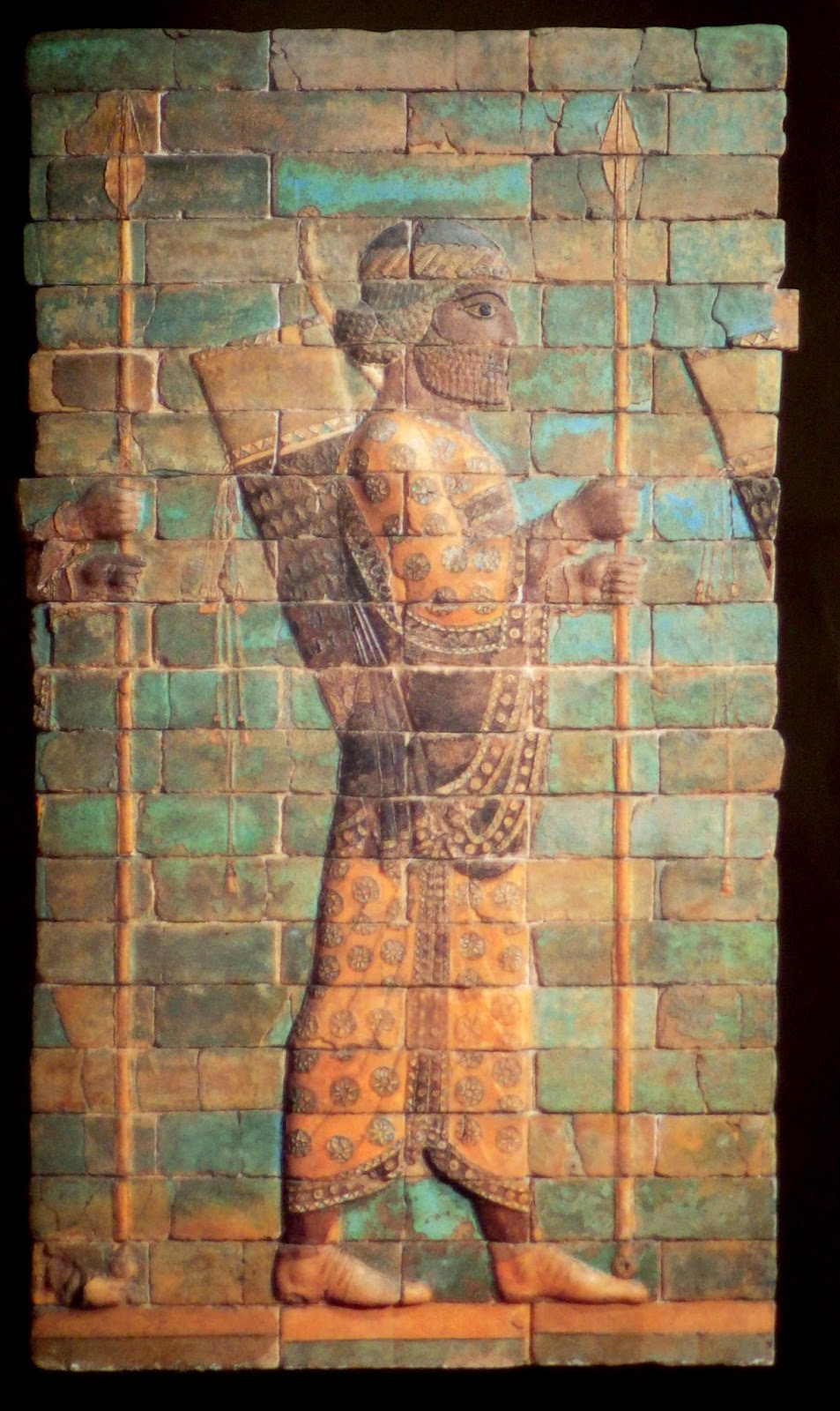
Three days was a short time to spend on Museum Island in Berlin in 1992, but I made the most of it. The Pergamon & Bode Museum was amazing and it was there I beheld the reconstruction of the Ishtar Gate. The gate hails from 6th century BCE Babylon, shortly before the Persians invaded that part of the world. The wall sculpture below, also at the Pergamon, identified as being from the Persian palace at Susa and being a depiction of a "Spear-bearer of the bodyguard of Darius I (521-486 BC)" shows how stylistically similar Persian work was to other art in the area.


Other work which I have confused in the past for Ancient Persian, are wall reliefs and sculpture from the earlier empire of Assyria (c. 7th century BCE). The British Museum has a beautiful collection of  artifacts from Assyria, including a dedicated long room full of wall carvings.


Whenever I visit the British Museum (every couple of years), I must stand in fascination in this room. The carvings are stunning.


These photos are from a visit in February 2011. Unfortunately, my young daughter felt uncomfortable with the animals being speared and shot with arrows (depictions of a lion hunt), so we did not spend as long in the room as I would have liked!