Showing posts with label OPW. Show all posts

Wednesday, 12 July 2023

Moon jars at Rathfarnham Castle

While I was at Rathfarnham Castle a couple of weekends ago I decided to have another look at the basement gallery that has been exhibiting work from the International Academy of Ceramics pieces in the State collection. Entering the first room of this gallery, I was delighted to see a collection of moon jars by Geoffrey Healy. 


The jars are large and with a beautiful form.


Geoffrey Healy is a ceramic artist based in County Wicklow. I have seen a lot of his work over the years and recently heard wonderful things about his abilities from other potters who are doing some technical training with him.


The next gallery contained work that I had previously seen - and blogged about here - but it I enjoyed having another gander.


Mark St John Ellis of nagOffsite has recently redesigned/recurated the work and I noticed some new pieces that hadn't been included before, keeping the exhibition fresh for repeat visitors like me. I particularly like the way these pieces are embedded in the architecture of the former basement kitchen.


I am sure this porcelain piece, which resembles a carved rock, was a new addition to the exhibition as I have no memory of seeing it before!

Wednesday, 6 July 2022

Ceramics at Rathfarnham Castle

I was at Rathfarnham Castle a few weeks ago to see the ceramic exhbition, which was being held in the former old kitchens area of this historic house. 


Curated by Mark St John Ellis for nag gallery offsite exhibitons. the work is from the State Collection 


and beautifully placed in the new exhibition areas of the former kitchens.


Each piece had it's own well-lit space from which to examine it in all its glory.


Some pieces were placed in the individual storage areas. Though obviously one could not walk around these works, they seemed to belong where they were placed. The ceramic pieces inhabited their individual cubby holes - they were not simply "shelved".


The apparent roughness of specific pieces worked well in the raw environment of this part of the castle, The ceramics both evoke and echo the nature of a kitchen as a place of warmth, nourishment and activity.

Wednesday, 23 February 2022

exhibition launch

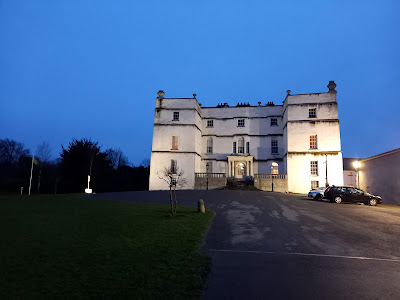
Last Thursday evening the launch of Memory Is My Homeland took place at Rathfarnham Castle. I had been given the go-ahead to send out invites for a cautious launch as covid restrictions had been lifted only a few weeks beforehand. So it was with some delight that I was able to approach the Castle at dusk.


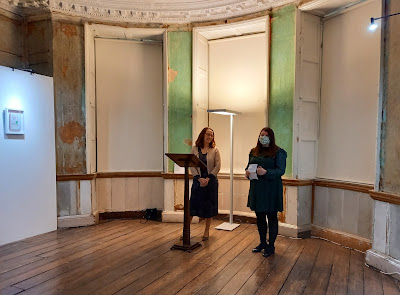
The  exhibition was officially launched by the Canadian Ambassador, Her Excellency Ms Nancy Smyth (left), with introductory words from Ms Ellen Brickley (right) from the OPW National Historic Properties.


As it has been only a few weeks since covid restrictions have eased, the launch itself was cautious and everyone kept to safety guidelines (social distancing and mask-wearing).


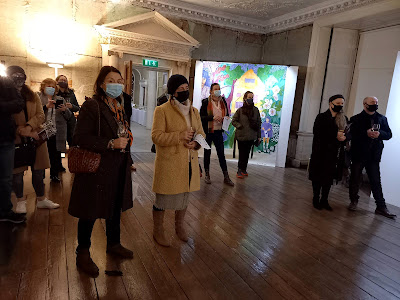
There was a pretty reasonable turnout of guests as people are learning to socialise again! There was wonderful catering (canapés and wine) so of course people could remove masks when eating & drinking, and there was seating scattered in the various rooms so that there were opportunities for people to relax and chat.


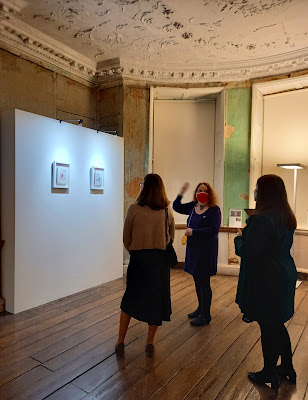
I was available to discuss my work with both the Ambassador and Ms Brickley.


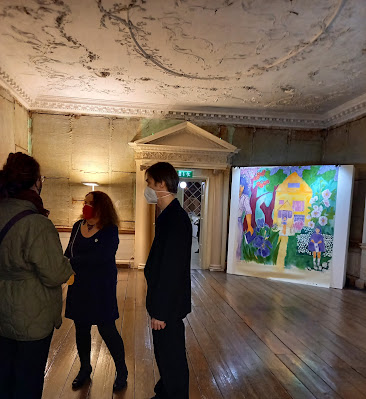
Of course, I had some opportunities to greet my friends and guests. This picture encapsulates my main reason for wanting to exhibit at Rathfarnham Castle: the historic walls and gorgeous architecture of the venue!
 

In the Saloon the painting details on the ceiling reflect the period of time in the early 20th century when the castle was owned by the Jesuits.


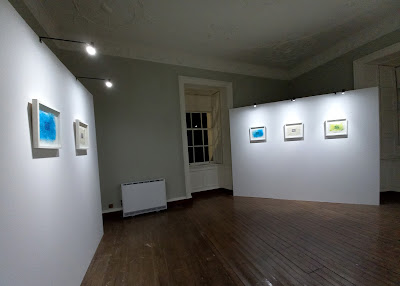
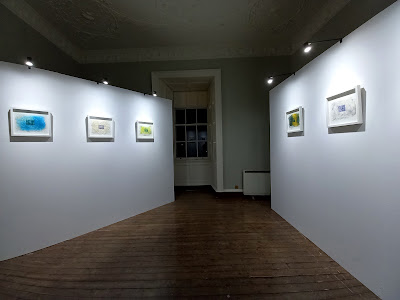
The Pistol Loop Room provided an intimate space for my linoprints on handmade silk fibre sheets.


There were three false walls, at angles to each other, which provided the surface on which to hang my unique prints.


Back in the large Dining Room, I had a photo opportunity with the Ambassador and my painting, Kingston Road: Waiting.

Wednesday, 16 February 2022

exhibition install day!

A busy start to the week for me, as my exhibition Memory Is My Homeland  opens to the public on Wednesday (Feb 16). The Canadian Ambassador to Ireland, Her Excellency Ms Nancy Smyth is launching the exhibition on Thursday evening. It will be the first launch that Rathfarnham Castle has had over the past two years (because of covid) and will be a small affair, but celebratory. So on Sunday evening everything was wrapped and packed into the car for an early start the next day.


Rathfarnham Castle is an Elizabethan era fortified home 


surrounded by a pleasant park. Although the skies were grey, I was glad that there was no rain to be seen, especially while we unpacked the car.


The false walls had been freshly painted and most were already dry, so work could begin immediately.


As the walls in the dining room weren't completely dry, we started in the saloon.


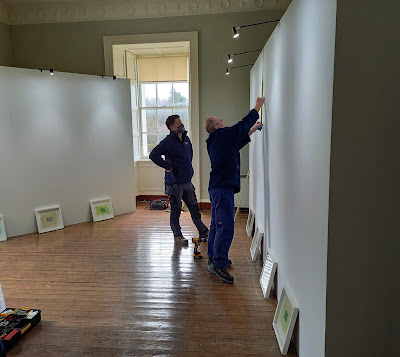
I was expecting just one other person to assist my husband and I in the hanging, but a fabulous team of OPW carpenters and electricians arrived to carry out the work.


I simply had to place the work where it was be to be hung and talk to the carpenters about placement height and space between works.  Once the work was hung, the electrician adjusted the lighting to my specifications and the painter touched up any areas that had pencil marks.


Everything was done before lunch! Before we left we checked out one of the exhibition signs that had been hung up on the fence between the castle and the carpark. For further information and pictures related to this body of work, do a search on this blog for Memory Is My Homeland.

Wednesday, 1 December 2021

Double Estate at the Pearse Museum, Dublin

On a cold but dry Sunday afternoon a few weeks ago, I made my way to Rathfarnham for the specific purpose of seeing a couple of exhibitions at two OPW museums that are near to each other. I previously blogged about the Mary Ruth Walsh exhibition at Rathfarnham Castle here, but on the way to the castle, I first visited the Pearse Museum. Please note that due to covid protocols one must phone first and specify the time of a visit. I had seen pictures of the exhibition in a recent issue of VAN, the Visual Artists Ireland newsletter, and was intrigued enough that I wanted to see the work IRL (in real life).

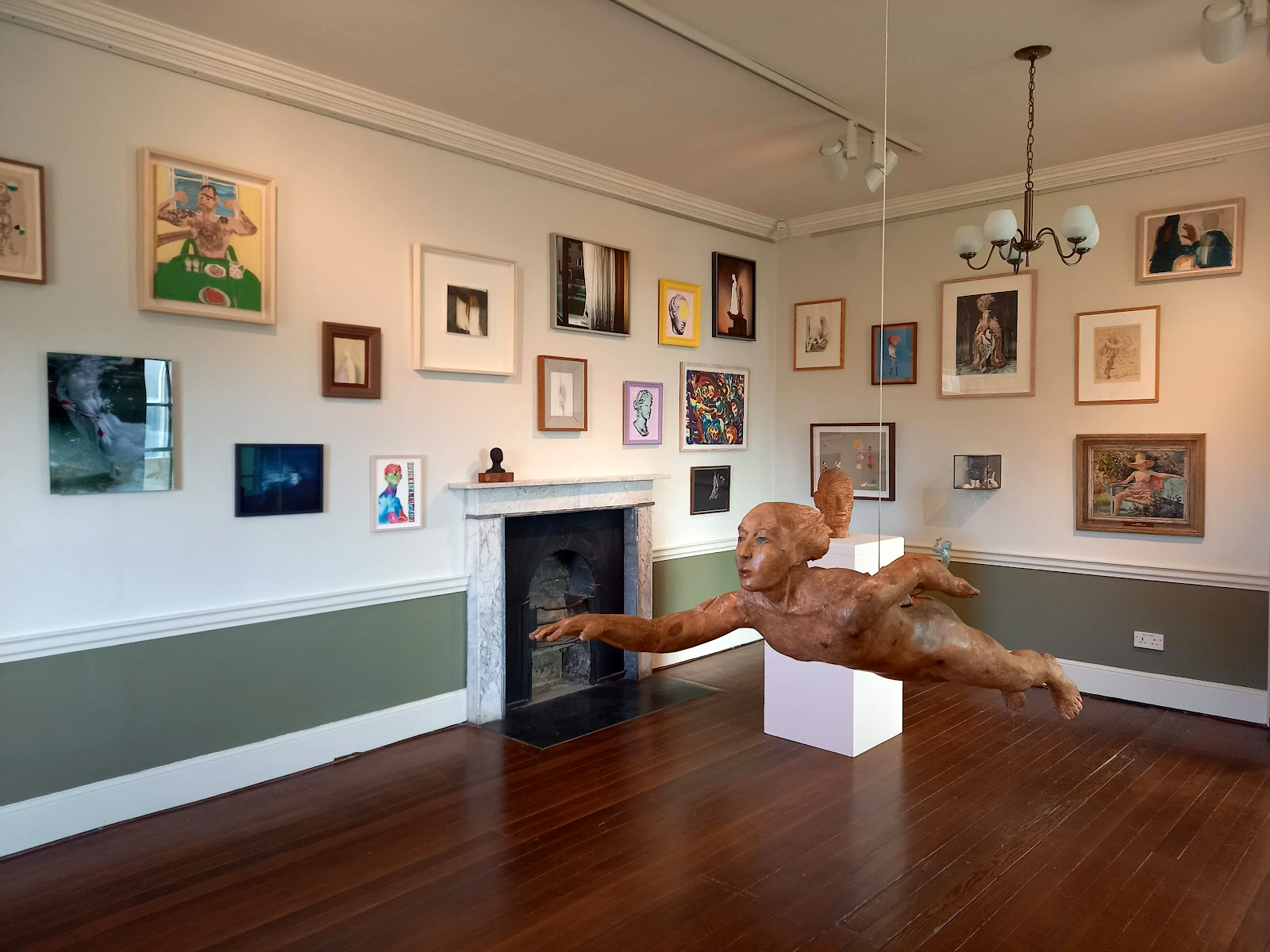
Though it is impossible not to be overwhelmed by Janet Mullarney's sculptural work hanging in the middle of the first room, the set-up also forced me to carefully wend my way around the perimeter of the room to look at works individually (taking care not to step backwards!).


From across the room I recognised a colourful carborundum print by Michael Cullen (lower right). Once I discovered what the title of the piece was, the image took form in my own memory - Caravaggio's Taking of Christ can be seen in the National Gallery.


The work in Double Estate is put together by curator Davey Moor from the OPW (Office of Public Works) art collection. A poem by Emily Dickenson inspires the show and the reasoning behind the amalgamation of these disparate works. Dickenson refers to the body and the soul in her poem, and Moor latches on to these concepts as his curatorial premise. Moor's essay, along with an essay by Brian Crowley (collections curator) are printed within Oonagh Young's beautifully designed full colour exhibition catalogue.


It was good to see the Pearse brothers represented in a contemporary exhibition at this location. William Pearse, Patrick's artist brother is represented by two pieces of sculpture (not in any of these photos, but in the catalogue) and Patrick himself appears in a 1944 lithographic portrait by Sean O'Sullivan.


The second room of the exhibition contained larger wall works and several sculptures but again was dominated by a mixed media floor piece.


I particularly liked this large drawing/painting/sculpture, Boy, by David Quinn.

The exhibition has been on show in the Pearse Museum for awhile now, but it finishes at the end of the year so there are only a few weeks left to have a look! 

Wednesday, 4 September 2019

Farmleigh House - nagOffsite installation, Gallery 2

Since Farmleigh House Gallery consists of two separate rooms, I decided to blog about each room individually. Just as the nagOffsite exhibition was related to the nagOffsite exhibition in Rathfarnham Castle, so too was gallery one related to gallery two. Both galleries were warmly and dimly lit with spotlights highlighting the work; this warmth and lighting conducive to observation and contemplation.


Impossible to photograph, the elegant "weaving" paintings on wood panels by Kohei Nakata were precise and calming, the woodgrain providing a natural foil to the symmetry of the paintings and


the pearl paint lines having a fragile, gossamer feel.


I had seen some of Masashi Suzuki's gorgeous cha wan (tea bowl) ceramics in the Rathfarnham Castle exhibition, where they were primarily displayed in a cabinet, sitting atop their kiri bako boxes.


Here, Mark St John Ellis, exhibition curator, presented them to greater effect in specialised individual displays, with their boxes, of equal interest and beauty, integral to their display but at a greater distance from the bowls.


There is something about gold that I find attractive, and this piece was my favourite -- the bowl so obviously celebrating itself as hand-crafted in its asymetry and texture.


Wednesday, 28 August 2019

Farmleigh House Gallery - nagOffsite installation, Gallery 1

Although it was a hike to get there, a visit to Farmleigh House Gallery last week was a worthwhile delight. The Gallery is divided into two separate spaces, both of which were curated by Mark St John Ellis as a sister exhibition to the one I had seen a few weeks ago at Rathfarnham Castle, and blogged about here. As such I viewed the exhibitions as related, and thought of the similarities and differences between the two installations. While Farmleigh House is a historical building (also worth a visit), the gallery is contained in a completely renovated outbuilding, so it is a modern space. The intimacy of the two gallery spaces is pronounced by the dim ambient lighting (this photo has compensated for the dimness) and spotlighting of individual artworks.


Unfortunately there was no catalogue available for Gallery 1 on the day I went, but I was able to get some information, with a quick google search, from nag gallery's website here.


I was most interested in seeing the State Collection ceramics and recognised the work of Katharine West.


I specifically loved this ceramic vessel sculpture, which seemed like it had a gashed tire around its rim (this is, however, totally ceramic).


The interior glazing and spiral movement definitely made me think of a dizzying fall into the void.


As each work had its own spotlight in the dim room, it was easy to focus on the individual pieces, yet a work could always be viewed in relation to at least one other piece.


Noting the expanded clay technique of texturing this work, I knew there was a lightweightness to it despite its size. Another friend referred to this piece as a "hornet's nest" and its organic quality is a tactile pleasure for the eyes.


Wednesday, 21 August 2019

Rathfarnham Castle - nagOffsite installation

In June I had gone to a food festival in Rathfarnham and also to have a look at nearby Rathfarnham Castle - an Office of Public Works restored fortified house from the 16th century. While in the "castle" an art exhibition was being set up. I was able to see some of the works and my interest in the group exhibition was piqued enough to return recently, before the exhibition closed. The exhibition was curated by Mark St John Ellis of NAG Gallery, as one of nagOffsite installations, where the work complements and is complimentary to the historic space in which it is situated.

In the first room there is a curious archival box, by artist Kristina Huxley, which has tags and numbers and envelopes and poetry perhaps. I was told, on my June visit, that Huxley has catalogued dust from the building. This is a labour of love piece of work and I was able to extrapolate meanings from the process related to me as well as from the form of the work. On my return recent visit I was also glad that there was some information on the artists, the work, and the curator of the exhibition (Mark St John Ellis) and nagOffsite as a creative presentation entity. This room also included some ceramic ware and boxes by Masashi Suzuki that present the epitome of shibui aesthetic (modesty, naturalness, texture, spontaneity). The framed photographs displayed with Suzuki's work, show ceramics as items of contemplation.


Moving along into the larger "dining room" works by Kristina Huxley and Helena Gorey were placed on walls/faux walls and juxtaposed beautifully with the painterly deterioration of Rathfarnham Castle's actual walls.


There was also a table cabinet in this room which had Japanese Edo Period wrapping paper displayed next to one of Gorey's subtle watercolours. I do not agree with the assumption of worth by proximity, and I did not think Gorey's work fared well in this display, where the Japanese paper and calligraphy were far more interesting visually.


The next room had several table cabinets also, as well as an ambient sound piece by Elijah's Mantle and digital prints by Roseanne Lynch. I was most curious about Huxley's "Citizens of Dust" rolled paper drawings and balls that made me think of watching men in the south of France playing bowls on a hot day. I found out later that the spheres were made of wax and soot and were the same size as musket balls excavated from Rathfarnham Castle.


A nearby display table held more Japanese wrapping paper with calligraphy and a small sculpture of a Buddhist figure from the personal collection of John Hutchinson. The overall effect of these items within an exhibition of contemporary artists is to stress temporality - items of everyday use (wrapping paper) become items of art with time. There is an overall mood of contemplation and timelessness within the exhibition in its entirety.


In the last room encountered, the intimacy of the space is palpable. One is almost encircled by Jane Proctor's drawings (like being on a stage of an amphitheatre and being encircled by an audience) and their subtleties beg for closer inspection. The grid drawings resemble woven cloth, and one's eyes follow the meticulous warp and weft. This is contemplation at its finest, as one is virtually transported while looking at this work.


Also in this small room, is a table cabinet with another of Kristina Huxley's "Dustopia" boxes and a furoshiki package, the blue of its cloth highlighting the bit of colour in Huxley's box and
complementing the colour of Proctor's surrounding drawings.