Showing posts with label ceramics. Show all posts

Wednesday, 12 July 2023

Moon jars at Rathfarnham Castle

While I was at Rathfarnham Castle a couple of weekends ago I decided to have another look at the basement gallery that has been exhibiting work from the International Academy of Ceramics pieces in the State collection. Entering the first room of this gallery, I was delighted to see a collection of moon jars by Geoffrey Healy. 


The jars are large and with a beautiful form.


Geoffrey Healy is a ceramic artist based in County Wicklow. I have seen a lot of his work over the years and recently heard wonderful things about his abilities from other potters who are doing some technical training with him.


The next gallery contained work that I had previously seen - and blogged about here - but it I enjoyed having another gander.


Mark St John Ellis of nagOffsite has recently redesigned/recurated the work and I noticed some new pieces that hadn't been included before, keeping the exhibition fresh for repeat visitors like me. I particularly like the way these pieces are embedded in the architecture of the former basement kitchen.


I am sure this porcelain piece, which resembles a carved rock, was a new addition to the exhibition as I have no memory of seeing it before!

Friday, 25 November 2022

Meitheal

From Oct 24 to Nov 6, I took part in the Meitheal exhibition at Signal Arts Centre. Meitheal is an Irish term to describe the coming together of neighbours to assist each other, especially with reference to saving crops or helping out with agricultural tasks. In the context of the arts centre it refers to this group show of staff artists, who have a variety of skills and artistic styles, coming together to create a coherent exhibition. Each artist was invited to exhibit a maximum of five pieces.


I chose to submit the maximum! Two framed pieces from the summer of 2020 when I took part in the combined Aos Dara-Umha Aois symposium and exhibition. I blogged about that here, here and here.

Saplings, acrylic collage, framed size: 58 cm x 44 cm, 2020


Lightning Tree, graphite, framed size: 58 cm x 44 cm, 2020


The exhibition was lovingly hung by two staff members to give each piece its own space and to allow the different works to be in dialogue with each other.


The show consisted of drawing, painting, ceramics and printmaking.


The artists involved were Don Rourke, Lorraine Whelan, Iseult McCormack, Deirdre Maher Ridgway, Dylan Clucas, Dan Laffan, Santa Selina, Lorna Lennon and Kelly Hood.


My contribution to the show also included three blind-embossed prints that I had previously shown in the spring of this year at Rathfarnham Castle. I give a virtual tour of Memory Is My Homeland here, here and here. For further information on works as they progressed, do a search on this blog for the exhibition title, which is the title of the body of work.


Ghost I, blind-embossed print on Fabriano paper, framed size: 30 cm x 29 cm, 2019


Ghost II, blind-embossed print on Fabriano paper, framed size: 30 cm x 29 cm, 2019


Ghost III, blind-embossed print on Fabriano paper, framed size: 30 cm x 29 cm, 2019


Wednesday, 6 July 2022

Ceramics at Rathfarnham Castle

I was at Rathfarnham Castle a few weeks ago to see the ceramic exhbition, which was being held in the former old kitchens area of this historic house. 


Curated by Mark St John Ellis for nag gallery offsite exhibitons. the work is from the State Collection 


and beautifully placed in the new exhibition areas of the former kitchens.


Each piece had it's own well-lit space from which to examine it in all its glory.


Some pieces were placed in the individual storage areas. Though obviously one could not walk around these works, they seemed to belong where they were placed. The ceramic pieces inhabited their individual cubby holes - they were not simply "shelved".


The apparent roughness of specific pieces worked well in the raw environment of this part of the castle, The ceramics both evoke and echo the nature of a kitchen as a place of warmth, nourishment and activity.

Wednesday, 18 May 2022

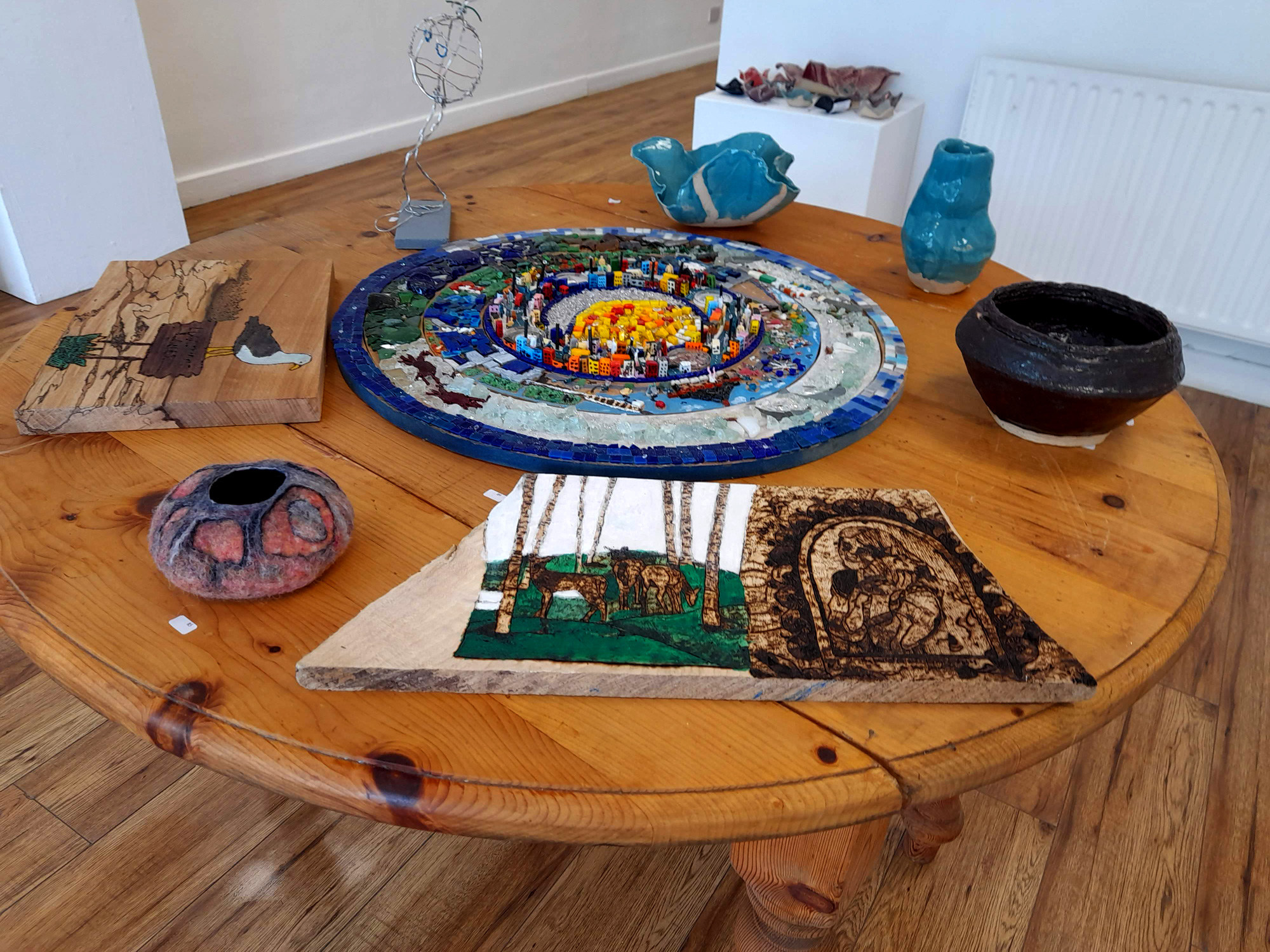
BAEC exhibition at Signal Arts Centre

I was at the launch of the Bray Adult Education (BAEC) exhibition of student work (from final years of both 2022 and 2021) at Signal Arts Centre last Friday evening.  The show’s title The Art Within was complemented by BAEC's Director Ray Finucane’s opening speech regarding the journey of each individual on the road to developing their art and the unquantifiability of the art. 


The exhibition is a fine showcase of the varied art and craft processes that the students learn at BAEC, each piece showing an individual creative response to a process. 


As well as the numerous crafted work on display - felted 2D & 3D works, ceramics, leathercraft, mosaics and pyrography - 


the walls were full of paintings and drawings, showcasing the developing skills of the students, many of whom had never formally explored art forms before.


The age old tradition of student artists copying from the Masters is visible on this wall!


The exhibition consists of work by this 2022's second (final) year students and last year's second year students since, due to covid restrictions, did not get to have an end-of-course exhibition.


So it was a big show to organise and hang!


Much appreciation went to the staff at Signal who basically curated as well as hung the show on the Monday beforehand in order to show each work at its best.

Wednesday, 1 September 2021

Pluid - The National Comfort Blanket

This week I had intended to write about the other exhibition, Pathos, at Rathfarnham Castle, but after seeing the Pluid exhibition on Sunday, I decided it was a priority because it is a fundraiser in which all of the works may be viewed here and many are available for auction in aid of Pieta House, a charity with a mandate for suicide prevention. I blogged about the Pluid Project back in April of this year when I decided to get involved; you can see that post here. While the initial intention of the project was to create a National Comfort Blanket where the individual contributions would be sown together into one giant work, it soon became apparent to the organisers, Claire Halpin and Madeleine Hellier, that both the variety of media and the number of artworks involved would make this an impossible task. Instead, the numbered works were laid out on a long platform and visitors to the exhibition could make their way around the table to view the squares.


Looking up the tables at the multitude of contributions! Admittedly it was a little overwhelming but also gorgeous to see. The two monoprints I submitted, Rosehips and Wild Rose (#81 & #82), are visible towards the bottom centre.


The brief was completely up to the contributing artist to interpret: so a 6 inch square encompassed both 2D and 3D work and any medium that could be thought of was used! I was particularly drawn to Ciara O'Connor's stitch-drawing image of a parent and child making pasta together.


There were three primary schools that took part in this project: Fairview NS (Dublin), Holy Family NS (Monkstown) and Gaelscoil Nás na Ríogh (Naas). This picture also shows a variety of textile-based work: knitting, crochet, felting, beadwork and quilting. 


Jenny Mahony's limestone sculpture (centre) is a beautiful example of a fully 3D artwork in the exhibition. As #56 - an early piece to arrive at Pluid headquarters - it certainly shows how impossible it would have been to stitch the works together as a literal blanket!


2D work took the form of painting, drawing, photography, sculpture and various types of printmaking. There were a few examples of sun-printed cyanotypes. The print at centre-right is by Val O'Regan.


I was thrilled to see a ceramic piece in the exhibition by Orla Kaminska (upper left), whose work I had seen at the annual Ceramics Ireland exhibition at Rathfarnham Castle in June (I blogged about that exhibition here). I was delighted to discover that Fungi (centre right), the beautifully debossed and gold leaf embellished hand-bound book by Fiona O'Grady, was a blank sketchbook! As someone who enjoys bookbinding myself it is such a treat to see what techniques another artist is using.


This picture again shows a variety of works in different media and techniques: painting, felting, photography, crochet and stitching. The gold embroidery on denim is an extremely delicate drawing of wild garlic by Mairéad Harrington, which to her were a comforting sign of spring. As I have wild garlic growing annually below the fuschia hedge in my front yard (from which I make pesto each spring), I delighted in this piece.


In many of my own art pieces I have referred to my "dream boat": an image of a red-sailed boat in the ocean that first appeared to me in a dream and which I have come to associate with my self. Seeing this marker drawing of the red-sailed boat (centre) by Laura Geragerthy brought a true smile to my masked face, like meeting an old friend.


Human touch, both painted and photographed, like these photos (top, black and white) by Joshua Sullivan, has such strong associations during this time of "social distancing". Hugging and holding hands, when possible, have become far more important and nuanced than at any other time in our lives. I was also delighted to see the mokuhanga print of Kate McDonagh. Stillness (centre) "reflects the solace [she] found in the quiet skies throughout the Pandemic particularly [during] the first lockdown when no planes were flying." I became acquainted with McDonagh's practice during one of Graphic Studio Dublin's "Artist Beyond the Studio" series of lockdown remote artist talks a few months ago. A recording of it can be watched here.


Comfort in nature was another theme found in various forms throughout the "blanket". I was particularly drawn to the bog cotton works by Pamela DeBrí. I used to live rurally in Kerry and the field next to me was where I first saw bog cotton, a sight which I thought wonderful and beautiful. It was a joy to see both the photograph of a cotton field and the real things immortalised on rag paper.


This picture shows varying 3D works by different artists. I enjoyed Grant McEwen's stainless steel Jigsaw Time (reflecting the overhead beams of the cowshed) and it gave my family the opportunity to do a squishy masked selfie. In front of McEwen's piece is the blue origami and graph paper work, Blue Pavilion, by Helen Barry and beside that is Nourishment, a driftwood and copper piece by Helen OBrien. Nearby I was struck by the altarpiece quality of Michelle Boyle's The Sun Rises in Spite of Everything, a mixed media work that includes gold leaf, granite and découpage elements to create something mystical. To the right of Boyle's work is a blue glass abstract landscape work, Bay, by Barbara Keneally.


There were a surprising number of glass works submitted and I was particularly drawn to the colourful works (centre) of Maresa Edwards, which were based on her daily walking routes.


Obviously it is impossible for me to feature every worthy artwork here - there are more than 1200 works! - so please look at the auction website, here, to view individual works and find out more about the artist's response to the theme of comfort. Altogether it is quite amazing how much thought and work and expression can go into a six inch square. Each artwork is so individual and so human - this is truly a project that has shown the depth of feeling that individuals are willing to show during this extraordinary time and to share their comfort with others. Brava Claire and Madeleine for intiating this project! Thank you.

Wednesday, 16 June 2021

Dublin gallery day - part 2 of 3

It seems ages away now, but it was less than two weeks ago that I had my big excursion in to Dublin for a "gallery day". I blogged about the first two stops (The Molesworth Gallery and The National Gallery) last week, and you can find that blog here. But the catalyst that got me venturing into Dublin in the first place was desire to see Damien Flood's new exhibition, Tilt, at the RHA. I met Flood (always Damo to me) many years ago when he was a teenager and a friend to several of my nieces. For many years now, he has been quite an accomplished artist and I am always curious to see the development of his work. I was aware of his (relatively) new excursion into ceramic figurative work and wondered how it would fare in juxtaposition with his paintings.


The RHA is a fairly large and open space so the figures can fully inhabit their area grouping but at the same time complement the 2D work. Having chatted with Damo about this exhibition (before it was installed) I knew that he had designed the plinths specifically for each sculpture group. The beautiful, careful, and appropriate plinths extended the ceramic figures giving them height and weight as sculptures. The figures themselves expressed angst and humour simultaneously and the use of gold leaf undeniably spoke of their emotional importance.


It was most surprising and delightful to see this tiny figure sitting steadfastly on the corner of a painting.


The figure seems resigned or glum in his position. As the only figure in the exibition that is directly situated on a canvas, without the company of other figures and the only 3D figure without added gold leaf, he is very much alone.


The paintings provide a steady evolution from earlier work. I, for one, am delighted at the lack of the colour brown in the paintings (since I abhor brown) and am glad to see Flood using a more colourful palette than in earlier work. There is a definitely surreal, dream-like quality to the work as images are within a floating world of their own. One is never sure whether it is a specific object or just the paint itself that is being depicted.


In one corner of the adjacent large gallery, another group of figures beckoned to me, again on beautiful, bespoke plinths.


These grinning figures had gold leaf applied to specific areas (brain, teeth) and the crackle glazing was both elegant and spoke of age. Two of the figures were on plinth cushions that related directly to the paintings. The use of gold leaf and cement echoed the figures and plinths in the previous gallery space.


In another corner there were ceramic vessels on their own special plinths, several appearing so precarious that I was beckoned closer just to see how the impossible was possible, but also fearing to go closer...


With these vessels I was brought directly to the imagery of the paintings. I could see them as a culmination of the painting and 3D figure work. Flood was able to express a unity in the materials - clay vessels, paint, glazes, rusted plinths - that made the entire exhibition have a satisfying wholeness to it. Where will he go from here?