Showing posts with label blind embossing. Show all posts

Wednesday, 2 March 2022

Memory Is My Homeland - Rathfarnham Castle - room 1: The Saloon

Since there are three rooms to my exhibition at Rathfarnham Castle, I thought I would do a virtual tour over the next few weeks of my blog, starting with the first room that one enters to view work: The Saloon.


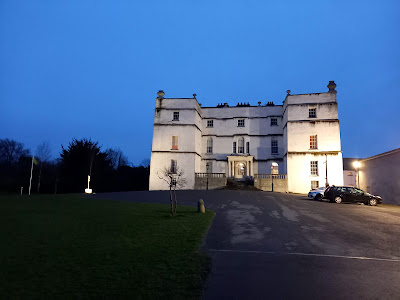
Of course, the real start of the tour is entering the Castle, an Elizabethan fortified home. The Entrance Hall on the first floor is where one picks up my catalogue and folder that accompanies the exhibition.  


After one enters The Saloon from The Entrance Hall the colour of the large painting, Knockeen, on your left, stands out


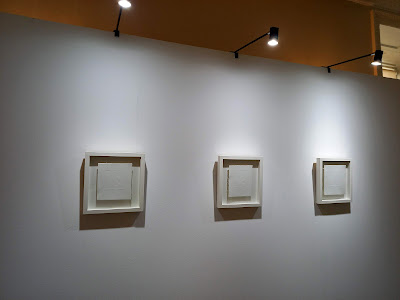
in contrast to what appear to be three framed blank pieces of paper! (For detail images of Knockeen, you can look here.)


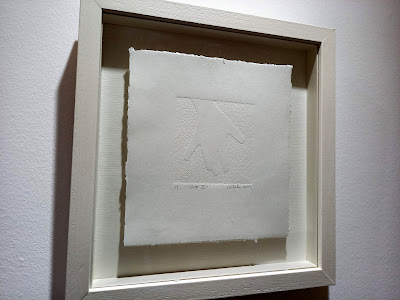
On closer inspection (though difficult to photograph) this is a trio of blind embossed prints, entitled Ghost I


Ghost II


and Ghost III. In answer to questions about their meaning, my response is that they are about being seen and not being seen. The hand images are made from photocopies of my own hands that have been reduced in size and cutouts made from sandpaper for the embossing texture. The form here is very appropriate to the meaning.

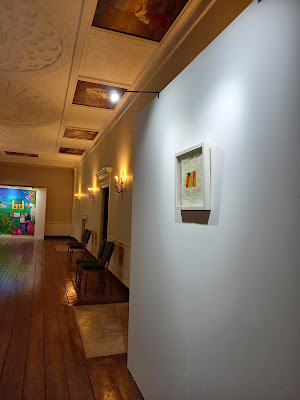
This is a view up the left hand wall from the back of the room. Note the decorative plaster work on the ceiling; the embedded painting panels are scenes from the life of Christ, placed here early last century when this building was owned by the Jesuit order for use as a seminary and retreat.


Florence Road: Butterfly Wall derives from an actual encounter when I moved back up to Bray from Kerry. I planned to paint all the walls in the house white, in order to brighten this old house, which had been unlived in for several years. Meanwhile, however, quite a number of butterflies had taken residence in the house and had become dormant on the old wall of the stairwell. While I was alarmed at this, my husband collected the butterflies and put them outside where they came out of stasis and flew away. Butterflies have always been an easy symbol of transformation and freedom and this was a personal experiene for me to paint.
 

This is a view along the right wall from the back of the room. The chairs mark the doorway that we have entered through, which is flanked by two fireplaces. In planning the location of the false walls, I stipulated that I did not want the fireplaces to be covered.


Red Wellies is a monoprint on handmade silk fibre sheet. I learned to make silk fibre sheet (technically not "paper" since it is not plant-based) during a zoom course that I took in the early days of the pandemic. The Fabriano paper inclusions are visible in the sheet and do make it easier to print on. I bought my wellies during a deluge in Galway in 1989 and practically lived in them (and wore them out) while I dwelt in Kerry for three years. They were worthy of commemoration!


Wednesday, 4 October 2017

Blind embossing


 I had an idea for a handmade book, "Ghost", where the images would be blind emossed prints. These would be small prints, facilitated by my pasta machine press. The plates are 800 micron acetate, each plate being a tiny 9 cm square. The printed pages are a whopping 12.5 x 15 cm, and they will be affixed to an accordion book 16.5 cm vertically; the covers are 17 cm square. All these figures are important and should be worked out in advance, when creating a book, so that finally putting it all together goes smoothly.

I had an idea of the images I would use, a hand as a metonym for the whole body. I had not done blind embossing on my pasta press before, so I began by testing some materials. Below is an image cut from oilcloth, using the smooth side up.


 I also tried the heaviest grade of sandpaper I could find.


This is the same sandpaper grade as above, but is the environment around the image.


 I did some tests on Fabriano paper. The heaviest grade sandpaper was very difficult to work with.


Although I liked the embossed imprint of the heavy grade sandpaper, I had to fight with my press to get the print! When embossing a thin tissue is placed over the plate so that the paper stays clean, yet I was finding that the tissue was becoming embedded in the print, and could not even be removed when dry.

I tried using completely dry paper, and even though I had some good results, I still had to fight with my press to get a print. So I abandoned the idea of using the heaviest sandpaper grade for my plates.


I also started using oilcloth in lieu of felts with my prints, as it is thin, yet has more weight to it than the thin felt I was using.


Here is a another sample of a plate with heavy grade sandpaper. Though not as heavy as the black sandpaper, there were still some difficulties with the prints.


I had decided I would probably use two hands in each image, the final image (of five) being two hands together emulating a bird in flight. The plate below shows the reverse side of oilcloth, which has a textured pattern.


Still using thin Fabriano for tests, I wanted to see how the oilcloth faired under the press. I was surprised that the pasta machine was sensitive enough to pick up the area where the two hands met. For the oilcloth tests I used two layers of oilcloth in lieu of felts. One must remember to have the smooth side of the oilcloth lying next to the paper, so as not to have any additional unplanned embossing.


My final tests were on the Khadi Indian rag handmade paper. The prints are subtle, but this is in keeping with the point of my book "Ghost".


 My final decision was to use the same grade of sandpaper for all five images, representing the environment rather than the hands.


The last step was printing out each plate. The book will be in an edition of ten, so I needed ten prints for each plate. I finished all the printing last week, and now I am working on putting the books together.