Showing posts with label monoprints. Show all posts

Wednesday, 19 July 2023

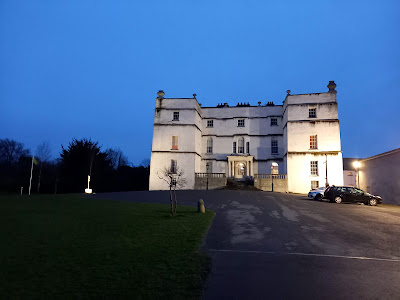
Martin McCann at Rathfarnham Castle

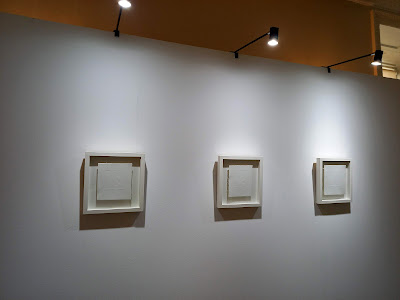
I had really wanted to see Wabi Sabi: the Beauty of Insignificance, an exhibition of paintings and prints by Martin McCann, but couldn't seem to fit it in to my schedule, so I was so glad that the exhibition was extended and I made it to Rathfarnham Castle on the very final day! I love seeing the very different ways that artists respond to the castle and how their work is set up in the gallery spaces of The Dining Room, The Saloon and The Pistol Loop Room. I discuss my own exhibition there last year in numerous posts, just search this blog for Memory Is My Homeland for virtual tours and the work as it progressed.

I think the work is fabulous but recognise that my pictures don’t do justice to the layering and textures. The largest paintings were in The Dining Room. 


 It was lovely to meet Martin at the Castle too, as he was on hand to talk about the work and answer questions. 


Infirmary Road, mixed media on cradled wood panel, 100 cm square


Martin set up all his midsize/smaller works in The Saloon, which allowed for more intimate looking.


A Not So Distant Shore, mixed media on cradled wood panel, 40 cm square 


Aerial #4, mixed media on cradled wood panel, 28 cm square


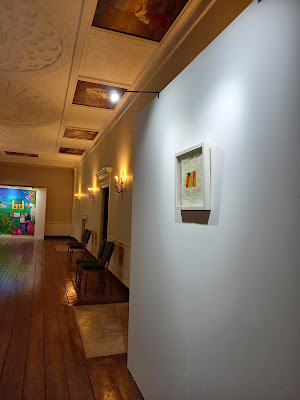
As I had done for my exhibition, Martin used the much smaller Pistol Loop Room to display all his prints. Gelli monoprint collages were the ideal medium to complement the layering and textures in McCann's paintings.

Wednesday, 10 May 2023

more from the "Lost" series

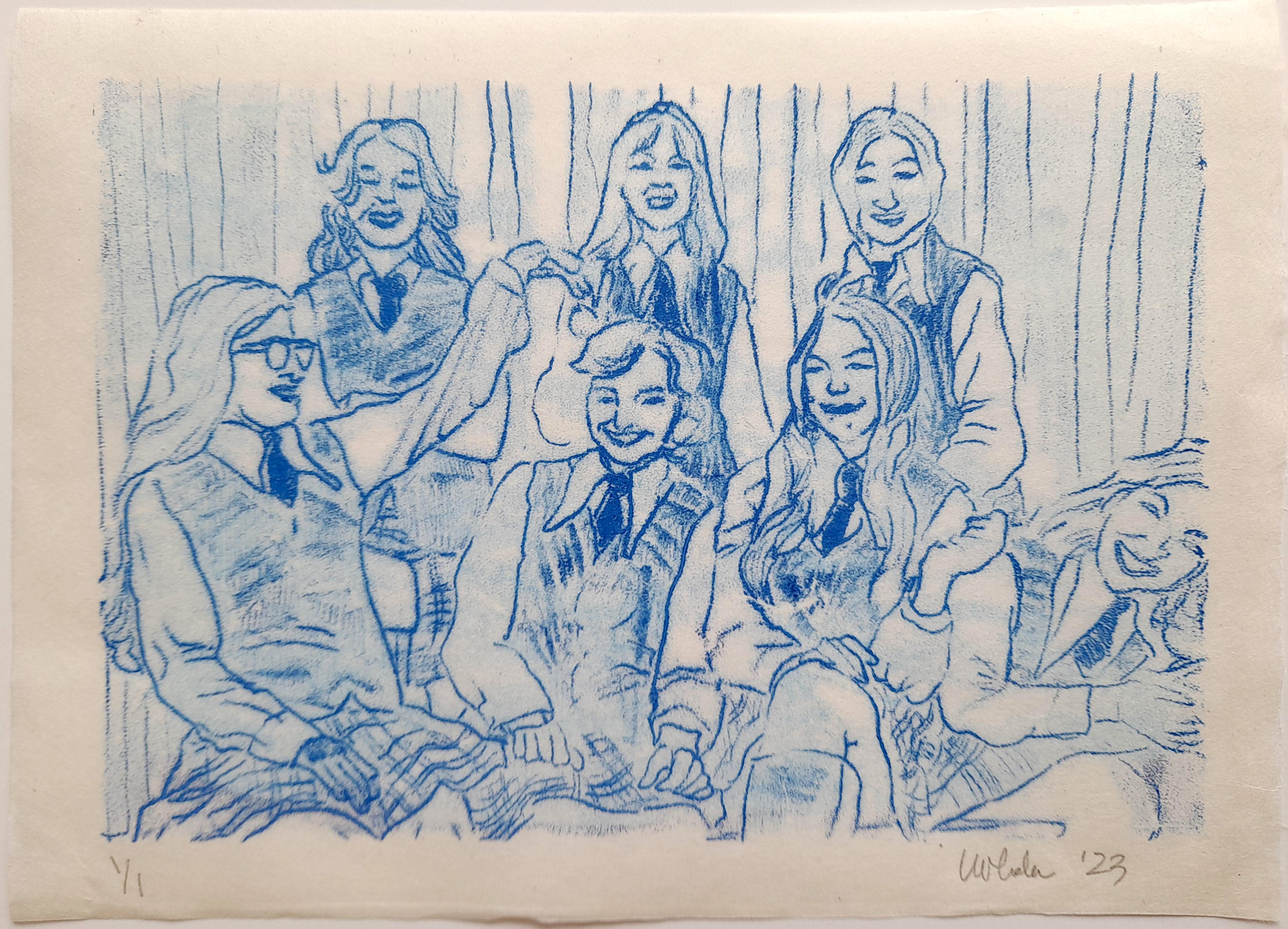
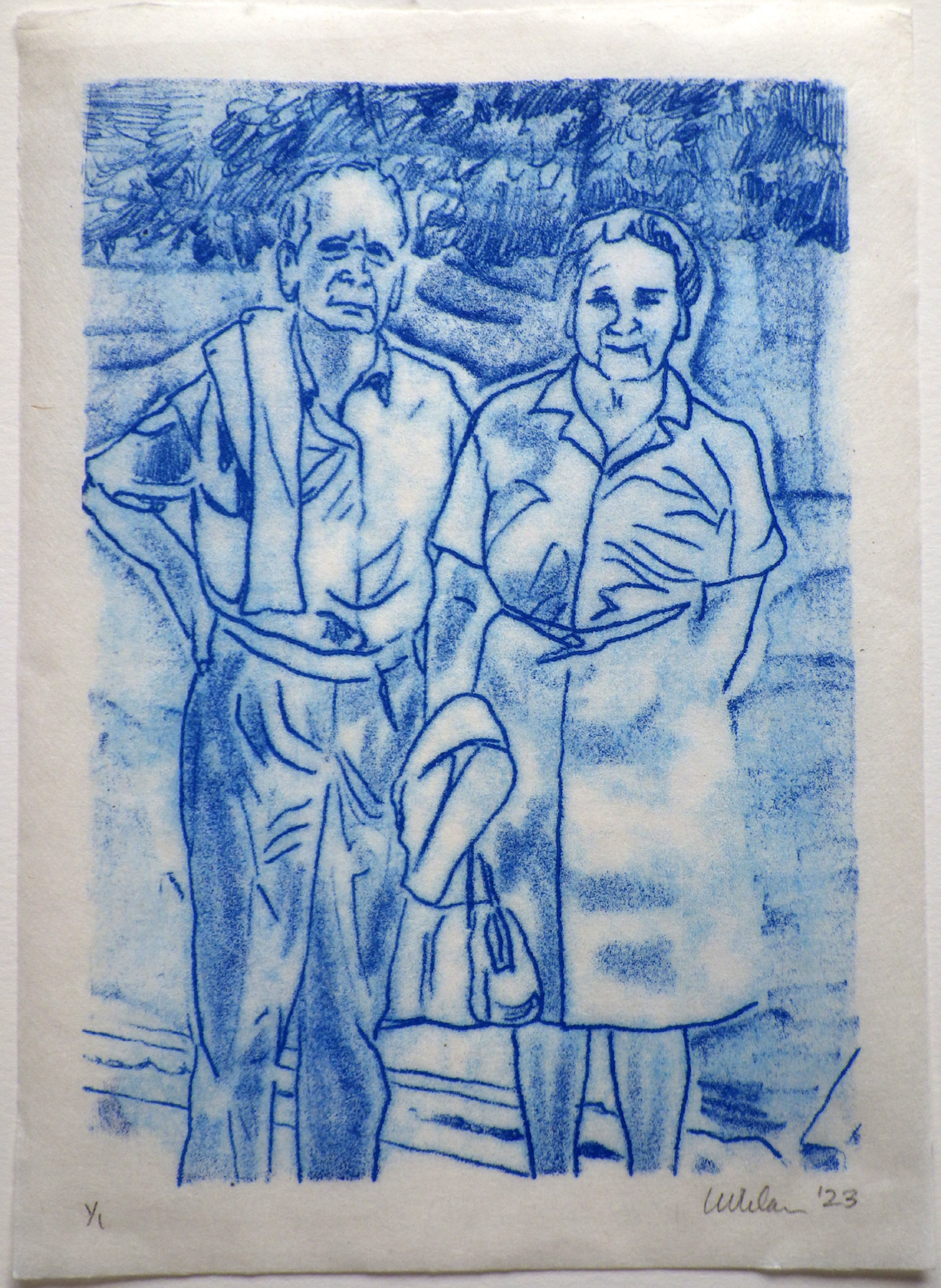
I am still working away on my Lost series of contact monoprints. So in addition to what I blogged about here and here, I am posting more in the series. Because the process can be very random, I can never be quite sure if the print is successful until the final lifting of the paper away from the plate. Sometimes I may have either over-inked or under-inked the plate so I put the print to one side to study if there is anything I liked about it and perhaps make more attempts with the specific image. I have limited myself to three tools for mark-making: a sharp pencil, an eraser and an old credit card. These three tools are giving me crisp sharp lines, soft blurs and sharp areas, respectively. I am very happy with my choices! All of the works are the same size, 12.5 cm x 18.5 cm (or 18.5 cm x 12.5 cm if they are vertical images), printed on Japanese mulberry paper.

Many things went missing from the shared studio


After thirty years abroad, they never regretted their return home


Despite the isolation, we made the place our home


There were only a few occasions when the whole family was together


The kitchen window offered a great view of visitors in the back yard

Wednesday, 19 April 2023

"Lost" series continues

I have been happily working away on the Lost series of monoprints, a new body of work which I first spoke about in detail here. In addition to being happy with my work, I was delighted to receive the recent news that an image of my "breakthrough" print (the rainy bus image included in that first blog about the series) has been chosen to be included in the spring issue of the US literary journal out of University of Pennsylvania, The Penn Review. In the meantime, here are some more images from Lost.

The kids could play at anything in the back yard, monoprint, ink on Japanese mulberry paper, 12.5 cm x 18.5 cm.


When I was going through the rooftop archives, it was interesting to see that I had attempted, in the late 1990s, to use the gate in front of the house where I lived in Kerry as an artistic motif. I don't think my use of it was successful at that time but it is an image I have come back to. (Look here to see some of the image of the gate from the rooftop archive.)

The gate in front of the house led to a huge field, monoprint, ink on Japanese mulberry paper, 18.5 cm x 12.5 cm. 


Of course, I have used this image before in more recent work - most notably the small linoprints on silk fibre sheets that I made for Memory Is My Homeland (a search of this blog using that title will bring about works in progress as well as a virtual tour of the exhibition at Rathfarnham Castle, Dublin, in 2022).

Field Gate, Knockeen, image size: approx 6 cm x 7.5 cm, sheet size: approx 20 cm x 26 cm, 


It really is just a blink of the eye, monoprint, ink on Japanese mulberry paper, 12.5 cm x 18.5 cm. 


The friends of 1975: where are they now?, monoprint, ink on Japanese mulberry paper, 12.5 cm x 18.5 cm. 

Wednesday, 29 March 2023

"Lost" - beginning new work

Although the sorting through and purging from the archive of rooftop portfolios and rolls has taken up a lot of my time these past few months, I have also been busy with some new work. In the autumn I received the delightful news that I would receive an Agility Award from The Arts Council/An Chomairle Ealion for my proposal of a new print series Lost. As often happens with new work, I certainly had moments of confusion and despair as nothing seemed to be working the way I imagined. I finally had my breakthrough moment in early February when everything worked as planned and I knew for certain that indeed I had chosen the right medium (contact monoprints) from which to create this new body of work. All of the works are the same size, 12.5 cm x 18.5 cm (or 18.5 cm x 12.5 cm if they are vertical images), printed on Japanese mulberry paper, which is both strong and delicate. The pictures are about memory and refer to lost moments, lost country, lost time, etc. I decided I wanted the titles to give a bit more information about the story behind the image, at least as a starting point.

Even on a rainy day, the bus might be on time


When I was a teen, I went on an amazing government-sponsored youth project, Educanada, which brought teens from all over the country to the capital to learn a bit more about their own country so there were day trips to Montreal, Quebec City, Upper Canada Village near Kingston, as well as local Ottawa tours of the Parliament Buildings, Rideau Hall (Governor General's home), national police headquarters, National Art Gallery, Museum of Civilization, etc. It was great! The thing that really stood out for me, though, was seeing the log booms floating in the Ottawa River past Parliament Hill. It has been many decades since the industry has transported timber this way, hence my inclusion of this image in my Lost series.

Log booms used to float down the Ottawa River past Parliament Hill


This image portrays a memory of my childhood playing with my little brother in the backyard of the house in Toronto’s east end. 

We used to play cowboy games in the back yard


On my first visit to NYC (back in the mists of time when I was at art school in Toronto) one of my friends, who shared a hotel room with me, was dramatising a teenager on the phone and giving me an art history lesson at the same time; I vividly remember that pop art was the topic so I decided to reference Roy Lichtenstein in my title. 

Well, Brad, let me tell you…
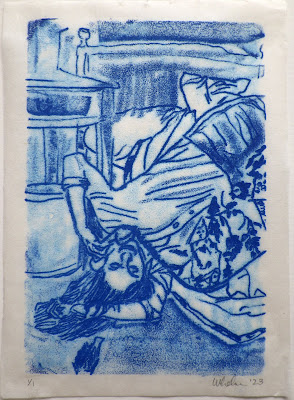

I did not meet my grandparents till I was about 9 years old when my family won a St Patrick’s Day competition from a magazine-type tv show in Toronto (as a matter of fact, the show was called "Toronto Today"). The prize was to bring two people over from Ireland for a holiday if you were picked as having the best reason to do so -- 6 of my siblings had not seen their grandparents since they emigrated and 4 of us, Canadian-born, had never even met them -- so we had a pretty good reason to win! I remember before meeting them that summer that I had been incredibly jealous of my friends who had grandparents and especially those who had a grandparent living with them. So when I met my Oma and Opa my adoration was unconditional. Letters that I have from them attest to the fact that they felt the same way. When my grandmother died in 1980, one of my letters to her along with the goodbye card I made for my grandparents, after that first meeting 11 years beforehand, was found in her purse and returned to me.

Although we only met a few times, they loved me and I adored them


I was born into a large immigrant family

Wednesday, 11 January 2023

rooftop archive 2

 A few months ago I decided to go through a number of portfolios that were in storage on the rooftop section of the attic (the other side of the wall from my studio). I blogged about opening the portfolios and finding things here and wrote about some of the early works here.

Going back a little bit further even, I was pleasantly surprised to see that I had held on to a few prints from CTS art school in Toronto. I think Blue Egg, an undated silkscreen print measuring 70 cm x 59 cm in an edition of 10 (this print is 10/10) is from late 1980 when I was in my third and final year. 

Also from my final year at CTS, though early the following year (1981) is an untitled etching. I did a test print of the linework before I added the aquatint.


 I remembered being teased mercilessly at the time by my friends/fellow art students for always painting and drawing sleeping subjects!

Although I did not pursue printmaking again till decades after art school, for awhile I enjoyed making monoprints - simply painting on the back of zinc plates and pressing them to paper with a wooden spoon as I didn't have access to a press. That summer of 1981 I became obsessed with tulips and I remember creating a series of monoprints of them in the basement of my parent’s house in the wee hours of the morning listening to an old record of Cream on a 1970s space-style Panasonic stereo. I loved the song Deserted Cities of the Heart, both the lyrics and Ginger Baker’s drumming. As I used the same zinc plate, the untitled works were all 38 cm x 28 cm. My good friend and cousin was visiting Toronto that summer and I gave her two from this series to take home with her – they are framed and on her wall in London to this day. Only those two, this one and one other from this series still exist. 


By time winter came along that year, my tulips became stemless and were more abstract. I remember creating this piece while minding a sister’s apt in downtown Toronto. It began as an oil pastel drawing within a matte frame and then I painted the surface with turpentine, so I am not sure how to categorize it (painting or drawing?). Untitled, 40 cm x 23 cm.

Wednesday, 2 March 2022

Memory Is My Homeland - Rathfarnham Castle - room 1: The Saloon

Since there are three rooms to my exhibition at Rathfarnham Castle, I thought I would do a virtual tour over the next few weeks of my blog, starting with the first room that one enters to view work: The Saloon.


Of course, the real start of the tour is entering the Castle, an Elizabethan fortified home. The Entrance Hall on the first floor is where one picks up my catalogue and folder that accompanies the exhibition.  


After one enters The Saloon from The Entrance Hall the colour of the large painting, Knockeen, on your left, stands out


in contrast to what appear to be three framed blank pieces of paper! (For detail images of Knockeen, you can look here.)


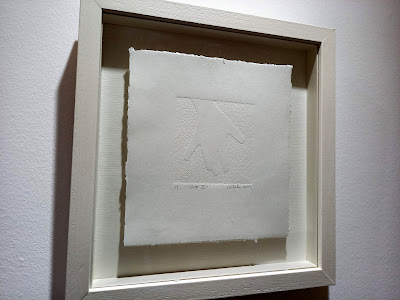
On closer inspection (though difficult to photograph) this is a trio of blind embossed prints, entitled Ghost I


Ghost II


and Ghost III. In answer to questions about their meaning, my response is that they are about being seen and not being seen. The hand images are made from photocopies of my own hands that have been reduced in size and cutouts made from sandpaper for the embossing texture. The form here is very appropriate to the meaning.

This is a view up the left hand wall from the back of the room. Note the decorative plaster work on the ceiling; the embedded painting panels are scenes from the life of Christ, placed here early last century when this building was owned by the Jesuit order for use as a seminary and retreat.


Florence Road: Butterfly Wall derives from an actual encounter when I moved back up to Bray from Kerry. I planned to paint all the walls in the house white, in order to brighten this old house, which had been unlived in for several years. Meanwhile, however, quite a number of butterflies had taken residence in the house and had become dormant on the old wall of the stairwell. While I was alarmed at this, my husband collected the butterflies and put them outside where they came out of stasis and flew away. Butterflies have always been an easy symbol of transformation and freedom and this was a personal experiene for me to paint.
 

This is a view along the right wall from the back of the room. The chairs mark the doorway that we have entered through, which is flanked by two fireplaces. In planning the location of the false walls, I stipulated that I did not want the fireplaces to be covered.


Red Wellies is a monoprint on handmade silk fibre sheet. I learned to make silk fibre sheet (technically not "paper" since it is not plant-based) during a zoom course that I took in the early days of the pandemic. The Fabriano paper inclusions are visible in the sheet and do make it easier to print on. I bought my wellies during a deluge in Galway in 1989 and practically lived in them (and wore them out) while I dwelt in Kerry for three years. They were worthy of commemoration!


Wednesday, 28 July 2021

Memory Is My Homeland - prints, part 1 of 2

In the spring of 2019 I embarked on a new body of work after having a dream of houses and prints. Tentatively I referred to this work as "The Home Project" and talked about it in early days here. Certainly as time went on the work began to take shape for me in terms of examining concepts of home in relation to place, time and memory. As I began to work on more pieces (paintings, drawings) I re-titled the body of work as Memory Is My Homeland, and a search within this blog will lead you to various pieces within this body of work. After taking a zoom silk fibre papermaking workshop, I decided that I wanted to make prints on this beautiful handmade support. So first things first, I made the silk sheets for the prints and blogged about it here. My idea, originally, was to create a series of monoprints, but for various reasons I was not happy with the results, which I discuss here. Though at the time I thought this monoprint was too bright to be included with the Memory Is My Homeland work, I now disagree with myself and think it belongs. 

Red Wellies; monoprint on handmade silk fibre sheet; image size: 9 cm x 13 cm; silk fibre sheet size: approx 24 cm x 24 cm; 2020


After not being happy with a number of monoprints, I made the decision that I would, instead, make linocuts to be printed in small editions and uniquely print each lino on a piece of silk fibre sheet. I had a studio residency at Signal Arts Centre last fall, during which I planned to do all the printing, but then there was another lockdown so I did the printing at home, which I discussed here. Below is one of the Distance editioned prints (image size: 6cm x 7.5cm)


and a unique print on silk fibre sheet. When making this sheet I included strands of green raffia fibre. Since this fibre reminded me of the confusion that telephone wires and relationships could be, I thought it provided an appropriate support for the telephone image (silk fibre sheet size: approx 20cm x 25cm). 


Prom Rail, Bray; image size: 6cm x 7.5cm


silk fibre sheet size: approx 22cm x 28.5cm


When thinking about images I wanted to print for this series, I realised I had already cut some linoblocks a few years ago for the Good Morning books that I wanted to reuse, and since the blocks were the same size as this series, there was no need for me to "reinvent the wheel"! I discuss those books here, here and here.

Hospitality; image size: 6cm x 7.5cm


silk fibre sheet size: approx 23cm x 27cm


Spilt Tea; image size: 6cm x 7.5cm


silk fibre sheet size: approx 21cm x 26cm


Wednesday, 14 July 2021

Anonymous Archive part 2 of 2

I blogged last week about anonymously and unexpectedly receiving some of my old work and you can read about that here, because I am now continuing from where I left off.

This print I was very happy to have back, as I do not have any other copies myself, but had never forgotten my work on it. Based on a sketch I did of one of my young nieces asleep, I wanted to recreate that variance in pencil linework and spent many hours of class time in the print room with my zinc plate in an acid bath to create this variance. I remember, in 1981 (my final year at CTS in Toronto) being so pleased that the test print showed the lines as I imagined.


My printmaking teacher convinced me to fill in my minamilist approach with aquatint, which I had never tried before. Although I took a similar attitude with the aquatint - giving it many "baths" in order to have a variance in shadow, I remember being hugely disappointed in the resulting test print. I thought the aquatint overwhelmed the linework.


I am not so disappointed now, though, as I think there is a good contrast between the lines and the shadows. I know I only made a very small edition, but since I have no idea of the provenance of the others, I am quite delighted to have one of the final prints in the edition.


After I finished at the Special Art Programme at CTS, I carried on with my own work as a developing artist. That summer I was very interested in specific flowers as representative of my self. I also made many monoprints, using the backs of zinc etching plates. At this point I do not recall whether these represented red tulips or rosebuds...
 

In the fall of 1981 I started working as a temp in an office in downtown Toronto. Because the employer had a policy that encouraged "staggered hours", I ended up starting work by 7.30 am so that I could go home in the afternoon before rush hour. As winter wore on I found myself at my desk watching the sun rise through the office blinds. I found this broken cityscape view quite inspiring and later did quite a number of sketches of it. I only finally did a large painting in 2015, Fractured City, which was inspred by this time and the sketches I did back then.


I was surprised to see this slightly later work in the Anonymous Archive. Still from the 80s, I did this mixed media piece as part of a series that ended up being exhibited in Winters Gallery at York University (while I was in my final year there in 1986) and then at Charyk Gallery in Downsview. At the time I was very interested in metonymy, visually as well as verbally, where part of the whole represented the whole. In the case of this series, the hand represented the body.