Showing posts with label IMMA. Show all posts

Wednesday, 26 April 2023

Patricia Hurl at IMMA

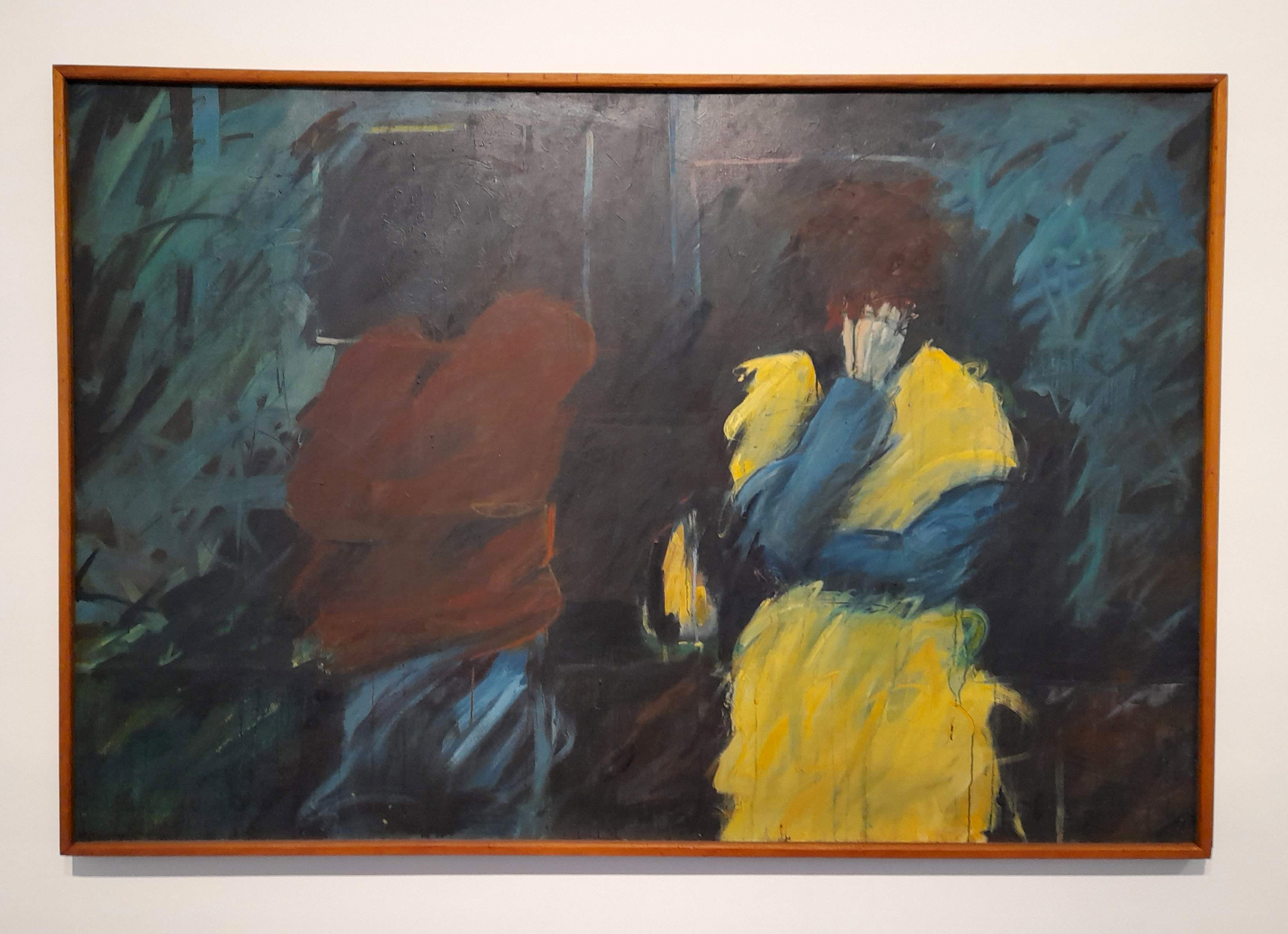
Recently I went to the Irish Museum of Modern Art (IMMA) to see several exhibitions that were on, but most specifically to see the Patricia Hurl retrospective Irish Gothic. It was a gorgeous day, and the museum was especially welcoming with all the flowers happily in bloom, both on the grounds and in pots surrounding the parking lot.


The night before, I had prepared myself for the exhibition by listening to a conversation between Hurl and fellow Na Cailleacha member, Catherine Marshall (who was formerly a curator at IMMA). The conversation is available at IMMA's SoundCloud page here and is both a witty and insightful hour of chat.


Of course, photos of paintings do not show the urgency of the painting itself, but I was also delighted to see images from Hurl's life and memories, concepts which are close to my own practice.


Each painting had a personal didactic, in which Hurl disussed the work's content in such a way that the audience stepped into the memory and the very essence of the painting. I totally enjoyed reading the didactics as companions to the paintings and Hurl's voice was fresh in my head from listening to the conversation the night before.


As well as the large paintings from the 1980s, there was a plethora of sketchbooks and ephemera on display, along with more current works which were more intimate but nonetheless vital (such as the ageing self-portraits and the Warrior series). I had also seen some of Hurl's current 3D work, with the collective Na Callieacha, last year at a group show Bones in the Attic at the Hugh Lane Dublin Municipal Gallery. I blogged about that show here.

It was wonderful to see Hurl’s work collected together, and most especially great l to re-meet Trick or Treat, a painting that I had first seen at the GPA exhibition in either 1988 or 1989. 

Wednesday, 18 September 2019

Then & Now: Janet Mullarney at IMMA

A few weeks ago I was delighted to see the exhibition of sculptural work by Janet Mullarney in the hallowed halls of IMMA. Mullarney was one of the first contemporary Irish artists that really impressed me when I had seen an exhibition of hers at the Project Art Centre about 30 years ago!


Mullarney's figurative work straddles that precarious space between dream and reality, fact and fiction - a space close to my own heart.


I concur with IMMA's description of the exhibition: "Although the works presented are diverse in scale, form and materials, they clearly belong to the distinctive world of Mullarney's imagination. Her underlying concerns with the strangeness, darkness and fragility of the human condition also form a connecting thread." IMMA website


Looking at the pictures and thinking about Mullarney's work now, I see a positive affinity with the work of Louise Bourgeois, another artist that I admire.


Mullarney comes from a classically trained background (Florence, Italy) and divides her time between studios in Ireland and Italy. The exhibition brings together old and new work, though I was surprised NOT to see any of the work I remembered from that early Dublin show that had so impressed me. The exhibition runs till October 13 2019.


Wednesday, 14 August 2019

plattensbau studio - drawing workshop

At the end of July a friend and I had signed up for a drawing workshop given by the Berlin-based Irish artist/architect duo plattensbau studio (Jennifer O'Donnell & Jonathan Janssens). They had a short residency at the Irish Museum of Modern Art (IMMA) to coincide with the group exhibition, A Vague Anxiety, of which they were a part. I hadn't seen the exhibition yet, so did not know what to expect, but they began the workshop with a presentation of their practice, which is arcitectural but always with a concern of the human presence.


The focus of the workshop was the fact that "IMMA Was A House", or rather, a home and hospital for veterans. The participants in the workshop would assist in the research of mapping signs of habitation at IMMA, specifically evidenced in the courtyard.


Each participant was provided with a clipboard containing an architectural drawing of the courtyard, markers, blank paper, and sticky dots. We were sent to the courtyard to observe... I was interested in the clock tower and sundial. Both used Roman numerals.


Details such as chimney pots (and a seagull preening beside a chimney pot), a window, curved features interested me.


My friend was walking around making her own observations. I wrote down a few words overheard...


I also marked the areas on the ground where there were circular and rectangular utility covers, on the provide architectural plan. I left this with plattensbau. There were large plans taking up several tables in the Project Space at IMMA, and it was here that after an hour or so the participants crowded around and added their observations. Afterwards there was a lively discussion about the evidence of habitation provided by observation. Before leaving IMMA, I and my friend made sure to have a look at the A Vague Anxiety exhibition, specifically because we wanted to have a closer look at the work of plattensbau in the context of the exhibition. Of most interest to me (though I could not find a proper picture of it - below. at the very bottom, only shows a partial image) was the to-size architectural drawing of O'Donnell's and Janssens' former flat in Dublin, but it included "things" in the flat (ie, the chopping board with carrots). It made me think of the archaeologically precise work that was done to bring the Francis Bacon studio from London and recreate it in Dublin some years ago.


The other work that plattensbau have in the exhibition is an architecturally rendered drawing of the apartment buildings, which are across from and identical to the apartment in which they live in Berlin. After seeing their presentation earlier, I was much more interested in taking a look at the signs of habitation in each apt - the differences between balcony furnishings, plants, etc. - rather than focusing on the bland buildings and the initial feeling of "sameness".  


Wednesday, 31 July 2019

Lucian Freud and Jack B Yeats

At the end of June I was at the launch of Life Above Everything: Lucian Freud & Jack B Yeats at the Irish Museum of Modern Art Freud Centre. A large amound of Freud's works are collected together in the Garden Galleries (a separate buillding) as The Freud Centre, for a period of five years. Different curators deal with the collection in different ways and I have seen several iterations of vision for this work. I was immensely curious how the work of two painters, who I think of as polar opposites, was going to be brought together coherently. Below is Girl with Roses by Lucian Freud (left) and Portrait Figure of an Irish Gentleman by Jack B Yeats (right). It was interesting to learn that the catalyst for the exhibition was the fact that Freud had a Yeats drawing by his bedside for 20 years and had advised a friend-collector on Yeats works to buy! I enjoyed seeing many Yeats works that I had never seen before, and to see the Freud works in a different context. The highlight of the night, for me, however, was the poetry reading by Freud's daughter, Annie, whose poetic works showed facility and humour.


I was pleased several weeks later, when meeting friends at the National Gallery of Ireland, to view works of Freud and Yeats amongst other modernist works. While I had seen all the Yeats works on display at NGI on previous visits, I had a fresher point of view after having seen the exhibition at IMMA's Freud Centre.


I had never seen, or noticed, this early Freud painting at the NGI before and was quite intrigued by its mystery and expressive painting style, which is so different from his later works.


Wednesday, 25 April 2018

Lucian Freud Symposium

Hot on the heels of seeing Daphne Wright's "Ethics of Scrutiny" curated exhibition of The Freud Project, I attended a day long symposium at the Irish Museum of Modern Art (IMMA). The programme of the symposium "Rethinking Freud & The Contemporary" was wide-ranging and fascinating.


The above photo by of Freud painting performance artist Leigh Bowery, taken by Bruce Bernard, along with a picture of the Courbet painting it emulated (below), was referenced several times during the day by different speakers.


The various speakers -- curators, artists, writers -- were all fascinating and added to the understanding of Freud (both his work and personal life). I was especially interested in what the artists had to say. Painter and inaugural Hennessy Prize winner, Nick Miller spoke about studio practice and portrait painting, and Daphne Wright, in conversation with writer Brian Dillon, spoke about her responses and choices as an artist curating the exhibition. Later in the day, the three Freud Research Residency artists spoke about their projects in response to the Freud Project at IMMA. Laura Fitzgerald's presentation was both humorous and significant as she, perhaps not intentionally, focused on portraiture. Sue Rainsford (collaborating with Bridget O'Gorman, who was not able to attend) discussed her project, A Knowing Body, which is at once both an intellectual and visceral development of work that takes a huge leap away and towards Freud!


 Performance artist Richard John Jones presented possibilities of work that echoes the relationship between Leigh Bowery and Lucian Freud. The eccentric Bowery was both a model and muse for Freud, the fleshy, nude portraits in many ways antithetical to Bowery's performance "disguises".


I find myself ever more curious about Bowery; I am a fan of the 1990s Simon Pegg tv show vehicle Spaced. I love the "Art" episode, and though I did not know at the time I first saw it, Leigh Bowery must have been the reference for "Vulva", the former partner of artist character Brian. Brian's wistful remembrances of performance duets, in flashback, are both hilarious and recognisable to anyone who has every experienced the absurdities of some performance art.


Wednesday, 28 February 2018

pastel drawings

I have been busy with a lot of writing lately (poetry, short stories, art criticism). At the end of January my short review of William Crozier: the Edge of the Landscape at the Irish Museum of Modern Art (IMMA) was published as part of CIRCA magazine's This Matters Now series. I saw this exhibition a few months ago, and blogged about it here, but you can read the review here. I was also delighted that my short story, Prayers for My Children was published a few days ago in the online journal, Tales from the Forest; you can read it here.

Last week I decided that, even though I hadn't finished cleaning up the studio, I wanted to do some visual work, other than ceramics. I pulled out some chalk pastels and heavy grey paper and began drawing.


As may be apparent from my prints and handmade books over the past year or two (see here, here, and here), I am inspired by my times of "shinrinyoku" (walks in the woods for good health)


and by walks along the seaside where I become obsessed with pebbles at the shore (also see here and here).


I really enjoyed drawing with the chalk pastels as I was able to lay down shapes and colour to effect quite quickly.

Wednesday, 19 April 2017

Lucian Freud Project at IMMA

I went to the Irish Museum of Modern Art (IMMA) recently to see the Lucian Freud work, which will be exhibited in the Garden Galleries for the next five years. While at the moment all the work is being exhibited as a large collection, I got the impression that over this period that the work may be exhibited in different curatorial permutations, so now was the time to see the work before there was any personal "agenda" attached to it! This etching is Self Portrait: Reflection, 1996


I have to admit that I was never particularly interested in Freud's (what seemed to me) hyper realistic painting before, but there is something compelling about seeing a collection of works together. And that I have long been interested in psychoanalysis. And that there is an unmistakable psychological element in his work that definitely is reflective of the work of his grandfather. So the name becomes part of the intrigue, and part of my reason for going to the exhibition. This etching is Bella in Her Pluto T Shirt, 1995.


The basement gallery was devoted to works on paper, mostly etchings. Given my relatively recent interest in printmaking, I was delighted to find the room full of work that was unfamiliar to me. This etching is Girl with Fuzzy Hair, 2004. I thought this print was especially interesting as I thought at first the white highlights in the hair were were created manually when wiping off the plate before going to the press. However, there was another print with similarities and the display included the metal etching plate; the highlighted areas were actually burnished on the plate itself! These burnished highlights in curly hair are a major feat of burnishing brilliance!


There were quite a lot of etching portraits in this exhibition, which had incredible detail and certainly did not speak of flattery; as I said above, something about psychology and the artist's name... This etching is The New Yorker, 2006.


Although most of the basement gallery exhibition displayed images of people, there were several landscapes, which also indicate Freud's meticulous translation of observation. This gorgeously detailed etching is Painter's Garden, 2003-2004.


Wednesday, 16 November 2016

Keeping Busy!

I have had a very busy few weeks, getting out and about! A few weeks ago, while my daughter was on mid-term break we made our way in to Dublin The National Museum at Collins Barracks. We thought it would be an awful shame if we didn't get to the special exhibition Proclaiming a Republic in the centenary year! Before going in to that exhibition, however, we noticed a small building dedicated to the yacht "Asgard". This private boat was used for gun-running in the early part of last century, prior to the 1916 Uprising. It was a fairly nice display, the yacht being the centrepiece with smaller historical artefacts, photographs and didactics in display cases and the surrounding walls.


Proclaiming a Republic is quite a huge exhibition, which is incredibly wide-ranging as it takes in both sides of the conflict, social and family issues, the suffragette movement and cultural aspects. I could easily have spent longer than I did (nearly two hours) at the exhibition but my teenage daughter does not have the stamina for museums... Amazingly, the republican flag that was raised at the GPO (General Post Office on O'Connell St (formerly Sackville St) is relatively intact. It was taken down by the British in 1916 but returned by the Crown for the 50th anniversary of the Rising.


At Collins Barracks we bumped into some friends we hadn't seen in awhile, which prompted us to go back into Dublin a few days later to see the VUE art fair that my last blog post talked about. A week later I found myself in Dublin again, at the National Print Museum for the launch of Theo Honohan's book Mechanicsville. The book is an "essay in 11 parts on the character of engineering", which I am finding fascinating and somewhat surreal (though I am not sure if this was the author's intention...). The Print Museum was the perfect setting for the launch, as it was a setting of machines - old printing presses, typesetting machines, paper ruling machines, etc. There were also some artefacts relevant to the centenary celebrations. I thought perhaps this was a draft of The Proclamation.


This was the third occasion I had to see a print of The Proclamation in as many weeks. First, on the day I was dropping off my books to be considered for the Dublin Art Book Fair, I had dropped in to see the Book of Kells at Trinity College, and a copy of The Proclamation was on display in Long Room. The second time was at The Proclaiming a Republic exhibition (above) and now here at The Print Museum.

I was in Dublin again a few days later, at the launch of the Dublin Art Books Fair at Temple Bar Gallery & Studios. My Good Morning books had been accepted into the curated artists' books section of the fair. The launch was pretty packed and there were a lot of art books and artist-made books. The atmosphere was fairly casual with people very interested in picking up and looking through the books. Here is a view of one of the large round tables.

And a close up of a set of my books (all three languages) on the table.


The following day I was back in Dublin, at IMMA for a lunchtime talk. The topic of Wounded Cities was fascinating and led by Professor Karen Till. There were two artists also involved in the talk, including my friend Susan Gogan who discussed her in-progress fictional film set in Berlin.

Though not in Dublin, the launch of the third (re-booted) issue of the Bray Arts Journal, took place at The Mermaid Arts Centre in Bray a few days later. A few of my images were included in the journal, but I was glad that the image of this 2012 painting, Together, was included alongside my poem Waking Dream, written shortly after the death of my Mum at the end of the summer.

Wednesday, 18 May 2016

Stable IMMAGES - Studios 9 & 10

It seems like ages, but it was only two weeks ago that I went to IMMA to see the exhibition of first year IADT art students. The exhibition was the culmination of research and work they had been creating in response to being based at the Irish Museum of Modern Art since January.  In my previous post I had a look at some of the work that required darkness for exhibition (in Studio 5) and some of the work that was sited outside. As I said in that post, I was very impressed with the cohesiveness of the exhibition and maturity of the work. 

On entering these exhibition spaces, via Studio 9 the variety and scope of the work was immediately apparent.


There were two short animated videos on one monitor. This one used the images of a red hand and a red face to interact with specific surfaces in the architecture of IMMA.


There was quite a lot of research into IMMA's architecture in this series of drawings & photographs, but because there were no labels for individual works, I could only wonder if this was the research behind the blue scale model of IMMA hung on the wall in Studio 5 (I posted a picture of it last week).


I spoke to the artist who took these photographs of colourful, temporary interventions she had made on various IMMA walls.


This photographic installation referred to the Greek myth of Narcissus.


The works are self-portraits of the artist, distorted by photographing through smoke, water and other materials.


Apparently this artist intensively examined architectural spaces around IMMA before creating detailed temporary chalk on black board drawings.


This series of photo documentation of mirror and light experiments was intriguing.


And I wondered if these experiments were the background for this installation of plastic sheeting and blue threads? However, this I will not know as I only met a couple of the students, and hadn't asked about this piece at the time.


So my gripe about the show is regarding non-labelling and attibution. Although the artists involved were named at the entrance to the studios, a floor plan should have been available to answer simple questions of authorship. Otherwise, I was greatly impressed by the exhibition and look forward to seeing more work by these developing artists.