Showing posts with label Irish Museum of Modern Art. Show all posts

Wednesday, 18 September 2019

Then & Now: Janet Mullarney at IMMA

A few weeks ago I was delighted to see the exhibition of sculptural work by Janet Mullarney in the hallowed halls of IMMA. Mullarney was one of the first contemporary Irish artists that really impressed me when I had seen an exhibition of hers at the Project Art Centre about 30 years ago!


Mullarney's figurative work straddles that precarious space between dream and reality, fact and fiction - a space close to my own heart.


I concur with IMMA's description of the exhibition: "Although the works presented are diverse in scale, form and materials, they clearly belong to the distinctive world of Mullarney's imagination. Her underlying concerns with the strangeness, darkness and fragility of the human condition also form a connecting thread." IMMA website


Looking at the pictures and thinking about Mullarney's work now, I see a positive affinity with the work of Louise Bourgeois, another artist that I admire.


Mullarney comes from a classically trained background (Florence, Italy) and divides her time between studios in Ireland and Italy. The exhibition brings together old and new work, though I was surprised NOT to see any of the work I remembered from that early Dublin show that had so impressed me. The exhibition runs till October 13 2019.


Wednesday, 14 August 2019

plattensbau studio - drawing workshop

At the end of July a friend and I had signed up for a drawing workshop given by the Berlin-based Irish artist/architect duo plattensbau studio (Jennifer O'Donnell & Jonathan Janssens). They had a short residency at the Irish Museum of Modern Art (IMMA) to coincide with the group exhibition, A Vague Anxiety, of which they were a part. I hadn't seen the exhibition yet, so did not know what to expect, but they began the workshop with a presentation of their practice, which is arcitectural but always with a concern of the human presence.


The focus of the workshop was the fact that "IMMA Was A House", or rather, a home and hospital for veterans. The participants in the workshop would assist in the research of mapping signs of habitation at IMMA, specifically evidenced in the courtyard.


Each participant was provided with a clipboard containing an architectural drawing of the courtyard, markers, blank paper, and sticky dots. We were sent to the courtyard to observe... I was interested in the clock tower and sundial. Both used Roman numerals.


Details such as chimney pots (and a seagull preening beside a chimney pot), a window, curved features interested me.


My friend was walking around making her own observations. I wrote down a few words overheard...


I also marked the areas on the ground where there were circular and rectangular utility covers, on the provide architectural plan. I left this with plattensbau. There were large plans taking up several tables in the Project Space at IMMA, and it was here that after an hour or so the participants crowded around and added their observations. Afterwards there was a lively discussion about the evidence of habitation provided by observation. Before leaving IMMA, I and my friend made sure to have a look at the A Vague Anxiety exhibition, specifically because we wanted to have a closer look at the work of plattensbau in the context of the exhibition. Of most interest to me (though I could not find a proper picture of it - below. at the very bottom, only shows a partial image) was the to-size architectural drawing of O'Donnell's and Janssens' former flat in Dublin, but it included "things" in the flat (ie, the chopping board with carrots). It made me think of the archaeologically precise work that was done to bring the Francis Bacon studio from London and recreate it in Dublin some years ago.


The other work that plattensbau have in the exhibition is an architecturally rendered drawing of the apartment buildings, which are across from and identical to the apartment in which they live in Berlin. After seeing their presentation earlier, I was much more interested in taking a look at the signs of habitation in each apt - the differences between balcony furnishings, plants, etc. - rather than focusing on the bland buildings and the initial feeling of "sameness".  


Wednesday, 31 July 2019

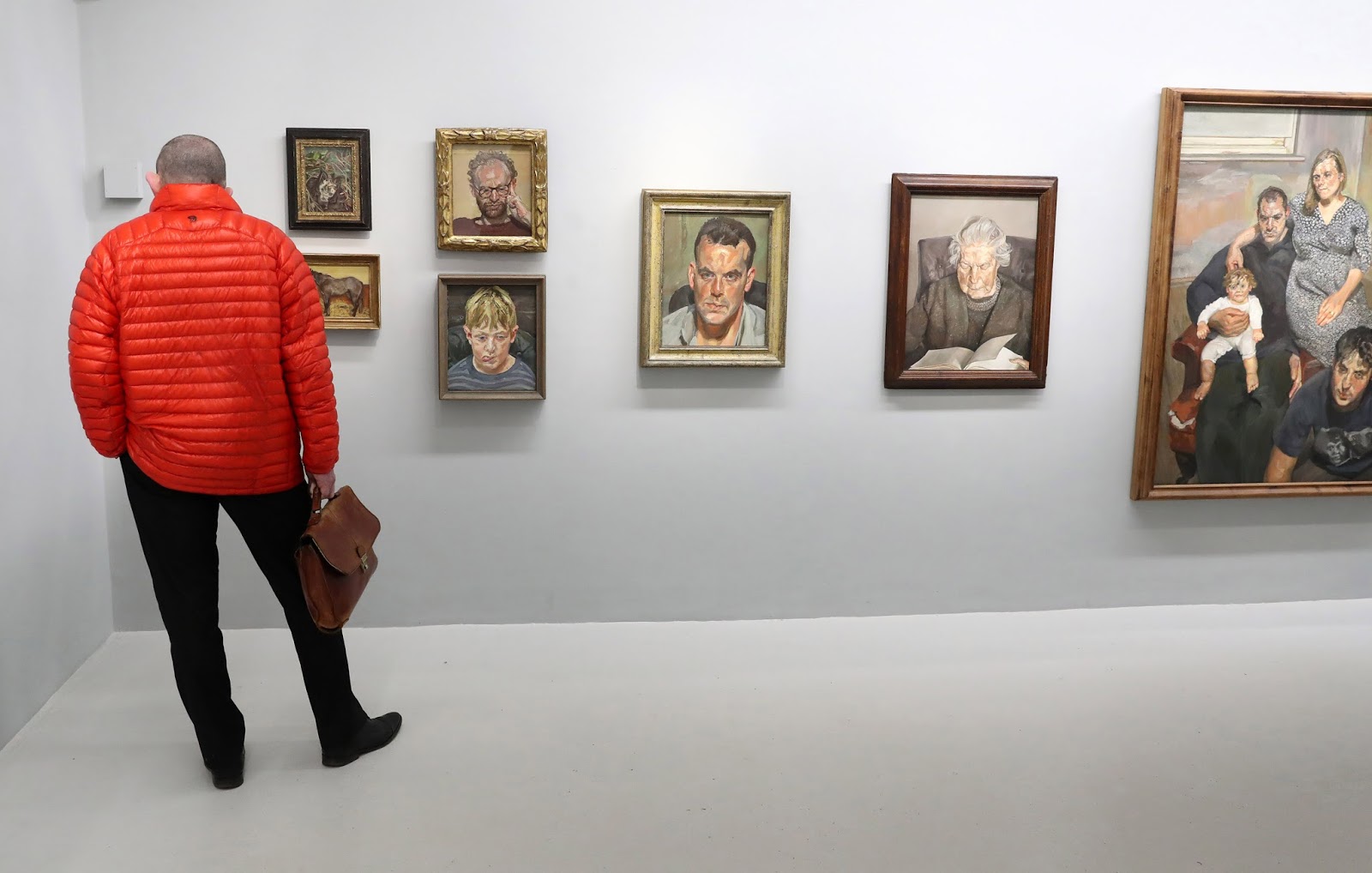
Lucian Freud and Jack B Yeats

At the end of June I was at the launch of Life Above Everything: Lucian Freud & Jack B Yeats at the Irish Museum of Modern Art Freud Centre. A large amound of Freud's works are collected together in the Garden Galleries (a separate buillding) as The Freud Centre, for a period of five years. Different curators deal with the collection in different ways and I have seen several iterations of vision for this work. I was immensely curious how the work of two painters, who I think of as polar opposites, was going to be brought together coherently. Below is Girl with Roses by Lucian Freud (left) and Portrait Figure of an Irish Gentleman by Jack B Yeats (right). It was interesting to learn that the catalyst for the exhibition was the fact that Freud had a Yeats drawing by his bedside for 20 years and had advised a friend-collector on Yeats works to buy! I enjoyed seeing many Yeats works that I had never seen before, and to see the Freud works in a different context. The highlight of the night, for me, however, was the poetry reading by Freud's daughter, Annie, whose poetic works showed facility and humour.


I was pleased several weeks later, when meeting friends at the National Gallery of Ireland, to view works of Freud and Yeats amongst other modernist works. While I had seen all the Yeats works on display at NGI on previous visits, I had a fresher point of view after having seen the exhibition at IMMA's Freud Centre.


I had never seen, or noticed, this early Freud painting at the NGI before and was quite intrigued by its mystery and expressive painting style, which is so different from his later works.


Wednesday, 18 April 2018

Lucian Freud

In 2016 the Irish Museum of Modern Art (IMMA) opened the Lucian Freud Project, dedicating the whole of the Garden Galleries (a small building) to the work of Lucian Freud for the following five years. I had seen that exhibition, which included paintings, works on paper, and prints along with copper plates that he printed. It was great to see so much of Freud's work in one place, but I wondered how IMMA planned to keep this exhibition fresh over the extended period.


Interestingly and intriguingly, IMMA decided to invite guests in to curate exhibitions around the specific collection that was on loan. The first of these exhibitions opened in mid-February; "The Ethics of Scrutiny" was curated by artist Daphne Wright. I went to the exhibition two weeks ago, totally curious as to how curation was going to change the exhibition. It was fantastic! 
 The first small gallery was a pleasant portent of things to come: dimly lit and reverent, on one wall there were some watercolour botanical drawings by Sigmund Freud (Lucian Freud's grandfather) and in the middle of the room a horizontal display case containing a number of reproductions of Emily Dickenson's "envelope poems". On a further wall was a small painting of Freud's that scrutinised the us, the audience, daring us to look closer. Each room that followed was a sparse but intense exploration of the curatorial theme. Wright made this a multi-media exploration with lightbox reproductions of Gwen John paintings and the sound of exhibition hub-bub in one room, and a reading from a short story in another. I especially was interested in Wright's subversion of what is normally thought of as a "male gaze" as she included artwork and writing by women.


In the large basement gallery, there were a lot of Freud's paintings for individual examination and two video monitors taking centre stage in the room. The videos were clips of John Berger in Ways of Seeing, his 1970s BBC series. In the clips he was analysing the historical view of the female nude.

In several rooms upstairs, Wright again juxtaposed work by other artists with key Freud works relevant to the theme of scrutiny. I loved seeing Kathy Prendergast's bronze sculpture Little Bouquet (2007), a piece of family history & memory, and also seeing a plant on the window ledge whose didactic informed that it was grown from a cutting of a plant belonging to Sigmund Freud. There was an audio of plant biologist Ottoline Leyser discussing plant intelligence.


In the final room there was a sculptural work by Thomas Schutte (which could be seen as portaits of an artist) and Freud's moving self-portrait. Doubly moving was the sound of Bernie Brennan singing the Nine Inch Nails' song Hurt, much in the style of the legendary Johnny Cash's brilliant cover of this song.

Wednesday, 13 December 2017

William Crozier: The Edge of the Landscape

I was really glad that I went to see the painting exhibition William Crozier: The Edge of the Landscape at IMMA (The Irish Museum of Modern Art). I had only recently heard of Crozier (1930-2011) because of advertising for this exhibition and another exhibition of his work in Cork.


From black and white ads, however, I have to admit I wasn't hugely interested, so it was a great surprise to see large, vibrant paintings when I found myself at the show!


Because of the layout of the exhibition space, I  was coming at the show from more recent work and moving backward through time.


This was fine as I encountered the really colourful, oft-times politically engaged work that he created after moving first to Spain in the 1960s and then to the west of Ireland in the 1970s.


I was attracted to the wild colouring of his paintings


and also to the drawing aspects within the paintings.


When I got to the final rooms (actually the historical start of the exhibition)


I was intrigued by the starkness of the images


but again there was the beautiful painterly drawing! I even thought it quite beautiful the way Crozier incised his signature, rather than painting it (something that oil painting allows easily).


These are works painted in Britain in the 1960s, expressing a bleakness and sorrow for the post-war world. Crozier was a young teen at the end of the war and horrified by post war images that came out of Germany and he later associated with the philosophy of Existentialism.


Wednesday, 3 May 2017

Accordion and Stick Books


I have my next book-print project in mind for during the summer (after my big painting is finished). One thing I needed to do, though, was whip up a couple of templates for an accordion book and a stick book. These were done really fast to ensure I had the concept right for the book designs, I haven't decided on paper or materials for covers yet.

So first off, I got some thin cardboard for the front and back covers. I recommend having a look at American artist Susan Kapuscinski Gaylord's YouTube channel here - she gives complete, quick instructions on how to make a variety of simple books for various uses. She is also a brilliant calligrapher and artist, using bookbinding within her gorgeous sculptures (have a look at The Spirit Books).


I used some heavy grey paper, folded it and glued the covers on either end. Okay, I have the concept figured out! In 2015, I saw an exhibition of Etel Adnan's work at the Irish Museum of Modern Art, and in a display of small works there was an accordion book, which was opened out to reveal a single painting. This has stayed happily in the back of my mind till now.


I am also planning a stick book for this coming project - the two types of books, with their prints, will be companions.


Again, I have not yet decided on the materials for the pages or covers. It is not likely that I will use acidic cardboard for covers, as I am not planning endpapers (I used 100% acid-free rag endpapers for the Good Morning/MaidgĂ­n Mhaigh/Buenos Dias books). However, never say never - it's early days yet!


Wednesday, 19 April 2017

Lucian Freud Project at IMMA

I went to the Irish Museum of Modern Art (IMMA) recently to see the Lucian Freud work, which will be exhibited in the Garden Galleries for the next five years. While at the moment all the work is being exhibited as a large collection, I got the impression that over this period that the work may be exhibited in different curatorial permutations, so now was the time to see the work before there was any personal "agenda" attached to it! This etching is Self Portrait: Reflection, 1996


I have to admit that I was never particularly interested in Freud's (what seemed to me) hyper realistic painting before, but there is something compelling about seeing a collection of works together. And that I have long been interested in psychoanalysis. And that there is an unmistakable psychological element in his work that definitely is reflective of the work of his grandfather. So the name becomes part of the intrigue, and part of my reason for going to the exhibition. This etching is Bella in Her Pluto T Shirt, 1995.


The basement gallery was devoted to works on paper, mostly etchings. Given my relatively recent interest in printmaking, I was delighted to find the room full of work that was unfamiliar to me. This etching is Girl with Fuzzy Hair, 2004. I thought this print was especially interesting as I thought at first the white highlights in the hair were were created manually when wiping off the plate before going to the press. However, there was another print with similarities and the display included the metal etching plate; the highlighted areas were actually burnished on the plate itself! These burnished highlights in curly hair are a major feat of burnishing brilliance!


There were quite a lot of etching portraits in this exhibition, which had incredible detail and certainly did not speak of flattery; as I said above, something about psychology and the artist's name... This etching is The New Yorker, 2006.


Although most of the basement gallery exhibition displayed images of people, there were several landscapes, which also indicate Freud's meticulous translation of observation. This gorgeously detailed etching is Painter's Garden, 2003-2004.


Wednesday, 18 May 2016

Stable IMMAGES - Studios 9 & 10

It seems like ages, but it was only two weeks ago that I went to IMMA to see the exhibition of first year IADT art students. The exhibition was the culmination of research and work they had been creating in response to being based at the Irish Museum of Modern Art since January.  In my previous post I had a look at some of the work that required darkness for exhibition (in Studio 5) and some of the work that was sited outside. As I said in that post, I was very impressed with the cohesiveness of the exhibition and maturity of the work. 

On entering these exhibition spaces, via Studio 9 the variety and scope of the work was immediately apparent.


There were two short animated videos on one monitor. This one used the images of a red hand and a red face to interact with specific surfaces in the architecture of IMMA.


There was quite a lot of research into IMMA's architecture in this series of drawings & photographs, but because there were no labels for individual works, I could only wonder if this was the research behind the blue scale model of IMMA hung on the wall in Studio 5 (I posted a picture of it last week).


I spoke to the artist who took these photographs of colourful, temporary interventions she had made on various IMMA walls.


This photographic installation referred to the Greek myth of Narcissus.


The works are self-portraits of the artist, distorted by photographing through smoke, water and other materials.


Apparently this artist intensively examined architectural spaces around IMMA before creating detailed temporary chalk on black board drawings.


This series of photo documentation of mirror and light experiments was intriguing.


And I wondered if these experiments were the background for this installation of plastic sheeting and blue threads? However, this I will not know as I only met a couple of the students, and hadn't asked about this piece at the time.


So my gripe about the show is regarding non-labelling and attibution. Although the artists involved were named at the entrance to the studios, a floor plan should have been available to answer simple questions of authorship. Otherwise, I was greatly impressed by the exhibition and look forward to seeing more work by these developing artists.


Wednesday, 11 May 2016

Stable IMMAGES 1 - Studio 5 & Grounds

On the weekend I went to the Irish Museum of Modern Art (IMMA) to check out the exhibition of work by the first year IADT DĂșn Laoghaire art students. These students had been based in IMMA studios since January and this final exhibition was a culmination of their research work in responding to that experience. The exhibition was spread over three studios and the grounds, so I will do another post to cover some more of the work. Studio 5 was darkened to accommodate all the works that needed to have a dark room for display. One of the first years, who was invigilating the studio, was very enthusiastic in discussing the work, the makers, and their inspirations so I got some great insight into the work. This first visible projection was created jointly by two women who were inspired by the statuary on the grounds of IMMA. It was a moving projection, so the image was constantly changing (so impossible to capture in a still image). 


I had met her previously, so I know this next moving projection was by Joanne Harold and she was inspired by the garden balustrades.


Another female art student created this sculptural video piece in response to the arches in the basement of IMMA.


 Unfortunately the pieces were not labelled, so the artists cannot be acknowledged by me, but this piece was in response to being aware of light reactions through the coloured acetate lettering in the main reception foyer of IMMA.


This piece is a carefully measured model of the IMMA building itself and treating the building as the artwork.


The artist here was creating a design for lighting in the extensive gardens at IMMA. 


I was struck by the maturity of the work and the coherency of the exhibition, though I was disappointed that there was no labelling of works or accompanying floor plan in order to acknowledge attribution (just a page of names and general location on the wall at the entrance).


 Though I did not see all the outdoor pieces, it was a gorgeous day and this woven branch work was unmissable!


Also, as I was leaving I saw this graffiti piece - painted plastic stretched between two trees.