Showing posts with label Sticks n' Stones. Show all posts

Wednesday, 13 February 2019

2019 ceramics workshop - one month in!

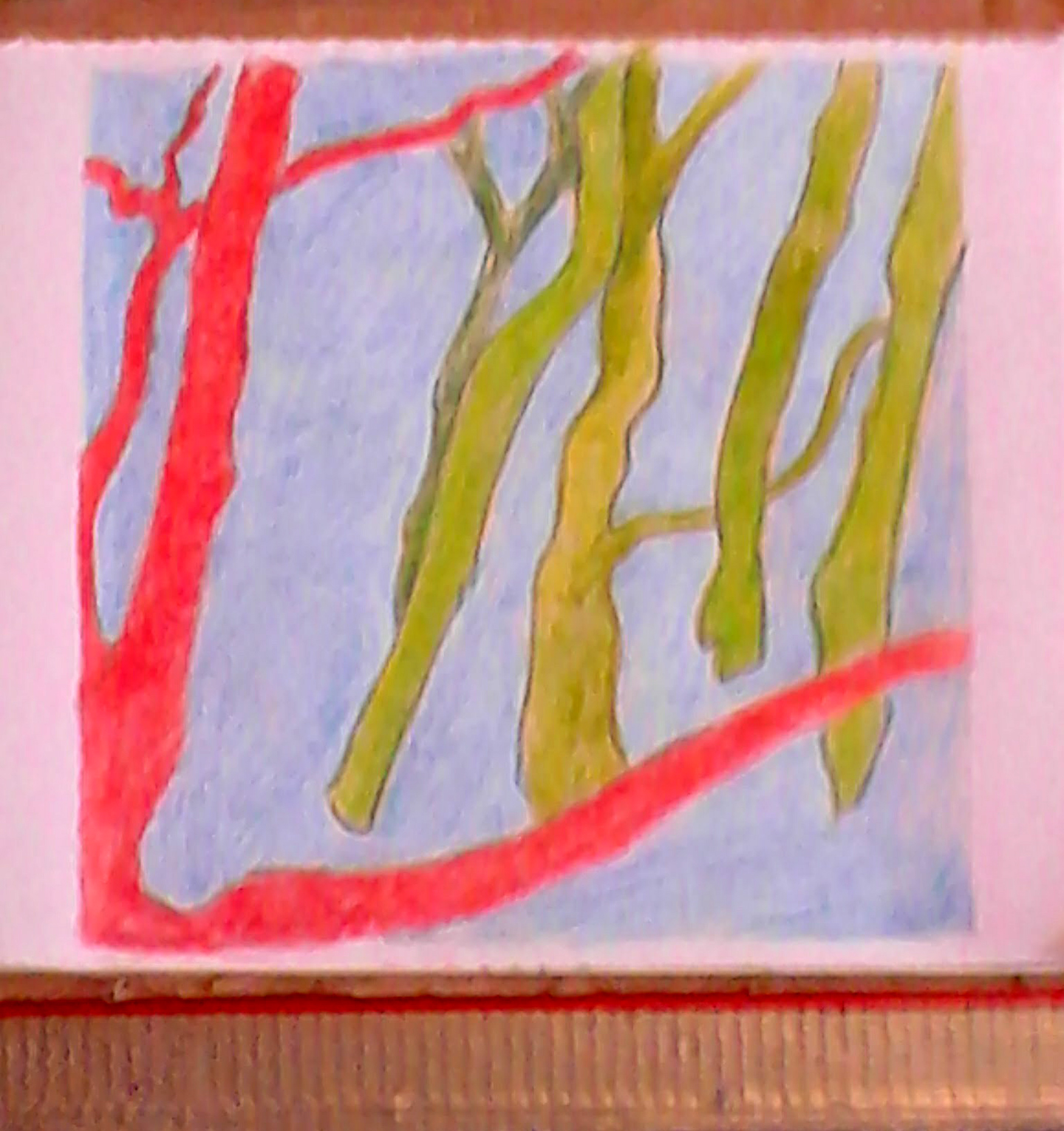
Last December I did some sketches of tree and stone imagery that I thought would be nice glaze-painted on tiles. When the ceramics workshop resumed in the new year, I was ready to do four small glaze paintings on ceramic tiles.


 When I was doing the "liminal" sketches of stones on the shore, I made the forms and colouring more complex than the more basic stick images.


With this in mind, I decided to paint the tree tiles first. Even here, I overlapped a few glazes anyway (reds & oranges, blues & greens) to see what would happen.


I was pleased enough with the results. I always lean towards Fauvism when I think of trees and colour at least one of them red.


Glaze painting is always a pleasant surprise as it is impossible to know how the pre-fired glazes will react with each other when fired. There is a certain amount of looseness when painting with glaze on a tile, but its exact colouring can never really be pinpointed.


The trees tiles were put away when I was painting the stones and I decided, in keeping with the sketches, to make the forms more complex. I did take pictures of the tiles before they were fired, but deleted them by mistake. I took especial care over the sand areas, as I did not want them to appear too solid. I glazed first with a bright orange and then, after the orange glaze had dried, took a smaller brush and dotted a bright yellow glaze overtop.


I am very pleased with the colouring and randomness of the glazes.


Wednesday, 28 February 2018

pastel drawings

I have been busy with a lot of writing lately (poetry, short stories, art criticism). At the end of January my short review of William Crozier: the Edge of the Landscape at the Irish Museum of Modern Art (IMMA) was published as part of CIRCA magazine's This Matters Now series. I saw this exhibition a few months ago, and blogged about it here, but you can read the review here. I was also delighted that my short story, Prayers for My Children was published a few days ago in the online journal, Tales from the Forest; you can read it here.

Last week I decided that, even though I hadn't finished cleaning up the studio, I wanted to do some visual work, other than ceramics. I pulled out some chalk pastels and heavy grey paper and began drawing.


As may be apparent from my prints and handmade books over the past year or two (see here, here, and here), I am inspired by my times of "shinrinyoku" (walks in the woods for good health)


and by walks along the seaside where I become obsessed with pebbles at the shore (also see here and here).


I really enjoyed drawing with the chalk pastels as I was able to lay down shapes and colour to effect quite quickly.

Wednesday, 6 December 2017

Stones - a stick book!

My original idea was that the book Stones would be a created as a stick book, companion piece to Sticks. I talk about the two books in a previous blog, along with showing simplified templates for both. In order to put Stones together I worked methodically: I scored the Khadi paper prior to printing and scored the Fabriano endpapers. The covers were made of a heavy duty, acid free blotting paper; only the front cover needed to be scored to facilitate folding when opening the finished book. 


Stones is a book of five intaglio prints based on pebbles at the seaside. The intaglio is done on 800 micron acetate plates and I printed the plates using my pasta press. I have given extensive details on how to convert a pasta machine into a miniature flatbed printer here.


After all prints were created, I decided on the page order. This is the first printed page.


Page 2.

Page 3.

Page 4.


Page 5.


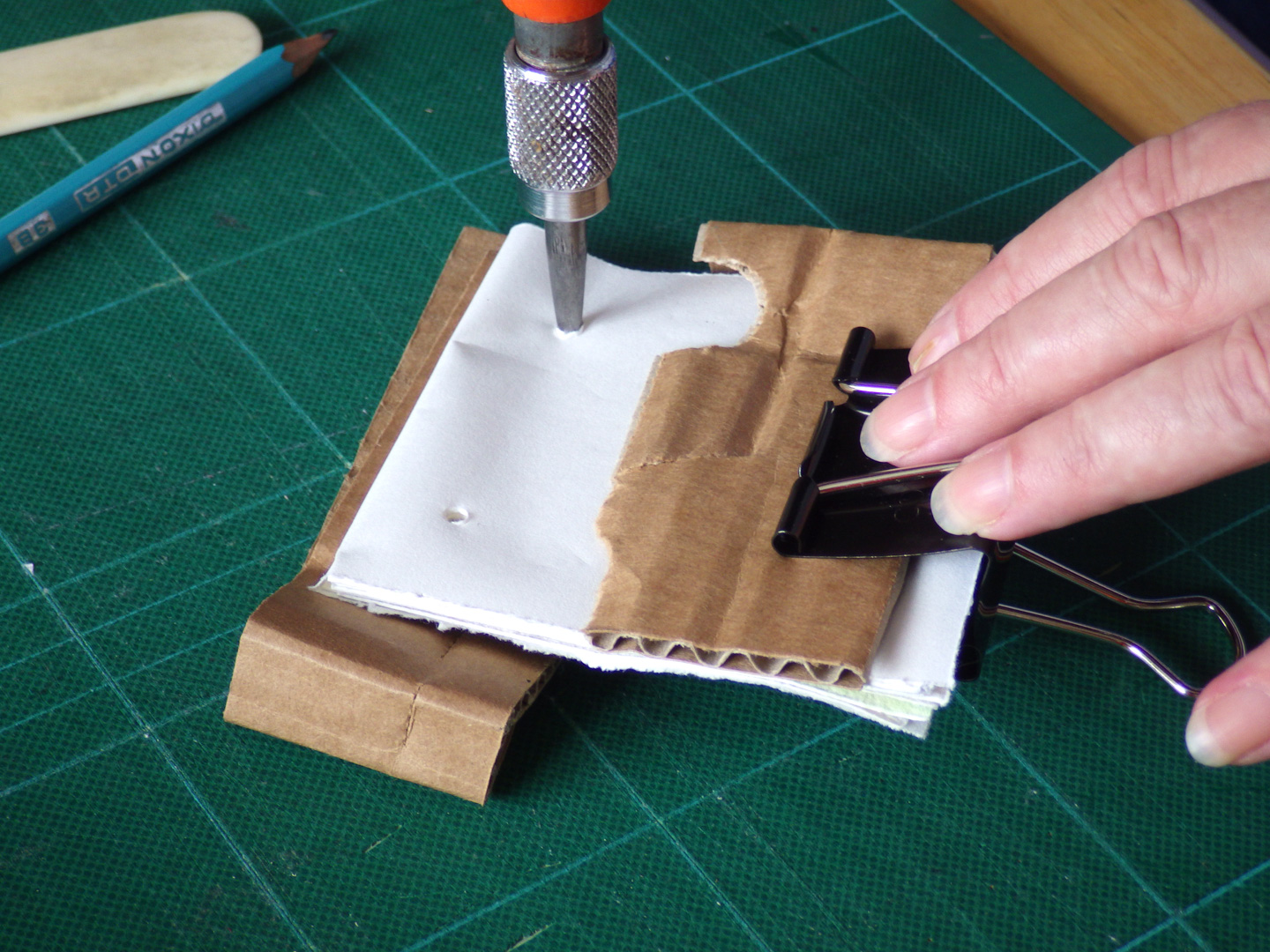
Page six is an information page (signature, title, edition number, date). The pages were sandwiched between the endpapers and then wrapped with the blotting paper cover. I used a page of white paper, some corrugated cardboard and a lion clip to hold everything in place while binding holes were created using a drill press.


Stick binding is a variation of Japanese stab binding (instructions here). The stick, however, allows the binding thread to pass through the same hole consecutively, without unravelling. Although I originally planned to use real sticks, I was hit by a bolt of lightening and decided to create my own sticks in the ceramic workshop I am taking weekly. I simply rolled out some coils, hand-formed end bits, and used a real twig to press in some texture. Because of the colour of my prints (various mixes of Permanent Green, Payne's Grey, and Cobalt Blue) I chose a slate blue glaze for the sticks. I matched this colour to the six strand cotton embroidery thread I used for binding.


I started binding at the top, back to front and around the top of the stick then down to the next hole, and so on. This process was repeated going back up the book, tying several knots at the top back and trimming to the desired length. This is the back of the book.


Here are several of the bound books, showing the slight variation in the ceramic sticks.


I was very pleased with the finished books. Stones is in an edition of ten books.


Wednesday, 8 November 2017

Sticks - accordion book

I conceived of "Sticks" as a simple accordion book for a single, long format intaglio print with ceramic covers. The print is a horizontal image of sticks based on some sketches I had done of wood debris floating in the Glencullen River in Knocksink Wood.


I had created a unique protype, "Shinrinyoku", of this image as an accordion book in June. I made the prototype to figure out how an accordion book could work, using handmade paper for the drawing and for the covers.


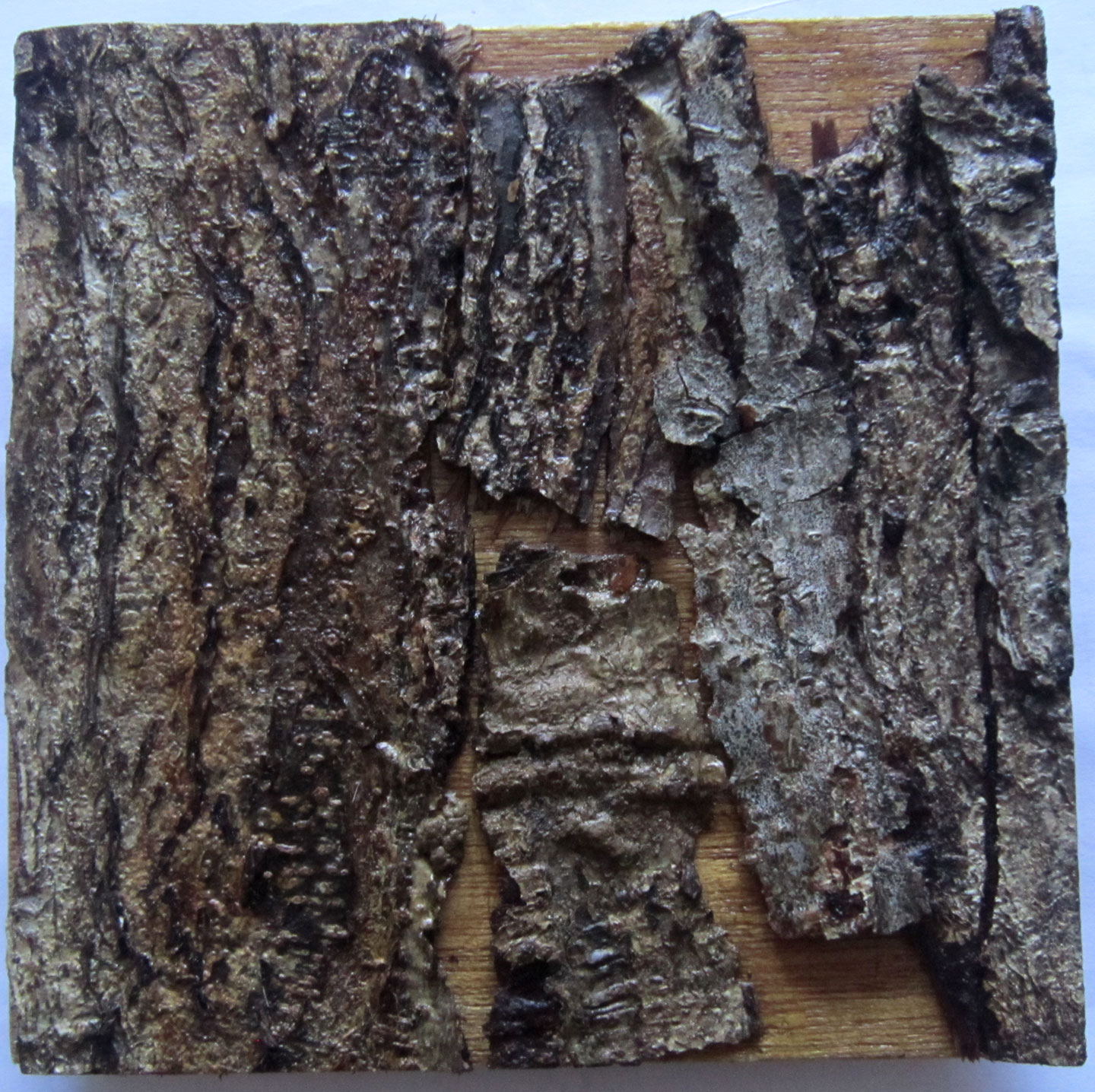
Because I wanted the front cover of the "Sticks" book to have some relationship to the future intaglio print, I created a bark stamp that could be pressed into the clay slabs that would be my book's front covers


The stamp itself was simply made from some scrap wood and the bark affixed to the front of the stamp with pva glue.


Although I coated the entire stamp to seal it, when using it on the clay it worked better to have a layer of cling film (Saran wrap) between the stamp and the clay slab. For the back covers, I simply used a rubber stamp kit to press my name in the clay slabs.


I was doing an edition of ten books, so needed 10 final intaglio prints of the image. I have detailed how I converted a pasta machine into a flatbed press in a previous blog (here). The small prints created using this press are only limited in size in one direction (in this case the length is shorter than the width). The prints are on Khadi 100% acid free handmade Indian rag paper.


When the prints were ready I did a general layout of how I would like the completely open book to appear, with both the front and back covers visible. This would give me an idea of how to fold the book.


Or rather, giving my trusty assistant the idea of how to make the folds (I fully recognise that my husband tends to measure more accurately than I!).


The prints were affixed to the background of Fabriano with pva, along the top only, prior to making the folds.


Components ready to be turned into books!


A view of the back of the accordion book.


A view of the front of "Sticks".


Wednesday, 18 October 2017

Holding it Together


Following the death of my mother after a short but intense illness in August 2016, my life irrevocably changed. I became the counsellor’s phrase: “an adult orphan”.

In order to channel my grief creatively, I threw myself into making work; this was my coping response. In answer to an open call from Temple Bar Gallery & Studios for a curated section of artist books in the Dublin Art Book Fair, I had the idea that I could combine my relatively new re-interest in printmaking with my skills in bookbinding. Through a course I had been taking, I found myself giving woodblock demonstrations at the Irish Museum of Modern Art the previous February. I hadn’t done much printmaking work for years, and I had so enjoyed the woodblock printing that I knew that I was going to love a further re-exploration of print media.


Complete immersion in my art was the context needed to help me to deal with the new order of things: I no longer had a mother; an integral part of my family life was now gone. I needed to create something to counteract this immense loss, which I was reminded of in every daily act. I felt the need to have some purpose, a specific project, to prevent me from otherwise being overwhelmed by despair. I needed to create in order to feel buoyant. I had a husband and child who were also grieving and I refused to let myself sink.


Until this illness, my vibrant mother had been in exceptional good health for the entirety of her ninety-something years. She celebrated joy. My mother was active in local social clubs, she loved singing and dancing, and had close friends of all ages. The fatal diagnosis in June 2016 was a shock alternating between disbelief and despair by her ten children, yet my Mum received the news with outrageous good humour. In her last months she repeatedly sang “I’m heading for the last roundup”, the refrain to a song by her hero Gene Autry. Her great age had no bearing on the unfairness of my mother’s diagnosis; she was not ready to depart this earth and the many who loved her were not yet ready to let her go.


After a number of sketches and design plans, my work began with a series of lino prints. I would bind these prints into several book editions, a different language for each edition. I chose three languages – English, Irish and Spanish – as a starting point, with the possibility that I might create future editions in other languages. This was the first time I used my bookbinding skills in an art book context. I have been hand-binding books for over twenty five years to use as sketchbooks, notebooks, photo albums and scrapbooks, but to bind books as part of an art work is a new development for me. Literally, it was a way for me to hold things together.


Each book contains five small lino prints. My prints are straightforward: a mundane greeting to start the day (good morning / maidĂ­n mhaigh / buenos dias) and its follow up query (how are you? / conas atĂ¡ tĂº? / ¿cĂ³mo estĂ¡s?) enclosing three simple images (an egg in egg cup, two mugs, a teapot). The images are printed in black ink. Clarity. Simplicity. These are images of sustenance, companionship and comfort. This is what I need. What I hope for. These are existential books that allow me to negotiate the circumstances of overwhelming loss: coming to terms with the banality of living while facing the abyss. Since August 25th 2016 my mother is only fully alive in my memory of her.


In November 2016, five copies of each of my books were included on the curated table of the Dublin Art Book Fair. To me, this opportunity provided a quiet memorial to my mother.


I am not religious yet I am not atheist. I believe in humanity as an entity of good, despite so much evidence to the contrary. There is much suffering both on a global and a personal level. But I have encountered kindness in strangers, selflessness in friends, willingness to share and care in unexpected places. These experiences allow me to fly. I keep faith with the unknown. Although I mourn, the best way for me to honour my mother’s spirit is to celebrate it through my artmaking. This helps me to remain unwaveringly hopeful.


I am still coping with the loss of my mother. I am still creating artwork. I am currently working on another group of books and whether they will be accepted for inclusion in the Dublin Art Book Fair 2017 remains to be seen. Whether they are accepted or not doesn’t matter. Fundamentally they are serving a greater purpose: they are holding me together.

Wednesday, 11 October 2017

Lithography workshop

It is probably becoming fairly obvious that my interest in printmaking techniques has become very pronounced over the past two years. When I heard about a weekend lithography workshop at Blackchurch Print Studio in Dublin, about two months ago, I was quick to sign up for it. Lo and behold, the time flew and the workshop, led by Alison Pilkington, took place last weekend. 


There were only four of us taking the workshop, so it was quite intense. I had brought some sketches of things I had been working on, and spent Saturday morning developing these sketches on a larger scale.


I had another look at my branches images, but decided on beachstones for the litho stone.


Saturday afternoon was spent drawing on the litho stone with a variety of litho crayons and then painting on tucshe in specific areas. For the small stones, I applied the tusche by flicking so that their texture would be totally different from the surrounding linework. Unfortunately I was too busy working, and did not have a camera with me anyhow, to take pictures of the stone in progress. On Sunday morning there were a few applications of nitric acid in gum arabic on the tusche areas and in the afternoon I printed up an edition of four on beautiful Fabriano paper. It was an exhausting but invigorating day!


Wednesday, 27 September 2017

Encaustic


 In the early 1980s, I was doing some experiments with wax in both painting and drawing. I was not doing anything methodical, so I can't exactly say I was working with encaustic painting, but my own experiments led me to some knowledge of the technique and curiosity about it that has stayed with me over the years. This piece from 1983 is paint, collage and paraffin on paper.


This piece, also from 1983 I think, is collage and wax paper on board. The image of the hand, as a metonym for a person, is relevant to the embossed prints I am doing now for my book "Ghost".


So when I read about an introduction to encaustic painting workshop being facilitated by Joanna Kidney at Outpost Studios here in Bray I jumped at the chance to attend. Lucky for me I secured the last place on the intimate workshop, and had a nice stroll across the park last Sunday morning to Outpost Studios. After an introduction to the technique, Joanna offered the participants a choice of wooden blocks to use as mounts for our workpieces that would allow us to learn a variety of techniques. 

As a starter, I chose a fairly small piece of wood and thinking of The Skipping Project, used the form of two jumping feet with which to experiment. After a quick sanding of the sides, we applied a clear layer of beeswax mix, and then two layers of whitened beeswax mix. After any layer of beeswax (coloured or clear), the block must be heated to fuse the wax to the layer below. For the first block we used a variety of tools to scrape, incise, carve, etc. the block in between applying colours (in heated wax). There was also a good supply of fat oilsticks, oil pastels, and a hot wax drawing tool to use in conjunction with the pre-mixed paints (with various sizes of brushes) warming on the hot surface of a flat type of "griddle". Joanna pointed out that an important tool to have is a specialty flat thermometer on the griddle to ensure that the wax paint does not overheat and fume, as this can be quite toxic.


In the afternoon, with another block, we learned about collage techniques for embedding objects and images (in my piece below there is a pictue of two rocks, wool, thread, and cous cous). We also learned how to transfer an image from a photocopy or print out directly onto the wax; in my case below I transferred the image of some pebbles from a colour photocopy of a photograph I took, as reference for the Stones book of prints that I am making.


In the afternoon of the workshop, Joanna also gave a demonstration of monoprinting in encaustic. A space was cleared on the griddle and one could brush on paint or draw with oil pastels or oil sticks (the drawing/painting melting on the warm griddle) and there were a variety of papers to choose from to experiment with how the different grounds interacted with the wax, also depending on which wax medium was used!

This is Fabriano paper as a ground for a mix of brush work and oil pastel drawing.


Again, a mix of brushwork and oil pastel for my "Dreamboat" image, but pulling the card away from the griddle leaves a pattern.


I only added a bit more wax colour to this rice paper Dreamboat.


I was thinking of Fort Carré when I brushed out this simple image of light and dark on Fabriano paper. The turquoise was drawn with oil pastel.


What a fabulous day for creative play with an interesting medium and a wonderful facilitator!