Showing posts with label RHA Gallagher Gallery. Show all posts

Wednesday, 29 June 2022

RHA Annual Exhibition - part 2 of 2

I gave a general overview of this year's RHA Annual Exhibition in my post here, but I also wanted to post a few pix of works that stood out for me among the plethora of excellent artworks.

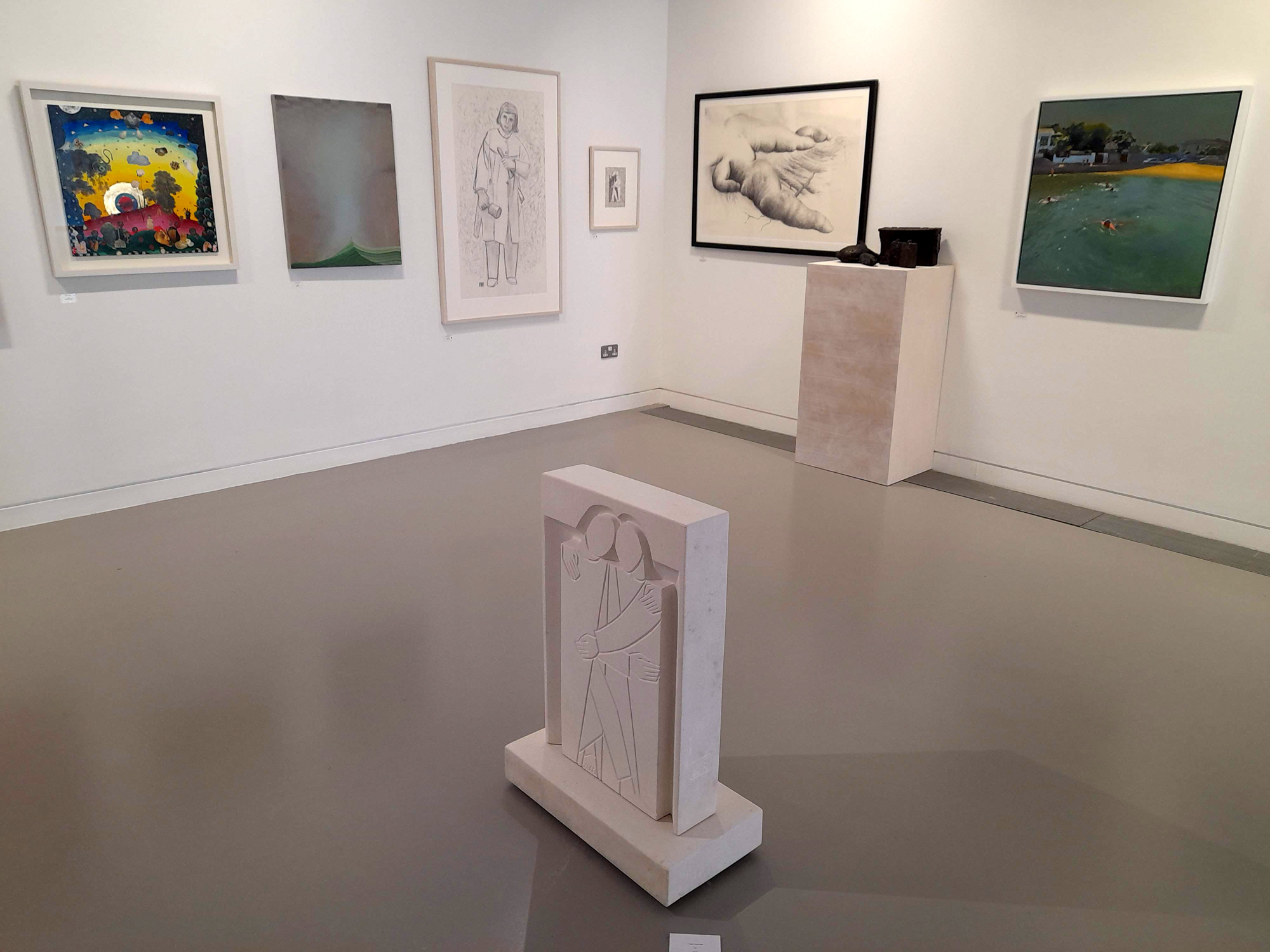
Although the first gallery room seemed chock-a-block with work, the hanging seemed very thoughtful as works definitely were in some sort of conversation and subtle echoes of each other. One of my friends who was viewing the exhibition on a repeat basis noted that visitors spent more time in this first room, before they really realised how huge the exhibition actually was. I tried to hurry my pace. In one corner I noted a large drawing, a self-portrait, by Imogen Stewart, a grand dame of the Irish art world. She is a notable sculptor and, indeed, the drawing was very sculptural in form. One of her sculptures is in the foreground of this picture. Also in the corner was a drawing and some sculpture by Danny Osborne. I had some familiarity with his fascinating work in lava casting because he had been on an Umha Aois project with my husband a few years ago.


My foray to the RHA was brought about by the desire to see Judy Foley's new work in the flesh. Through the delicacy and clarity of her images of body implants, she subverts traditional icon painting techniques (egg tempera and gold leaf triptych) to boldly make statements of the fragility of humanity versus godliness. I have followed Foley's work for a number of years and have previously written about it for CIRCA online magazine here.


After being introduced to Myra Jagos work at the recent "Show and Tell" at Signal Arts Centre, I was looking forward to seeing her painting in the flesh too. I wrote about the Signal event in a previous blog, here.


In one of the large rooms upstairs, there was a whole wall full of small prints. It was here that the tiny self-portrait etching of Daniel Lipstein leapt off the wall to my eyes in recognition. I had met Lipstein a number of years ago when he was giving open printmaking workshops at Trinity Arts Workshop. Not only was this pre-pandemic, but it was pre-policy change - shortly after Lipstein demystified carborundum printing for me (I had never heard of this process till I came to Ireland!), TAW decided that their workshops would no longer be open (albeit paying) to anyone who was not affiliated in some way to Trinity College. Since I am not, I could no longer attend the workshops. Boo, hiss, on Trinity Art Workshop!


I noticed this larger woodblock print and recognised the work of Kate MacDonagh, who gave an artist talk via Zoom last year, hosted by Graphic Studio Dublin. I had also virtually attended MacDonagh's artist talk on the mokuhanga technique (Japanese traditional woodblock printing) of which she is a virtuoso, through the DĂșn Laoghaire-Rathdown arts office.


Susan Early is also associated with Graphic Studio Dublin. She is the education outreach administrator there (from whom I get loads of e-information on artist talks and courses) and also a printmaker. I was unable to attend her recent Zoom artist talk (thank you GSD for holding these talks throughout the lockdowns and continuing them into the foreseeable future!) but look forward to seeing the recording when it is available. GSD has a YouTube page so previous artist talks can accessed here.


I also recognised the work of Stephen Lawlor from a GSD artist talk and likewise the work of


Ailbhe Barrett (though this print stood out anyway to me, for its ethereal atmosphere).


Speaking of ethereal atmosphere, I loved this intimate painting by Anne Magill.


I thought, when I first saw them on the wall, that this tiny work and a companion piece by the same artist, Bernadette Madden, were colourful, miniature paintings but then realised that with all the sold red dots beside them, they were in fact prints - silkscreen. Gorgeous! it is really inspiring to see so much fantastic work by fantastic artists - my blog is just touching the tip of the iceberg, and in any case a quick pic taken with a phone is nothing compared to the live experience of seeing the actual work. I have my gripes against the RHA, but I can't fault the work being shown there.


Wednesday, 15 June 2022

RHA Annual Exhibition - part 1 of 2

It has been many years since I attended the annual exhibition at the RHA in Dublin, so it really took me by surprise just how much work there was to see! 


I couldn't help but be impressed by the quality of the work also, it wasn't just quantity.  


The first room downstairs seemed the most orderly in the way it was hung - pieces seemed to relate to one another in a thematic, colour or movement type of way and this was a satisfying way to look at work, though I would have preferred more space around individual works.


Each work deserved way more time than I gave it -- the first couple of rooms really won out when it came to my attention, but it was somewhat overwhelming to know that there were several huge rooms waiting upstairs...


I don't even have a picture of the large hall which was chock-a-block with small works, mostly paintings, skyed almost to the ceiling. The stairwell seemed to be dedicated to the work of one ARHA member. The room full of prints asked for closer attention to individual pieces and I was only able to give this attention if something stood out and/or was familiar - in that I have taken several printmaking classes over the past few years and participated in a number of zoom artist talks during the pandemic so recognised the work of particular artists.


While I object to and don't participate in open exhibitions where the artist has to make a payment, I find the RHA Annual Exhibition somewhat distasteful in that there are three distinct tiers: ARHA (part of the club!) members are ENTITLED to exhibit several pieces of work, for whatever reason some artists are INVITED to exhibit, and the rest (about 2/3) PAY a fee to enter. Competition is high and not everyone is accepted, but it sure is a huge batch of cream! Regardless of my personal opinion, within Ireland exhibiting at the RHA Annual Exhibition is considered a privilege and an honour.


ALL of the work in the exhibition is worth taking the time to see. I will do another post on individual pieces that I paid the most attention to. The exhibition runs till July 24.

Wednesday, 20 April 2022

A Growing Enquiry at the RHA Gallagher Gallery, part 2

In last week's post I did an overview of this exhibition and spoke specifically about a few of the artists. As it is a large exhibition I thought I would mention a couple more of the artists.


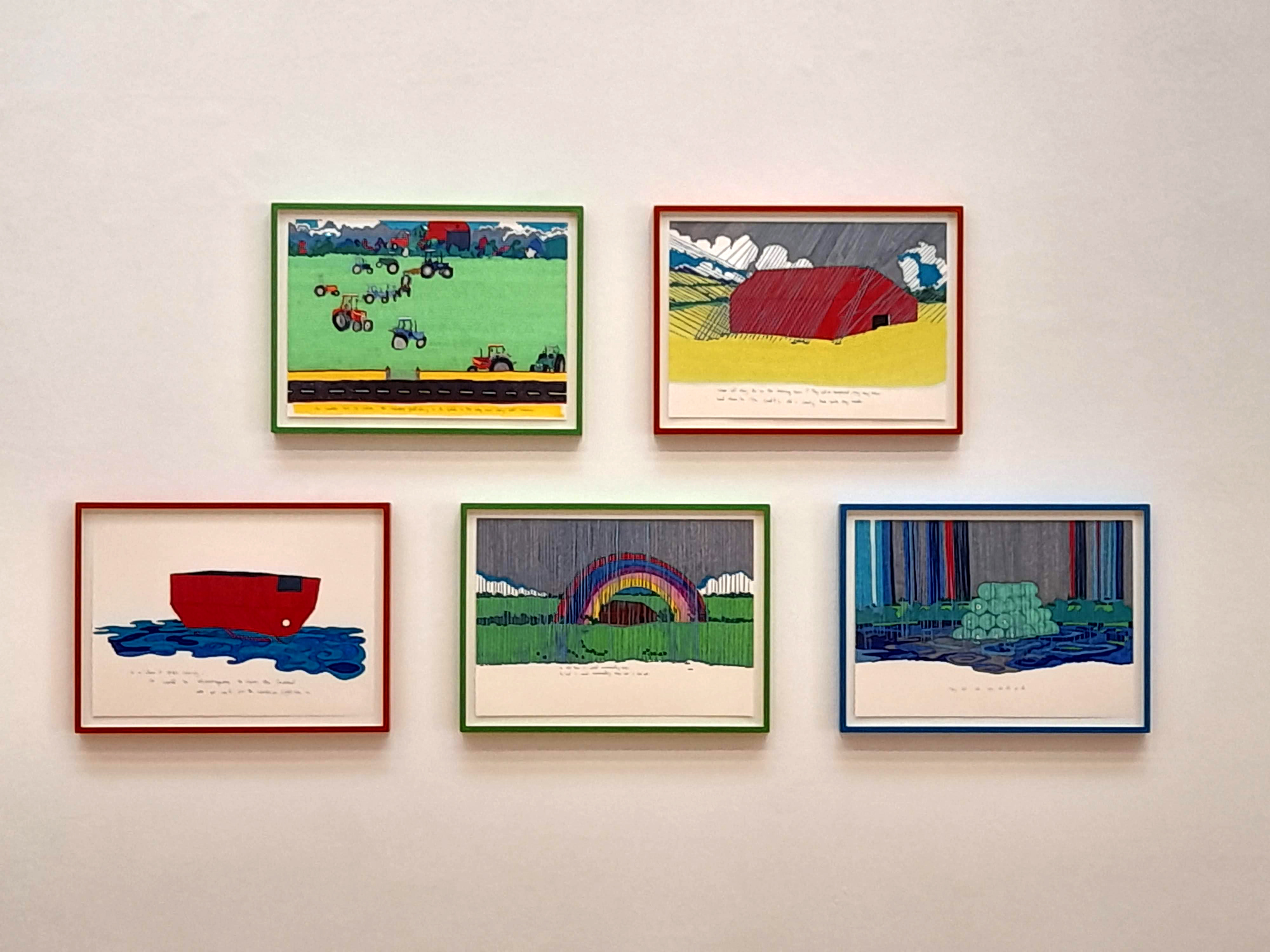
On entry to the gallery I could see Laura Fitzgerald's 2D works on the wall across the room and from that distance thought they were embroidered works - they seemed so fine and precise. But no these were not embroidery (though no less painstaking); they are certainly fine and precise, but these are witty drawings done with Sharpie pens! I looked at the accompanying didactics for this group and indeed the titles also are full of good humour: (clockwise from upper left) Restless Tractors, More Weather, but I do still care, Powerful People Promises and The Ark.


Here's a closeup of Restless Tractors.The back and forth drawing of the field with the Sharpie mimics plowing field and draws the viewer into both the making and the meaning of the work.


The panoramic landscape scroll A Mountain for Venice also has a witty didactic in which Fitzgerald details each item used in the work's creation - not just the material but where it was purchased and how (and in the case of the specific paper, how long it spent in customs before she finally received it!).


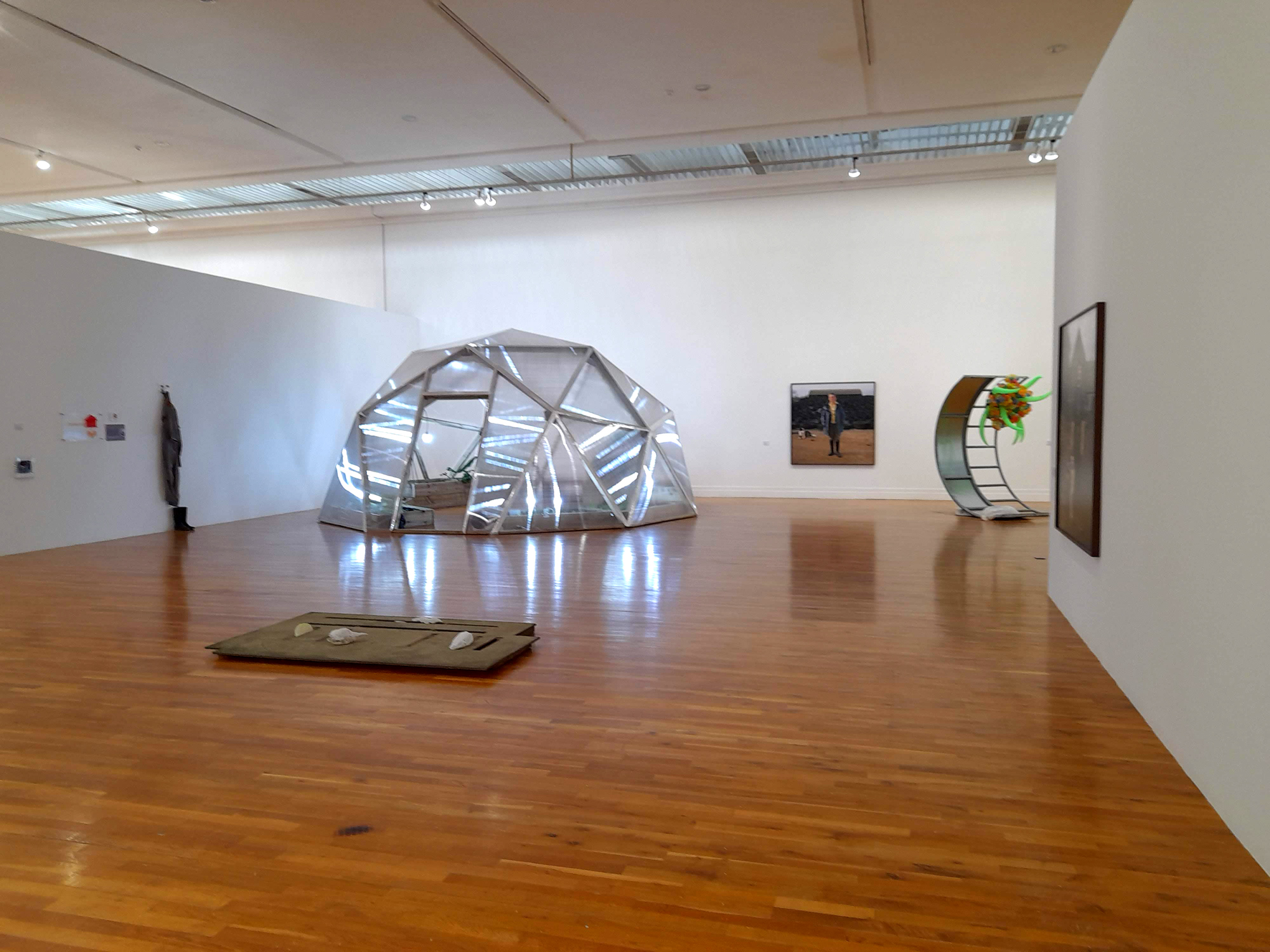
Jane Locke's Consumer Farmer (which could only be seen once one was fully in the gallery) is also a witty work with an eye to the future. I was especially looking forward to her contribution to the exhibition as I have experienced her work on several occasions in the past (and wrote about one in CIRCA Online here). Locke's installation comprises of a futuristic geodesic dome greenhouse where the plants are sparse but alive and well, a worksuit, which again seems futuristic as it has a farmer's patch on it very similar to what one might expect on a NASA spacesuit, and the product catalogue for the spring of 2123 full of Locke's beautiful drawings and surreal product descriptions.


The exhibition A Growing Enquiry - Art and Agriculture, Reconciling Values continues till April 24, 2022.

Wednesday, 13 April 2022

A Growing Enquiry at the RHA Gallagher Gallery, part 1

I was delighted to see, in person, the large group exhibiton, A Growing Enquiry - Art & Agriculture, Reconciling Values at the RHA Gallagher Gallery in Dublin recently.


The exhibition consisted of new installations by seven women artists - Miriam O'Connor, Laura Fitzgerald, Orla Barry, Katie Watchorn, Jane Locke, Maria McKinney and Anna Rackard. Two of these women (Barry and O'Connor) are farmers as well as artists, and Rackard's large photographs, portraits of women farmers, are scattered throughout the exhibition, certainly reminding the viewers that agriculture is NOT an exclusively male environment.


The exhibition, curated by Patrick T Murphy, responds to questions about how does one create value systems around art and agriculture.


The exhibition is impressive with its wit, artistic response and sheer scale. The didactics were a pleasure to read, giving insight into each artist's personal response to the enquiry and allowing the audience to enter into the dialogue.


The gallery is huge, which allows one to wander the space and engage with each installation (except Rackard's which appear throughout the space) as a separate entity.


There was also some overlap as I could hear the song/chant, which was part of Orla Barry's installation that was not immediately visible until one turned a corner in the gallery.


Barry's installation also included raw sheep wool and a large printout of an Aran knit sweater. Barry's work spoke of commodity, hierarchy, production and language as both the printout and cane crooks were embedded with words. The song itself was evocative.


The song, which was a collaboration with composer Paul Bradley, could be heard throughout the gallery, and the lyrics were written on rough wood - a mirror split of a tree adjoined to resemble the shape of a Celtic cross.


I'll talk about a few more of the artists and their work in next week's blog. A Growing Enquiry - Art & Agriculture, Reconciling Values runs till April 24.


Wednesday, 23 June 2021

Dublin gallery day - part 3 of 3

More than two weeks have passed since I made my big excursion in to Dublin for a "gallery day", but it was impossible to blog about it all in one blog day, so I divided up chronologically to suit how my day went. I blogged about the first two stops (The Molesworth Gallery and The National Gallery) last week, and you can find that blog here and I continued on to see Damien Flood's new exhibition, Tilt, at the RHA, which I blogged about here. The RHA is so huge that there was another big exhibition going on across the hall: Sean Scully's "Eleuthera", recent paintings titled after the Caribbean island where his family holidayed a few years ago.


It was a huge coincidence that I had seen an earlier, small abstract piece of Scully's at The National Gallery exhibition, Living with Art: from Picasso to Celmins. The accompanying didactic specifically said that Scully had worked figuratively before becoming reknowned for his totally non-objective large paintings. Both my husband and I looked at each other doubtfully - neither of us had ever seen any figurative work by Sean Scully. Then we walked across the hall to be met by these huge, vibrant figurative Scully works! I absolutely love them!


The huge paintings were done on aluminum and this picture gives an idea of their size! 


All the work in the exhibition focusses on Scully's 8 year old son playing in the sand with bucket and spade. The secondary figure that appears in many works is most likely the child's mother. This simple idyll has a multitude of variations where drawing as well as painting has a role to play in the final composition.


There was a large framed display of research photographs in the first part of the exhibition and in the second part small works were displayed, probably part of Scully's colour decision process.


The smallest works, at the end of the exhibition, were all black and white sketch drawings. Possibly these drawings were created from the photos, but they had the exuberance and immediacy of in situ sketches. Though Scully is a reknowned master of contemporary non-objective painting, this vibrant exhibition spoke directly to my sensibilities and I hope to see more work like this from him in the future.


Wednesday, 16 June 2021

Dublin gallery day - part 2 of 3

It seems ages away now, but it was less than two weeks ago that I had my big excursion in to Dublin for a "gallery day". I blogged about the first two stops (The Molesworth Gallery and The National Gallery) last week, and you can find that blog here. But the catalyst that got me venturing into Dublin in the first place was desire to see Damien Flood's new exhibition, Tilt, at the RHA. I met Flood (always Damo to me) many years ago when he was a teenager and a friend to several of my nieces. For many years now, he has been quite an accomplished artist and I am always curious to see the development of his work. I was aware of his (relatively) new excursion into ceramic figurative work and wondered how it would fare in juxtaposition with his paintings.


The RHA is a fairly large and open space so the figures can fully inhabit their area grouping but at the same time complement the 2D work. Having chatted with Damo about this exhibition (before it was installed) I knew that he had designed the plinths specifically for each sculpture group. The beautiful, careful, and appropriate plinths extended the ceramic figures giving them height and weight as sculptures. The figures themselves expressed angst and humour simultaneously and the use of gold leaf undeniably spoke of their emotional importance.


It was most surprising and delightful to see this tiny figure sitting steadfastly on the corner of a painting.


The figure seems resigned or glum in his position. As the only figure in the exibition that is directly situated on a canvas, without the company of other figures and the only 3D figure without added gold leaf, he is very much alone.


The paintings provide a steady evolution from earlier work. I, for one, am delighted at the lack of the colour brown in the paintings (since I abhor brown) and am glad to see Flood using a more colourful palette than in earlier work. There is a definitely surreal, dream-like quality to the work as images are within a floating world of their own. One is never sure whether it is a specific object or just the paint itself that is being depicted.


In one corner of the adjacent large gallery, another group of figures beckoned to me, again on beautiful, bespoke plinths.


These grinning figures had gold leaf applied to specific areas (brain, teeth) and the crackle glazing was both elegant and spoke of age. Two of the figures were on plinth cushions that related directly to the paintings. The use of gold leaf and cement echoed the figures and plinths in the previous gallery space.


In another corner there were ceramic vessels on their own special plinths, several appearing so precarious that I was beckoned closer just to see how the impossible was possible, but also fearing to go closer...


With these vessels I was brought directly to the imagery of the paintings. I could see them as a culmination of the painting and 3D figure work. Flood was able to express a unity in the materials - clay vessels, paint, glazes, rusted plinths - that made the entire exhibition have a satisfying wholeness to it. Where will he go from here?

Wednesday, 9 November 2016

VUE Art Fair, Dublin

While at the National Museum Collins Barracks in Dublin last week, I was delighted to meet up with some friends/fellow artists I hadn't seen in awhile. It was because of this meeting that I made my way on the weekend to the RHA Gallagher Gallery to VUE 2016, the annual art fair in Dublin. Since Karen Hendy was one of the artists who drew my attention to the fair, it was a delight to see her painting featured at the Catherine Hammond Gallery stall at the fair.


I have long been an admirer of the work of Janet Mullarney and was happy to see a small sketchbook at one of the galleries participating in VUE. I have to admit though that I was disappointed at the framing of the sketchbook, as I wanted to turn the pages! A few years ago my friend Sean O'Dwyer had shown me a specialty frame he made for a sketchbook - it had a hinge and mechanism that allowed the frame to open so that pages in the sketchbook could be turned. I still think this practical way of framing a sketchbook is both ingenious and necessary, allowing one to truly appreciate the book format as a static piece of art.


 I was very intrigued by this embroidery frieze "The Politicians" by Ursula Burke. It is both a beautiful piece of work and a scathing indictment of the elite decisionmakers of this (and every) country.


Here is a detail of one of the panels.