Showing posts with label photography. Show all posts

Wednesday, 21 September 2022

PULSE at Limerick City Gallery of Art


Though it seems ages away now, on the way home from The Burren (which I blogged about here) at the end of August, we took the route that would lead us to Limerick as I especially wanted to see the PULSE exhibition at Limerick City Gallery of Art. This was organised as a covid response to the fact that recent graduates (2017-2021) of art colleges had missed out on opportunities for end-of-year exhibitions and/or other exhibiting opportunities that normally follow graduation. There were 16 artists in total, most getting space to show a few pieces of their work.

The artists are: Paul Cashin, Paddy Critchley, Judy Foley, Shane Hynan, Aisling Jelinski, Grace Loughlin, Day Magee, Sinéad McKillican, Katie Moore, Daniel Murray, Andrew Neville, Jonathan O'Grady, Bara Palcik, Sorcha Frances Ryder, Niamh Schmidtke and Nicola Sheehan. *Apologies to any artist whose work is in my pictures below - justice has definitely not been done - my pictures are simply to give an idea of the scope of the exhibition.

The exhibition took up most rooms on the ground floor of the gallery. After entering the gallery, where work was visible the foyer walls, taking a right turn I ended up in two adjoining smaller spaces. In this picture the main entrance is visible with some of the photos from the foyer as well as work of Grace Loughlin in this small room.


Judy Foley's two wall-mounted icon pieces and the tableaux installation to mend an aorta (which won an Irish Research Council Award) were also in this gallery. 


In an adjoining area of this room was Kate Moore's Entropy, an installation of dried gypsophilia flowers.


Several artists with large works were located in a large gallery space. 


I realise I lost the sheet that connected the artists names with their work. There were also several video artists represented in the exhibition, but I could not photograph a screen to give any sense of the work. 


Another large gallery contained the work of two artists, each having space to present mini bodies of work.


These are paintings by Paddy Critchley.


I think the show seemed like a graduate group show, but there was a high level of competence. It was exciting to see most art forms being represented: sculpture, painting, photography, video and installation art. The artists were chosen by Patrick T Murphy (Director, RHA) and artist Aideen Barry.

Wednesday, 20 April 2022

A Growing Enquiry at the RHA Gallagher Gallery, part 2

In last week's post I did an overview of this exhibition and spoke specifically about a few of the artists. As it is a large exhibition I thought I would mention a couple more of the artists.


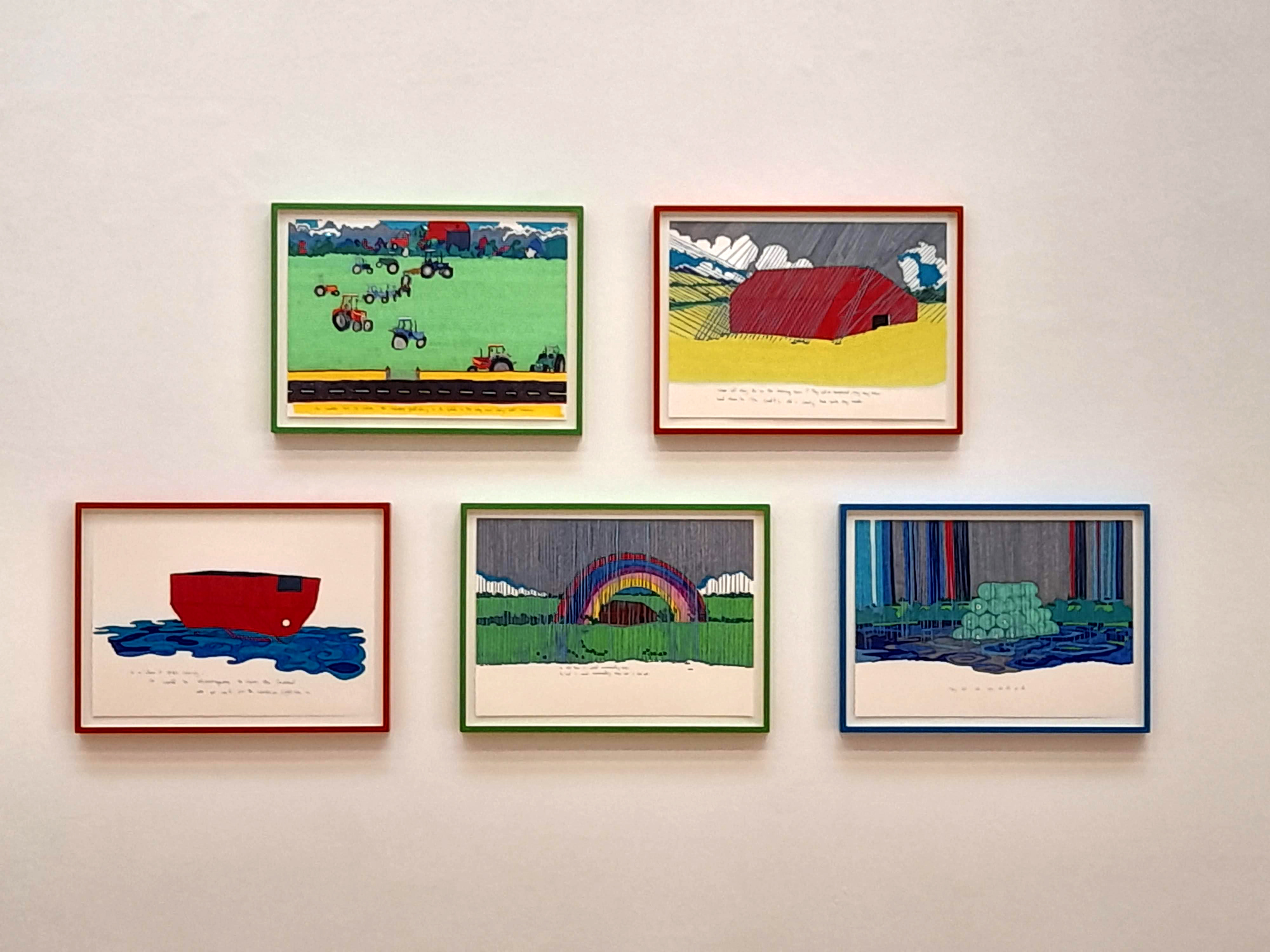
On entry to the gallery I could see Laura Fitzgerald's 2D works on the wall across the room and from that distance thought they were embroidered works - they seemed so fine and precise. But no these were not embroidery (though no less painstaking); they are certainly fine and precise, but these are witty drawings done with Sharpie pens! I looked at the accompanying didactics for this group and indeed the titles also are full of good humour: (clockwise from upper left) Restless Tractors, More Weather, but I do still care, Powerful People Promises and The Ark.


Here's a closeup of Restless Tractors.The back and forth drawing of the field with the Sharpie mimics plowing field and draws the viewer into both the making and the meaning of the work.


The panoramic landscape scroll A Mountain for Venice also has a witty didactic in which Fitzgerald details each item used in the work's creation - not just the material but where it was purchased and how (and in the case of the specific paper, how long it spent in customs before she finally received it!).


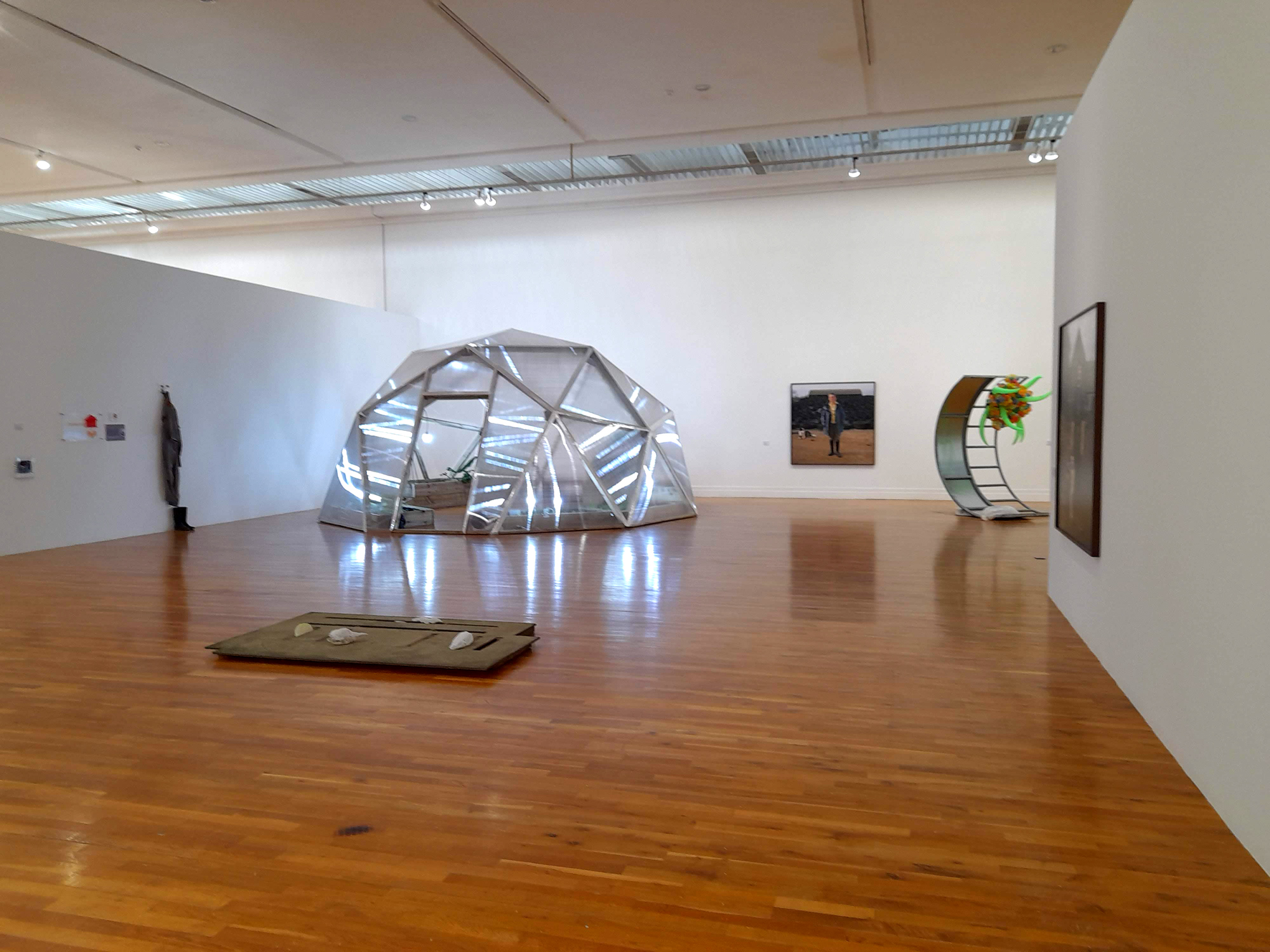
Jane Locke's Consumer Farmer (which could only be seen once one was fully in the gallery) is also a witty work with an eye to the future. I was especially looking forward to her contribution to the exhibition as I have experienced her work on several occasions in the past (and wrote about one in CIRCA Online here). Locke's installation comprises of a futuristic geodesic dome greenhouse where the plants are sparse but alive and well, a worksuit, which again seems futuristic as it has a farmer's patch on it very similar to what one might expect on a NASA spacesuit, and the product catalogue for the spring of 2123 full of Locke's beautiful drawings and surreal product descriptions.


The exhibition A Growing Enquiry - Art and Agriculture, Reconciling Values continues till April 24, 2022.

Wednesday, 13 April 2022

A Growing Enquiry at the RHA Gallagher Gallery, part 1

I was delighted to see, in person, the large group exhibiton, A Growing Enquiry - Art & Agriculture, Reconciling Values at the RHA Gallagher Gallery in Dublin recently.


The exhibition consisted of new installations by seven women artists - Miriam O'Connor, Laura Fitzgerald, Orla Barry, Katie Watchorn, Jane Locke, Maria McKinney and Anna Rackard. Two of these women (Barry and O'Connor) are farmers as well as artists, and Rackard's large photographs, portraits of women farmers, are scattered throughout the exhibition, certainly reminding the viewers that agriculture is NOT an exclusively male environment.


The exhibition, curated by Patrick T Murphy, responds to questions about how does one create value systems around art and agriculture.


The exhibition is impressive with its wit, artistic response and sheer scale. The didactics were a pleasure to read, giving insight into each artist's personal response to the enquiry and allowing the audience to enter into the dialogue.


The gallery is huge, which allows one to wander the space and engage with each installation (except Rackard's which appear throughout the space) as a separate entity.


There was also some overlap as I could hear the song/chant, which was part of Orla Barry's installation that was not immediately visible until one turned a corner in the gallery.


Barry's installation also included raw sheep wool and a large printout of an Aran knit sweater. Barry's work spoke of commodity, hierarchy, production and language as both the printout and cane crooks were embedded with words. The song itself was evocative.


The song, which was a collaboration with composer Paul Bradley, could be heard throughout the gallery, and the lyrics were written on rough wood - a mirror split of a tree adjoined to resemble the shape of a Celtic cross.


I'll talk about a few more of the artists and their work in next week's blog. A Growing Enquiry - Art & Agriculture, Reconciling Values runs till April 24.


Wednesday, 1 September 2021

Pluid - The National Comfort Blanket

This week I had intended to write about the other exhibition, Pathos, at Rathfarnham Castle, but after seeing the Pluid exhibition on Sunday, I decided it was a priority because it is a fundraiser in which all of the works may be viewed here and many are available for auction in aid of Pieta House, a charity with a mandate for suicide prevention. I blogged about the Pluid Project back in April of this year when I decided to get involved; you can see that post here. While the initial intention of the project was to create a National Comfort Blanket where the individual contributions would be sown together into one giant work, it soon became apparent to the organisers, Claire Halpin and Madeleine Hellier, that both the variety of media and the number of artworks involved would make this an impossible task. Instead, the numbered works were laid out on a long platform and visitors to the exhibition could make their way around the table to view the squares.


Looking up the tables at the multitude of contributions! Admittedly it was a little overwhelming but also gorgeous to see. The two monoprints I submitted, Rosehips and Wild Rose (#81 & #82), are visible towards the bottom centre.


The brief was completely up to the contributing artist to interpret: so a 6 inch square encompassed both 2D and 3D work and any medium that could be thought of was used! I was particularly drawn to Ciara O'Connor's stitch-drawing image of a parent and child making pasta together.


There were three primary schools that took part in this project: Fairview NS (Dublin), Holy Family NS (Monkstown) and Gaelscoil Nás na Ríogh (Naas). This picture also shows a variety of textile-based work: knitting, crochet, felting, beadwork and quilting. 


Jenny Mahony's limestone sculpture (centre) is a beautiful example of a fully 3D artwork in the exhibition. As #56 - an early piece to arrive at Pluid headquarters - it certainly shows how impossible it would have been to stitch the works together as a literal blanket!


2D work took the form of painting, drawing, photography, sculpture and various types of printmaking. There were a few examples of sun-printed cyanotypes. The print at centre-right is by Val O'Regan.


I was thrilled to see a ceramic piece in the exhibition by Orla Kaminska (upper left), whose work I had seen at the annual Ceramics Ireland exhibition at Rathfarnham Castle in June (I blogged about that exhibition here). I was delighted to discover that Fungi (centre right), the beautifully debossed and gold leaf embellished hand-bound book by Fiona O'Grady, was a blank sketchbook! As someone who enjoys bookbinding myself it is such a treat to see what techniques another artist is using.


This picture again shows a variety of works in different media and techniques: painting, felting, photography, crochet and stitching. The gold embroidery on denim is an extremely delicate drawing of wild garlic by Mairéad Harrington, which to her were a comforting sign of spring. As I have wild garlic growing annually below the fuschia hedge in my front yard (from which I make pesto each spring), I delighted in this piece.


In many of my own art pieces I have referred to my "dream boat": an image of a red-sailed boat in the ocean that first appeared to me in a dream and which I have come to associate with my self. Seeing this marker drawing of the red-sailed boat (centre) by Laura Geragerthy brought a true smile to my masked face, like meeting an old friend.


Human touch, both painted and photographed, like these photos (top, black and white) by Joshua Sullivan, has such strong associations during this time of "social distancing". Hugging and holding hands, when possible, have become far more important and nuanced than at any other time in our lives. I was also delighted to see the mokuhanga print of Kate McDonagh. Stillness (centre) "reflects the solace [she] found in the quiet skies throughout the Pandemic particularly [during] the first lockdown when no planes were flying." I became acquainted with McDonagh's practice during one of Graphic Studio Dublin's "Artist Beyond the Studio" series of lockdown remote artist talks a few months ago. A recording of it can be watched here.


Comfort in nature was another theme found in various forms throughout the "blanket". I was particularly drawn to the bog cotton works by Pamela DeBrí. I used to live rurally in Kerry and the field next to me was where I first saw bog cotton, a sight which I thought wonderful and beautiful. It was a joy to see both the photograph of a cotton field and the real things immortalised on rag paper.


This picture shows varying 3D works by different artists. I enjoyed Grant McEwen's stainless steel Jigsaw Time (reflecting the overhead beams of the cowshed) and it gave my family the opportunity to do a squishy masked selfie. In front of McEwen's piece is the blue origami and graph paper work, Blue Pavilion, by Helen Barry and beside that is Nourishment, a driftwood and copper piece by Helen OBrien. Nearby I was struck by the altarpiece quality of Michelle Boyle's The Sun Rises in Spite of Everything, a mixed media work that includes gold leaf, granite and découpage elements to create something mystical. To the right of Boyle's work is a blue glass abstract landscape work, Bay, by Barbara Keneally.


There were a surprising number of glass works submitted and I was particularly drawn to the colourful works (centre) of Maresa Edwards, which were based on her daily walking routes.


Obviously it is impossible for me to feature every worthy artwork here - there are more than 1200 works! - so please look at the auction website, here, to view individual works and find out more about the artist's response to the theme of comfort. Altogether it is quite amazing how much thought and work and expression can go into a six inch square. Each artwork is so individual and so human - this is truly a project that has shown the depth of feeling that individuals are willing to show during this extraordinary time and to share their comfort with others. Brava Claire and Madeleine for intiating this project! Thank you.

Wednesday, 11 August 2021

Bite The Hand That Feeds You

 A few weeks ago I went to Rathfarnham Castle to see the PhotoIreland Festival group exhibition Bite The Hand That Feeds You. In that very large space I was delighted to see that the exhibition was a smaller group show than I expected, where each artist was given ample room to stage individual installations of work around this year's themes (food consumption & human-animal relationships being the bigger ones). The first installation that one comes across (due to Covid the system of masked movement is, understandably, very particular) is by Finnish artist Hertta Kiiski. Milky Way consists of goods (cloth and clothing) that reference her video (not in the picture below) of two very bored looking teens, dressed alike and cradling large, oddly-shaped, clear bottles of milk, which they periodically drank from. There was no dialogue in the video (at least while I was watching) and the ennui was infectious, so I did not stay for the duration. I definitely had the sense of teen insecurity (in the way the bottles were cradled), boredom, and the ability to consume as something to be taken for granted. I assumed this was cow's milk as opposed to human milk and it highlights that, perhaps somewhat dubious, human-animal relationship where human's are the beneficiaries of an animal product.


In the next room one is also confronted with the treatment of animals, again cows, in the large digital data drawings of Dániel Szalai, Unleash Your Herd's Potential. Using assorted surveillance and computer techniques, Szalai brings to the fore a number of issues concerning the human-animal relationship. 


However, I have to admit, that it was the imagery and painterliness of these computer drawings that attracted me to this work.


Accompanying these works is the strange-seeming abstract floor sculpture; this, however, is a piece constructed from actual shapes of salt cow-licks and brings the element of reality into this hi-tech installation.


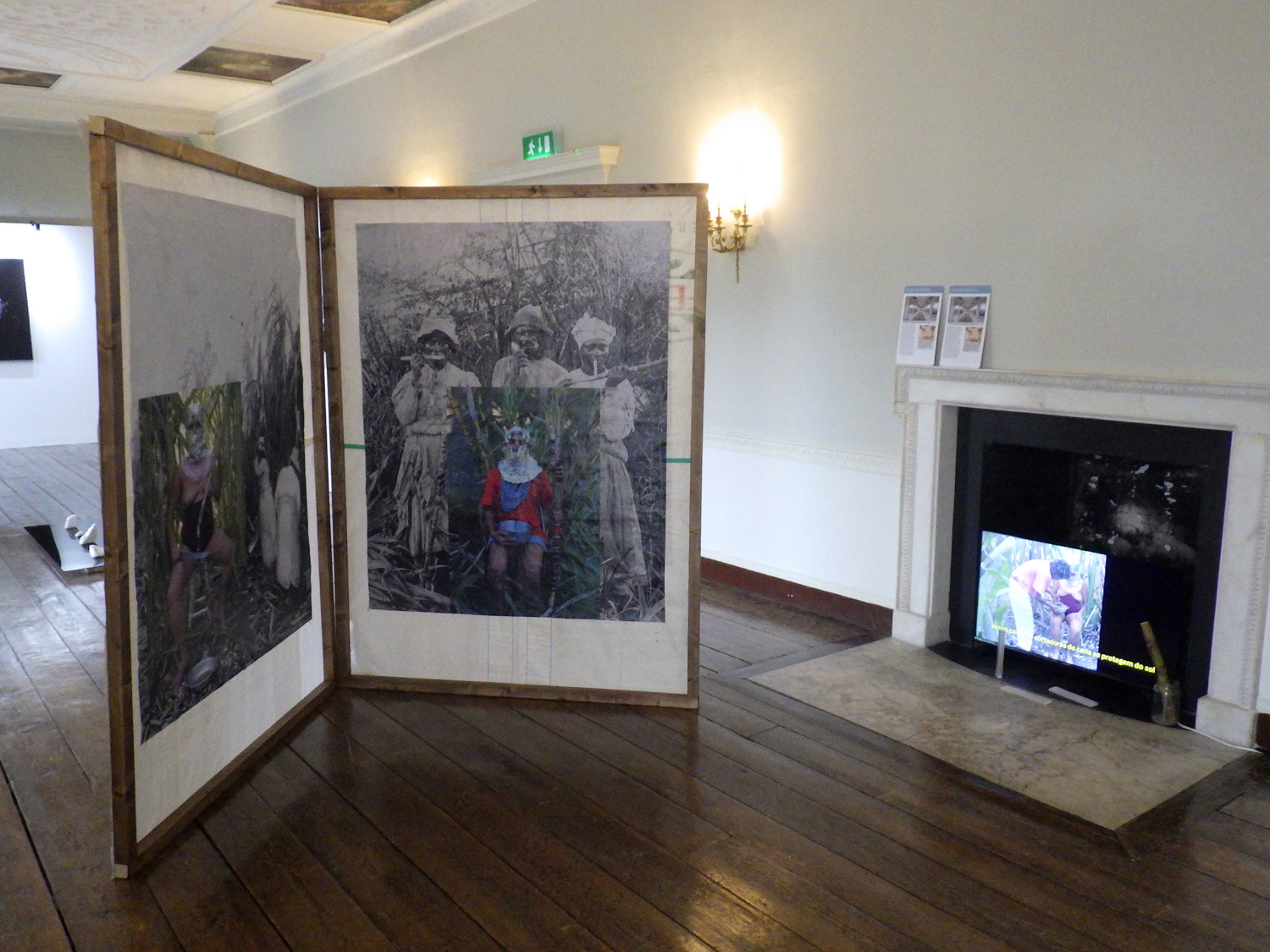
Sharing the room with Szalai was Overlapping Histories, a mixed media installation by Gê Viana.


The video seems to be of the artist setting up a posed National Geographic style "authentic" cultural photograph, which is included and enlarged within the installation. There are clearly doubts about any authenticity, but also concerns about colonisation and cultural appropriation raised. While it is a thoughtful piece, I found it difficult to engage with.


Almost as an afterthought, Tuna by Sheng-Wen Lo, was placed in the same room as these two larger installations and really seemed out of place. According to the accompanying didactic, Lo's game is concerned with sustainability and the available bottle of hand sanitizer next to the video game attested to the fact that this was a hands-on piece. However, I found nothing in its presentation to tempt me to give it a go.
 

The smallest room allowed for Hans van der Meer to present a video, book, and related photographs of cows together as a single entity, Time to Change. The video, in which cows, in turns, enter a hoisting machine in order to have their hooves shorn/scaled for hygienic, health and safety purposes. The most interesting thing I found about watching this rather hypnotic process was that the cows did not in the least mind the noise (an angle grinder!) or being lifted from the ground by the machine, legs manoevred neatly in order to accommodate the human doing the work. Other sections of the video showed the cows systematically ignoring automated processes - the cows just went about their business as various machines went about theirs!


The wall of photographic portraits of these cows presents them in all their glory: ready for sale, for work (milking, procreation) or consumption (prime beef). The cows themselves do not really seem fussed at all - are they condescending or dumb?


The final, large room contained two installations. Spinebone Soup and Stuffed Rabbits by Ksenia Yurkova is a large, multi-media humorous installation where the seemingly innocuous concept of the recipe takes on absurd dimensions. From transparent, impossible and confusing recipes hung from a complex free-standing framing system (where ingredients may include sawdust and glue) to a vox pop video, where topics include thoughts on the point/pointlessness of meat flavoured substitutes for vegetarians and vegans to the possibility of growing meat scientifically from human tissue to end world hunger. I do not know if Yurkova's video was scripted and staged or a genuine vox pop, but it most certainly provokes a reaction of ethical proportions as one tries to figure out one's own answers to some of the queries. While the overall piece delves into the absurd and comical, it has a fundamentally serious edge.


The final piece before exiting the exhibition was Alan Phelan's A World Looted. The hexagonal pillar with light emanating from  some of its planes provided a TARDIS-like curiosity seen from the corner of my eye while viewing the previous installation.


On closer inspection, those back-lights illuminated individual Joly photographs* set within the pillar. Phelan's photographs are concerned with specific global, corporate fruit controversies highlighting concerns of how fruit is produced, consumed and the ethics of globalisation and colonisation.


While the display's execution is pristine, if it weren't for the didactic and the titles of individual pieces (such as Pineapple: let's depopulate and extract profit to make the perfect pineapple) I wouldn't have had a clue what Phelan's work was about.


*This explanation of "Joly photographs" was written on a didactic at the exhibition: This is a method of colour photography developed in the 1890s by John Joly, a physics professor at Trinity College, Dublin. It is an additive colour method, with a striped red, green and blue (RGB) colour screen placed in front of the film in-camera on exposure and then again on display. Colour information is recorded on black and white film and rendered as a colour image when the screen and film are put together. The film is processed as a positive and so what is displayed is the film that was in the camera, not a print or reproduction.

Wednesday, 15 June 2016

IADT Grad Show

At the beginning of June I went (several times) to view the IADT Grad Show. I had had a chance to get to know the fourth year art students last November when I helped out with the "rollover" shows at Pallas Studios in Dublin. It was a double pleasure then to see the final works of these emerging artists and to see how their practices had developed in the intervening months.  

I had previously seen photos of Mary McClelland's mixed media photographic installations (or wall mounted photographic sculptures?) but didn't realise until I saw them in person that the delicate framing is layered waxed paper. This was the centre piece of an alter-like triptych.


The elongated rose form is again created from layers of waxed paper, not quite enclosing a piece of honeycomb, fresh and oozing. McClelland's work is elegant and evocative; at once spiritual and erotic. To see the other elements in this piece and more of McLelland's work click here.


Since I consider myself primarily a painter, I couldn't help but take an interest in the paintings on display. There were three large paintings by Mateusz Lubecki, two of which can be seen below.


I was intrigued that Lubecki's paintings are both naturalistic and abstract at the same time!


I was very attracted to the stylised and mysterious paintings of Jago Moulton. The loose brush work of the white and flesh tones played off and emphasised the flatness of the polka dot dress and the black hair and background.


To me this painting is like a photograph from a dream - holding a memory and meaning that you can't quite get at to understand fully. I love it!


The exhibition contained all art forms and I have only featured a few pieces here by three grads, but a more comprehensive look at works in the exhibition can be accessed here.