Wednesday, 25 November 2020

lino printing - the start of a new series

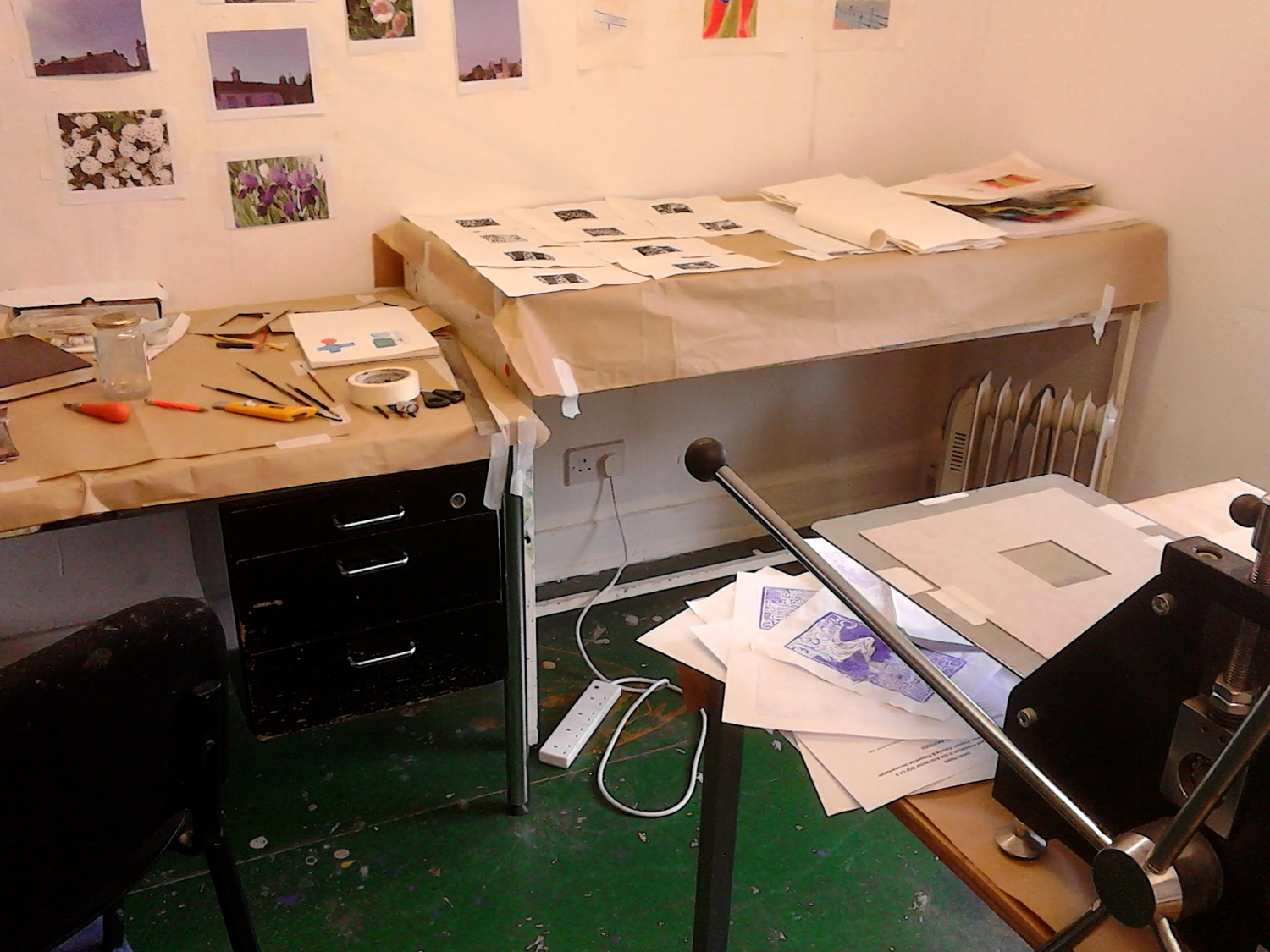
I started the Signal Arts Centre studio residency at the end of September and I blogged about starting it  here. My plans for the studio this year included a daily self-portrait (which I blogged about here), making silk fibre paper for printing on (which I blogged about here) and printmaking. My initial plan was to create a series of monoprints and print them on the silk fibre paper. However, after trials (here), I found that the monoprints, though I liked the results on the paper I made, would actually be too vibrant for my Memory Is My Homeland series and even working small, would be too big for the silk fibre paper, which I wanted to be as memorable as the printed image. I have worked on very tiny lino blocks before and decided that this format would be better suited to the planned series. I had five images in mind and wanted to start work on them immediately.


After transferring all the images to the tiny blocks, I started the basic outline cutting.


Then I worked on each block individually. 


This is ostensibly finished, though I would make a final decision after a test print. (NB the image below is larger than the actual lino block!)

I was happy with this test print and didn't do any further work on the chain lino. The image derives from my memory of the chain barriers in front of the first house in Toronto where I lived. I remembered sitting on the chains and treating it like a swing. I always wondered about this memory, until one time passing the area on a streetcar I saw the "barriers" that separated the house lawns from the surrounding footpaths. They were very low chains between short bollards, no more than two feet high. It made sense of my memory - my family moved from that house when I was two years old.

The test print of the gate at Knockeen was also satisfactory. This small gate, seemingly within the hedge separating the second house in which I lived in Kerry from the fields in front of the house, had a glass ball (a buoy?) affixed to it's post.


Though I bought the red wellies in Galway in the summer of 1988 because my shoes were soaked from a downpour, I practically lived in these wellies, rain or shine, while in Kerry 1994-1996. I wanted to keep the image simple, so did no further work on the lino. 

I have spent about half my life living in Ireland now, just as long as I've lived in Toronto, and although I haven't always been in Bray, it is most certainly my "home". There is a Victorian promenade at the seafront, looking out over the Irish Sea, and it easily becomes a genteel symbol of the town's history.


The block I did of pegs did not work on such a small scale, and I decided I would make another image of one peg, as the image has meaning within the series.


Wednesday, 18 November 2020

daily self-portrait

During my three studio residencies at Signal Arts Centre, I have always started the day with a self-portrait. I have previdusly blogged about my studio residencies many times, the main beginning or progress posts can be found here (2018), here (2019) and here (2020) and there are a number of other posts that refer to those residencies. For me focussed observation is a good warm-up to making art and a good way to start the day. The main decision is regarding what media to use. This sketch is from my second week at the studio (Oct 9) and the medium is watercolour pencil.


This is also a watercolour pencil sketch, but shows how a different day can affect an observation, even if the same medium and same subject is the focus. This sketch is from Oct 13.


My tray of watercolours has gone AWOL so I was unable to bring them to the studio. I do, however, have some cheap tubes of watercolour (which feel more like gouache as they dry very chalky). I decided to use them up, and first off I decided I would limit myself to using only three colours and one brush.


I found the exercise of limits both fun and freeing, so I did it again the next day (Oct 16), choosing three colours only but this time allowing myself the use of two brushes.


I specifically had set up an area of the studio for making the self-portraits, thus I could leave a wet page open to dry while I carried out other work in the studio.


I absolutely hate using any colour that resembles brown but decided that, in order not to be left with undesirable tubes of paint, I would choose three colours that I normally wouldn't touch with a 10 foot brush: burnt umber, yellow ochre and burnt sienna. Once again I allowed myself the use of two brushes for this sketch of Oct 19.


Giving the paints a break, I decided on Oct 20 to use a soft 6B pencil for my daily self-portrait. It was to be my last self-portrait in the studio for the month of Oct, as I packed up supplies to bring home since another level 5 lockdown was due to start.


Although I would have been able to continue working from the Signal studio, at least part-time, I decided that I simply needed to keep up the work momentum of my residency in my studio at home. With this in mind I have continued the practice of a daily warm-up self-portrait before doing any other work. The first example of this is the blind contour drawing of Oct 21. This is an enjoyable technique of intense observation without reference to the surface on which one is drawing and without lifting your medium from the page so that the line is continuous.


Wednesday, 11 November 2020

Home Sweet Home Goodbye published

I founded Precariat Press in the spring of this year with the publication of my first chapbook of poems in mind; My husband, James Hayes, designed the logo for me after an evening of brainstorming. The cover design is based upon my earliest existing piece of "art" - a goodbye card I made for my grandparents when they were returning to Ireland from a visit to Toronto in 1967. I talk about that in a previous blog, here. This was the first time I met them, and the card was found in my grandmother's handbag after she (my Oma) died in 1980 and it was returned to me.


I have spent the months in lockdown (the first one!) designing and printing up the cover, which I have blogged about here and hereand choosing the final poems to be included. The chapbook contains a mix of poems previously published in other journals (which I acknowledge) and work that I think are deserving of publication! They are a mix of oldish poems (probably revised somewhat) and newish poems - spanning 40 years of writing poetry.


I have bound Home Sweet Home Goodbye in the traditional chapbook binding style, i.e., three-hole bind, with cotton thread. It contains 17 poems over 25 pages of poetry, and the cover is a monochrome linoprint. It is approx A5 in size, a standard chapbook size. I have blogged about the book mockup and binding herehere, and hereThis is a limited edition publication, with 50 copies only. 


Wednesday, 4 November 2020

pre-lockdown printmaking

It's only been a couple of weeks since I left the studio residency at Signal Arts Centre, due to the second lockdown, but I did get a lot done in the three weeks that I was there, and am happily continuing the momentum. I posted a blog at the start of the residency here.

My plan while at Signal was to focus on creating silk-fibre paper (I had learned how to do this in a Zoom workshop in the summer and blogged about that workshop here) and use these pages as surfaces for alkyd monoprints. I spent the first week and a bit at Signal making silk fibre paper, which I blogged about here and then I wanted to start printing, but first I did some test prints of images that I was interested in creating as part of Memory Is My Homeland. I have previously blogged about the origins of this body of work here and have continued to blog about it numerous places on this blog (NB, at the beginning I simply referred to it as "The Home Project"). 

One of my reference photos is of my Mum & I, in the 1980s, standing in the backyard of my parents house in Bray in front of the clothesline, pegs awaiting laundry. The backyard was a very tiny space, off the kitchen and, while I lived in this house for a couple of years in the late 1980s, it mirrored my own backyard on the same street later when I returned to the east coast from living in Kerry, on the west coast. In any case, it was the image of colourful plastic pegs, waiting on an empty line with a white-washed stone wall behind them, that interested me.

Because I knew I wanted the handmade silk-fibre paper to be as featured as nuch as the printed image, I was working on small acetate plates, using alkyd paints to create monoprints. However, even with a tiny brush, I could not get the details of the pegs on the line, and the press just seemed too happy to squeeze the colour enough to blur the image. Although I do not think this image (below) worked, I did not give up on the idea of the peg image!


Although the Victorian railing has since been painted more subtly (which I think is uninteresting) the orange and bright blue railing is an iconic image of Bray, recognizable to anyone with affiliations to the town. 


I bought a pair of red wellies in Galway in 1988, shortly after I had re-located to Ireland. I wore them on dry, sunny days in Kerry while gardening, and they were a necessity on the wet, sideways-rain days too. I think their death-knell was sounded when I sunk into the bog while looking for the stations of the cross on the mountain near my home in Kells Bay, Co. Kerry. The stations were there since the days of hidden religion, before Daniel O'Connell, "The Liberator", secured the emancipation of Catholics in Ireland in 1829.


I was so intrigued with the first test print, that I did another on heavier paper.


The final test was to see how the print would work on silk fibre paper. On the one hand I was happy with the print - the silk fibre paper was happy to take the print - but I thought the image was still too big for the paper. 


With regards to Memory Is My Homeland I decided that the colours were too vibrant for my idea of memory. It was after doing this print that I made the decision to do much tinier images, using lino blocks and the final images will be monochromatic. I have not made any decision on colour for future prints, but I have begun working on the linos. Watch this space!

Wednesday, 28 October 2020

Signal studio residency: making silk fibre paper

In June I had taken a Zoom workshop, with artist Tunde Toth, on silk fibre papermaking (which I blogged about here) and immediately knew I planned to make more of the paper for my printmaking when taking up studio residency at Signal Arts Centre come autumn. Well, that time came fast enough and I spent the first week (plus a bit of the second week) focussed on making silk fibre paper. One of the first things for me to do, then, was set up a work station: spreading a clean table cloth over the table, having water bottle spritzer filled, iron to hand, scissors, ruler, bag of silk fibre, parchment paper roll, small dry brushes, pigments, and strips of Fabriano paper that I planned to use as inclusions.


I had the ruler to measure the sheets of parchment, as I wanted the finished pieces to be large enough to show off the paper and to carry a small print in its centre. I had two types of silk fibre: "carded coccoon strippings" and "throwsters". I actually don't know which is which, but one is like angel hair and the other is more like cotton batten. The process is simple - pull/tear the fibre to form a shape on the surface of the parchment.


If one is using "inclusions" (i.e. elements that are not silk fibre) - in my pages I decided to use small, torn pieces of Fabriano paper - 


they must be sandwiched between layers of fibre.


Sometimes I used a mix of silk fibres (with inclusions of paper)


and for other pages I used just one type of fibre, again here I added the paper inclusions.


Though it is hard to see in this picture, I included some really soft coloured fibres in this piece.


This piece is made of a sandwich of one type of fibre with paper inclusions. It is at this stage that pigment may be sprinkled/flicked onto the fibre with a small, dry paintbrush. This is an enjoyable process, but you have to be happy to give away control, as the effects of the pigments are full of randomness (going through the processes of flicking, spritzing, and ironing to mix at their own inclination).


When the "sandwich" is complete, the next step is to spritz the entire "page".


Cover with another sheet of parchment and gently, with the palm of your hand, rub the water into the fibres. It will be apparent what areas are wet. Turn the whole thing over and rub on the other side too, spritzing a bit more if necessary.


On high, but not steam, heat iron lightly. It is the water and heat that releases a natural glue, serecin, from the silk fibres, which binds the fibres together to form a paper. As you can see from the photo, I am only lightly holding the iron, allowing it to glide slowly on the surface with its own weight. You can actually hear the water sizzling!


When finished ironing (about 5 mins) peel back the top layer carefully. If the paper still seems too wet, iron some more, but if it is mostly dry, carefully peel the whole page from the parchment.


It can finish drying on a clean piece of paper or blotting paper. This is a finished sheet of textured, undyed, silk fibre paper, with Fabriano paper inclusions. It is ready to be printed on.


I had enough silk fibre material to make 20 sheets of paper, so I experimented with colour pigments, different inclusions, and also set up another table with blotting paper to place damp but finished pieces on.


Here are some of the finished pages using different pigments and in the yellow piece on the left I used a dry, fibrous green inclusion.


Wednesday, 21 October 2020

binding the chapbook


In my previous blog, here, I discussed the preparation for binding and gave links to all my blog posts relating to this chapbook. With everything ready, the next step is simply to bind the books!


In creating a traditional poetry chapbook (less than 40 pages) I also decided to bind the book with thread (as opposed to stapling) and use a very simple saddle stitch with three holes in the spine. I have made a diagram of the thread journey below, where A, B and C represent the spine holes. The solid lines with arrows represent the direction of the thread on the exterior, and the broken lines with arrows represent the direction of the thread on the interior. Just as a reminder, the pages should be placed inside each other, as per the right side of my diagram.


This image shows the start, the first threads going into the centre hole. Please note, that though a large-eyed, fairly strong needle is necessary to hold 6-strand cotton (embroidery) thread, the needle should not be a fat needle, as used in leather binding as this will expand the binding holes and there is more risk of tearing the paper. Leave a few inches of thread outside the spine hole in order to tie a knot when the thread finishes its binding journey.


The thread appears in the centre of the chapbook.


The thread then follows the interior route to the bottom hole B (in fact it does not matter whether it goes to the top hole or the bottom, but just choose one consistently).


On the outside spine, the thread takes a long journey to the top hole C and goes to the interior back to A and out again to the exterior spine. Here one ensure that the long spine thread is in between the entry and exit threads before tying a simple knot or two. This will ensure that there is no floppy long thread on the spine: the exterior binding will appear the same as the interior except for the loose threads at entrance and exit points. 


On my books I decided to leave these threads at about 6 cm as a design feature, first tying knots in the thread ends to prevent separation of the strands.


Wednesday, 14 October 2020

Preparing to bind the chapbook

By request, my husband (artist James Hayes) made me a beautiful (all-powerful, almighty, awesome) awl for my birthday this year. He even made a holder for it to protect the sharp point -


and to protect me from the sharp point! I used to have an awl but it went AWOL some years ago, and last year when I did a lot of bookbinding I resolved to get another because I was fed up using pushpins! With the founding of Precariat Press in the spring of this year, I knew I'd be doing more bookbinding, so getting a new awl was mandatory. So when this gorgeous tool was made specially for me, I swooned!

Once I had decided on the concept, design, cover image & printing, the poems to be included and the layout (all of which I discussed here, here and here) the final step was to collate and bind. Collating all the pages together into booklets also required a lot of folding with my trusty bone folder.


I had a second mock-up book (from which I made corrections) and I measured out where the 3 binding holes would be placed and, after punching these holes used the individual pages as templates for the final books. I had decided early on that I would be doing a traditional 3-hole chapbook bind.


Once binding holes had been punched in all the chapbooks (it is an edition of 50), I was ready to start binding. I had picked up 6-strand cotton thread in a colour to match the cover some weeks ago. In next week's blog I will discuss the journey of the thread to bind the chapbooks.