Showing posts with label oil painting. Show all posts

Wednesday, 12 October 2022

Citizens? at Rathfarnham Castle

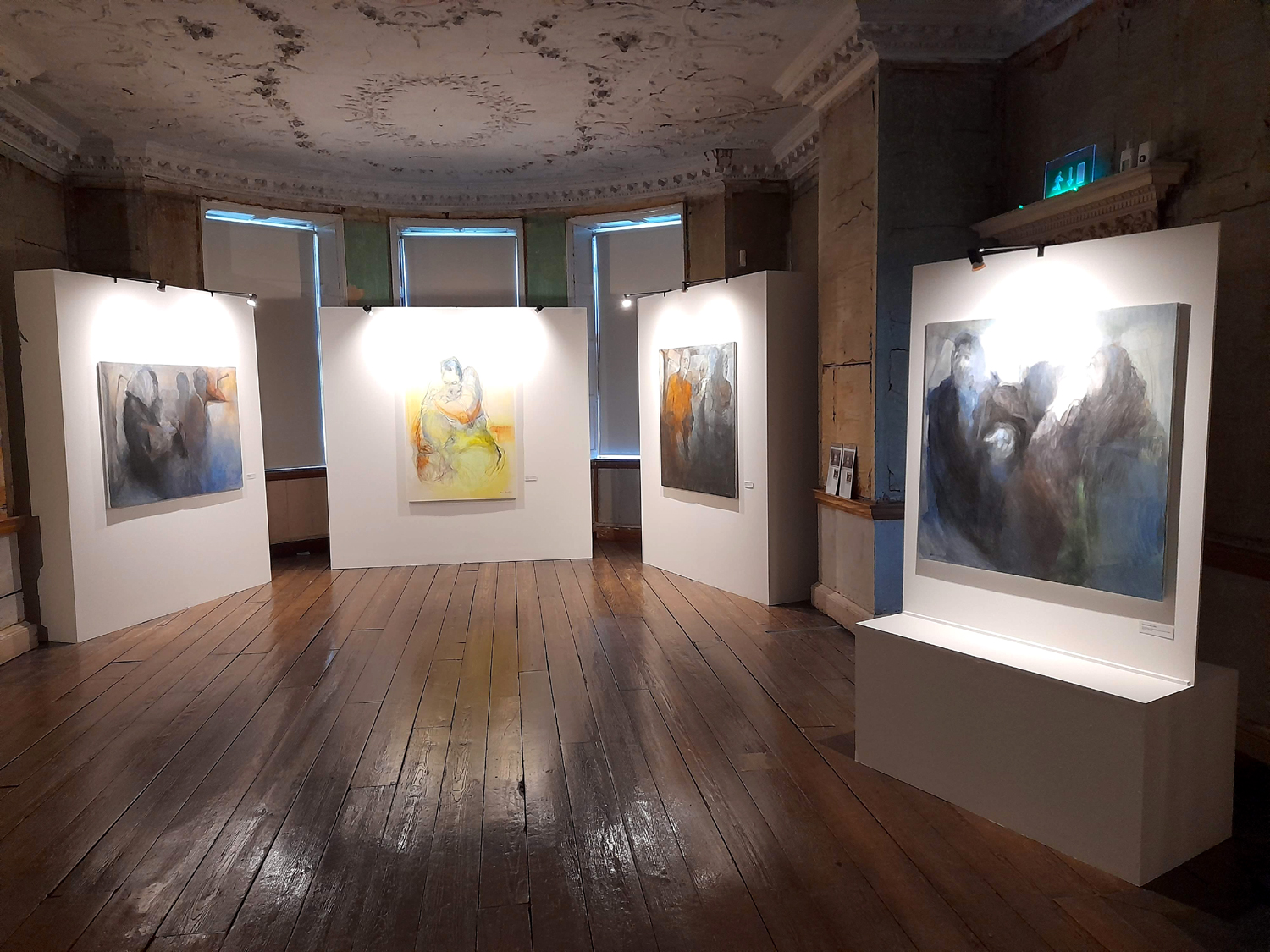
A few weeks ago I was at the launch of "Citizens?" at the wonderful Rathfarnham Castle. This two-person exhibition examines and responds to notions of citizenship, home and identity. It is a show of work by Syrian painter Manar Al Shouha, who is an asylum seeker living in Dublin and artist Belinda Loftus, who is a descendant of Adam Loftus the Elizabethan commissioner of the castle, which became his family home.


Al Shouha's gorgeous paintings are exhibited in the large Dining Room. Unfortunately my photos do not give justice to the amazing paintings but only give an idea of scale and how they are exibited in the space.


Thin layers of oil painting and fine draughtsmanship in the charcoal drawing on canvas render the images ghostly and exquisite. I was reminded of the incredible work of early 20th century Austrian painter Egon Schiele, whose drawing skills I previously have tended to consider unmatched.


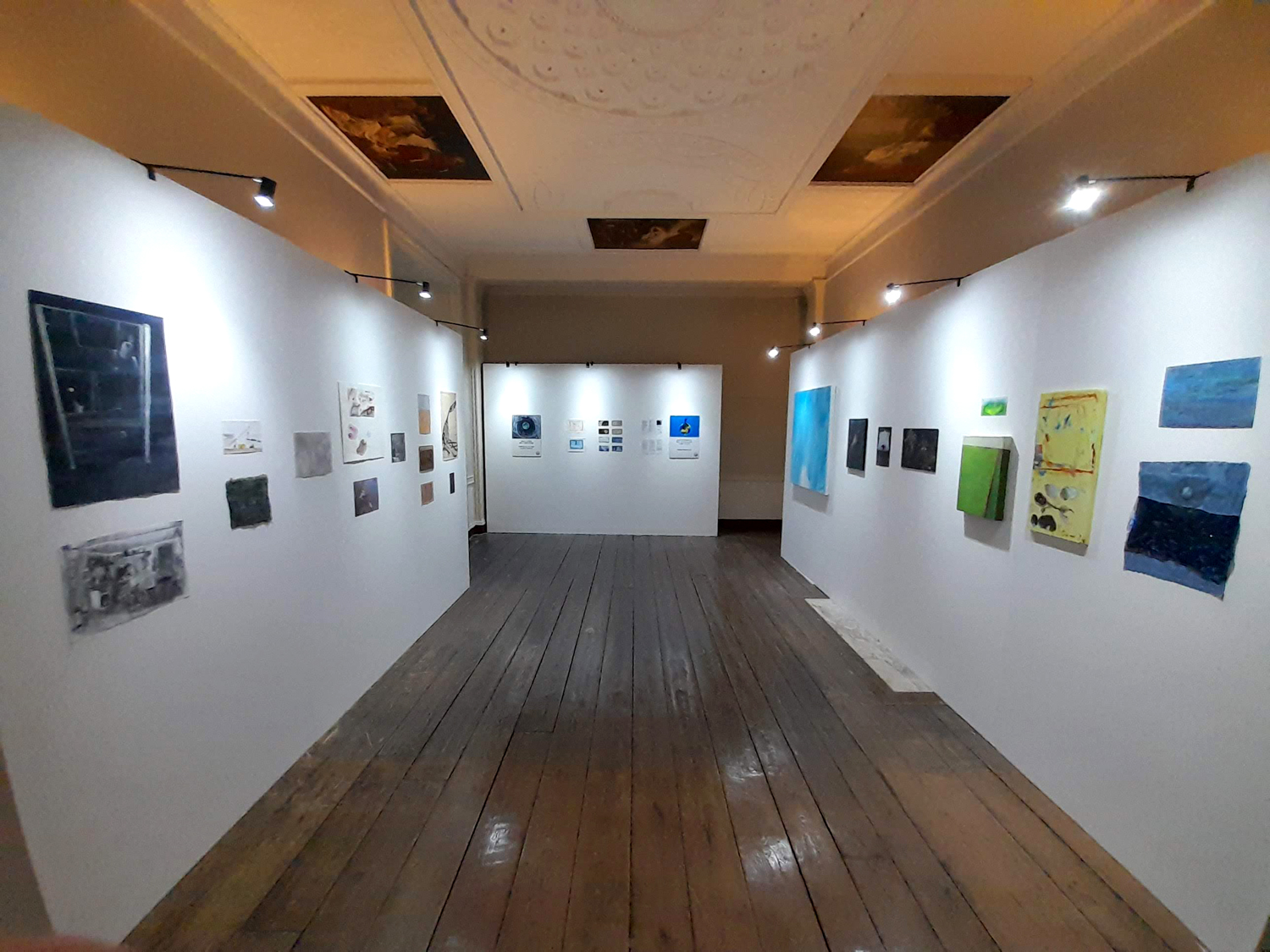
Loftus's work was exhibited in The Saloon and The Pistol Loop Room. Her work could be considered more experimental, as she worked in a variety of media and styles, ranging from conceptual to faux naif. However, it did not have the impact on me that Al Shouha's work did.


The exhibition continues till October 23 and is well worth visiting.

Wednesday, 1 September 2021

Pluid - The National Comfort Blanket

This week I had intended to write about the other exhibition, Pathos, at Rathfarnham Castle, but after seeing the Pluid exhibition on Sunday, I decided it was a priority because it is a fundraiser in which all of the works may be viewed here and many are available for auction in aid of Pieta House, a charity with a mandate for suicide prevention. I blogged about the Pluid Project back in April of this year when I decided to get involved; you can see that post here. While the initial intention of the project was to create a National Comfort Blanket where the individual contributions would be sown together into one giant work, it soon became apparent to the organisers, Claire Halpin and Madeleine Hellier, that both the variety of media and the number of artworks involved would make this an impossible task. Instead, the numbered works were laid out on a long platform and visitors to the exhibition could make their way around the table to view the squares.


Looking up the tables at the multitude of contributions! Admittedly it was a little overwhelming but also gorgeous to see. The two monoprints I submitted, Rosehips and Wild Rose (#81 & #82), are visible towards the bottom centre.


The brief was completely up to the contributing artist to interpret: so a 6 inch square encompassed both 2D and 3D work and any medium that could be thought of was used! I was particularly drawn to Ciara O'Connor's stitch-drawing image of a parent and child making pasta together.


There were three primary schools that took part in this project: Fairview NS (Dublin), Holy Family NS (Monkstown) and Gaelscoil Nás na Ríogh (Naas). This picture also shows a variety of textile-based work: knitting, crochet, felting, beadwork and quilting. 


Jenny Mahony's limestone sculpture (centre) is a beautiful example of a fully 3D artwork in the exhibition. As #56 - an early piece to arrive at Pluid headquarters - it certainly shows how impossible it would have been to stitch the works together as a literal blanket!


2D work took the form of painting, drawing, photography, sculpture and various types of printmaking. There were a few examples of sun-printed cyanotypes. The print at centre-right is by Val O'Regan.


I was thrilled to see a ceramic piece in the exhibition by Orla Kaminska (upper left), whose work I had seen at the annual Ceramics Ireland exhibition at Rathfarnham Castle in June (I blogged about that exhibition here). I was delighted to discover that Fungi (centre right), the beautifully debossed and gold leaf embellished hand-bound book by Fiona O'Grady, was a blank sketchbook! As someone who enjoys bookbinding myself it is such a treat to see what techniques another artist is using.


This picture again shows a variety of works in different media and techniques: painting, felting, photography, crochet and stitching. The gold embroidery on denim is an extremely delicate drawing of wild garlic by Mairéad Harrington, which to her were a comforting sign of spring. As I have wild garlic growing annually below the fuschia hedge in my front yard (from which I make pesto each spring), I delighted in this piece.


In many of my own art pieces I have referred to my "dream boat": an image of a red-sailed boat in the ocean that first appeared to me in a dream and which I have come to associate with my self. Seeing this marker drawing of the red-sailed boat (centre) by Laura Geragerthy brought a true smile to my masked face, like meeting an old friend.


Human touch, both painted and photographed, like these photos (top, black and white) by Joshua Sullivan, has such strong associations during this time of "social distancing". Hugging and holding hands, when possible, have become far more important and nuanced than at any other time in our lives. I was also delighted to see the mokuhanga print of Kate McDonagh. Stillness (centre) "reflects the solace [she] found in the quiet skies throughout the Pandemic particularly [during] the first lockdown when no planes were flying." I became acquainted with McDonagh's practice during one of Graphic Studio Dublin's "Artist Beyond the Studio" series of lockdown remote artist talks a few months ago. A recording of it can be watched here.


Comfort in nature was another theme found in various forms throughout the "blanket". I was particularly drawn to the bog cotton works by Pamela DeBrí. I used to live rurally in Kerry and the field next to me was where I first saw bog cotton, a sight which I thought wonderful and beautiful. It was a joy to see both the photograph of a cotton field and the real things immortalised on rag paper.


This picture shows varying 3D works by different artists. I enjoyed Grant McEwen's stainless steel Jigsaw Time (reflecting the overhead beams of the cowshed) and it gave my family the opportunity to do a squishy masked selfie. In front of McEwen's piece is the blue origami and graph paper work, Blue Pavilion, by Helen Barry and beside that is Nourishment, a driftwood and copper piece by Helen OBrien. Nearby I was struck by the altarpiece quality of Michelle Boyle's The Sun Rises in Spite of Everything, a mixed media work that includes gold leaf, granite and découpage elements to create something mystical. To the right of Boyle's work is a blue glass abstract landscape work, Bay, by Barbara Keneally.


There were a surprising number of glass works submitted and I was particularly drawn to the colourful works (centre) of Maresa Edwards, which were based on her daily walking routes.


Obviously it is impossible for me to feature every worthy artwork here - there are more than 1200 works! - so please look at the auction website, here, to view individual works and find out more about the artist's response to the theme of comfort. Altogether it is quite amazing how much thought and work and expression can go into a six inch square. Each artwork is so individual and so human - this is truly a project that has shown the depth of feeling that individuals are willing to show during this extraordinary time and to share their comfort with others. Brava Claire and Madeleine for intiating this project! Thank you.

Wednesday, 13 December 2017

William Crozier: The Edge of the Landscape

I was really glad that I went to see the painting exhibition William Crozier: The Edge of the Landscape at IMMA (The Irish Museum of Modern Art). I had only recently heard of Crozier (1930-2011) because of advertising for this exhibition and another exhibition of his work in Cork.


From black and white ads, however, I have to admit I wasn't hugely interested, so it was a great surprise to see large, vibrant paintings when I found myself at the show!


Because of the layout of the exhibition space, I  was coming at the show from more recent work and moving backward through time.


This was fine as I encountered the really colourful, oft-times politically engaged work that he created after moving first to Spain in the 1960s and then to the west of Ireland in the 1970s.


I was attracted to the wild colouring of his paintings


and also to the drawing aspects within the paintings.


When I got to the final rooms (actually the historical start of the exhibition)


I was intrigued by the starkness of the images


but again there was the beautiful painterly drawing! I even thought it quite beautiful the way Crozier incised his signature, rather than painting it (something that oil painting allows easily).


These are works painted in Britain in the 1960s, expressing a bleakness and sorrow for the post-war world. Crozier was a young teen at the end of the war and horrified by post war images that came out of Germany and he later associated with the philosophy of Existentialism.


Wednesday, 2 March 2016

Collage Cards 2

I have been trying to process everything from the Grey Box find of last year, and make some sense of all the various items found in it. There were so many miscellaneous sketches and cards - the cards often acting like sketches. Sometimes the card came first - as in this abstract xmas card from 1982 (I think). For a series of individual cards I painstakingly attached tiny strips of gold tape and silver paper ovals (that for me were a development from my stem-less tulip paintings); the colour was added with wax crayon and burnished. I made about 30 of them of them I think, taking care of my xmas card list...


Continuing the theme from the xmas cards, I created small works in the following year on wood blocks that I had readily available (off cuts from various projects). As I gave a number of them away as gifts a few small pieces survive, along with this piece that I kept for myself. I did a couple of larger paintings on sheets of plywood while at university, but these are no longer in existence.


From 1983 (and for several years) I had many watery dreams of figures and dolphins and this imagery made its way into many drawings and paintings. Though undated, I think this oilstick drawing dates from 1983 or 1984 and is probably one of the earliest appearances of the gold tumbling figures in the water.
I had been on holiday in Ireland in 1987, visiting my parents, and became enamoured by watching individual rainclouds in the distance over the sea and images of these clouds made their way into my watery paintings, like this one "Meeting", oil on canvas.


In 1988 I used the image of the gold figure tumbling above the water as a design on a St. Patrick's Day card for my new boyfriend (now my husband). I found stripey paper to use as gold rain and I added the green stars as a reference to a line in William Carlos Williams poem "Our Stars Come from Ireland". 


As well as making an appearance with other elements in numerous paintings and drawings, the rainclouds also appeared in their own right on a birthday card for my Dad in 1989.


The rain became a little more menacing I guess in this postcard from 1989.


I moved to Ireland in 1988 and started work on a completely new body of work as I had left all my dream paintings in Toronto. This new work consisted of a large group of figurative drawings where I covered the paper in graphite and used an eraser to draw. Later works in this series got more colourful as I drew with large oilsticks. This body of work became my first solo show, at Temple Bar Galley & Studios, Dublin in 1989. 


In February 1989 I used the theme in a Valentine postcard sent to my boyfriend in Toronto.


I have always loved the stone walls and stonework ruins found everywhere in Ireland, totally different architecture than I had grown up with in Canada. I was back in Toronto when I sent this Mother's Day card to my Mum in Ireland in 1990.


At the time, although I was back in Canada, I started work on a series of paintings based on windows from ruins which were part of my life in Ireland. I exhibited a number of these paintings in a group show at Cedar Ridge Creative Centre in Scarborough in 1992. I brought the series with me to Ireland when I returned in 1993, completed more in the series and started a tour of the large group under the exhibition title "My Tower of Strength". The exhibition opened at Siamsa Tire arts centre in Tralee, Co. Kerry and its last stop was The Courthouse Arts Centre in Tinahely, Co. Wicklow in 1998 taking in a number of galleries in between. This painting, "The Holly & the Oak", is acrylic on canvas, 122 cm x 91.5 cm (4' x 3'), 1992 is in the collection of the Office of Public Works, Ireland. The window is structurally based on Raheenacluig - the church of the little bell - a ruin on the side of Bray Head, in the town where I live.


Wednesday, 15 October 2014

Matisse and Me!

There is a huge show at the MoMa, New York about Matisse's cut-outs, and I have been enjoying all the images of works, films, photographs of Matisse in his studio, etc. that are available on the internet (the MoMA facebook page keeps posting them, so no need for me to reproduce here). The show was originally in London's Tate Modern last year, and somehow I missed the hype, so sadly didn't see it. Apparently the MoMA show is an expansion of that one. With all this imagery and information floating around, I have been reminiscing about my relationship with the master, who I freely admit has influenced my work. I think this is obvious from some of my very early work such as this Sleeping Dee Dee, oil on canvas,122 cm x 91.5 cm, 1980. 


The picture above is a re-photograph from a polaroid - I don't actually have any other documentation of this piece. I don't know if the painting still exists or not; I gave it to the model (my younger sister!) quite a long time ago.  As well as Matisse, I was also influenced by an unknown painter who attended Parsons School of Design in New York. Before I painted this, a friend of mine had started attending that art school, and a rep from the school came to give the students in my art school a talk. The rep handed out the PS of D prospectus which included a painting where the shadows were painted light blue. At the time this was a revelation to me and it is apparent that I did the same thing with my shadows at the first opportunity!

I did so many drawings and paintings of my sister while she was sleeping that friends who had not met her asked if she was ever awake. This Sleeping Dee Dee is smaller than the one above, oil on masonite. Again, I have no documentation of this other than this re-photograph of a polaroid.


This is an oil on masonite painting, also from 1980 of a woman who I had met in a bookshop near my art school. She was looking for a house-mate and I rented a room from her for one month, my first foray away from home.


Matisse's cut-out show also made me think of how I enjoy the playfulness of  art work. In 1989 I had a residency in the Tyrone Guthrie Centre, ostensibly to create new work for my first exhibition in Dublin. However, due to availability (or lack of) at the Centre, I had all but one drawing complete for the exhibition by the time I was granted the residency. In many ways this was very liberating: I was not under any pressure, had a large studio to work in, food was provided with fabulous dinners being prepared by someone else and a variety of artists (playwrights, poets, musicians, sculptors, performance artists, other painters) on location for lots of interesting discussions over coffees and dinners,


So once I had the last drawing complete for the exhibition (a large black and white, graphite, figure drawing), I changed direction and got out colourful pastels, scissors and blue tack. Using imagery from my dreams I created an entire temporary environment in the studio.


It was at The Tyrone Guthrie Centre at Annaghmakerrig that I met and became friends with Dublin painter, Pat Moran, who dubbed my studio "The Playroom". Unfortunately Pat died suddenly in 1992 at the age of 30, and is sadly missed by the Irish art scene where his expressionist, figurative painting and drawing is known.


Further to my interest in "cut-outs" as a process, this picture of me in 1993 with some of my paintings from the My Tower of Strength series shows how I used cut-outs (the birds above the paintings) to help me figure out composition puzzles.


Sorry for the poor quality of photos in this post, but all images are re-photographs of existing photos and used as part of my training in GIMP, a free software programme which I am learning in order to replace my reliance on PhotoShop!