Showing posts with label foliage bowls. Show all posts

Wednesday, 12 February 2020

Shamrock bowls - revamped!

In 2018 I made two foliage bowls, which I was really happy with from a beautiful results point of view, but realised that I put such a huge amount of effort into their making that I wanted them to remain unique, for my own use only. Last autumn I wondered if there was a way for me to create several similar bowls that I would be happy to sell at a reasonable price. I decided that I would make the bowls using one plant and that I would make them without "feet" thereby removing the necessity to take them home in order to complete. Details of making the fern and wild rose leaf foliage bowls are here and images of those finished bowls are here. I had a pot of shamrock in bloom, so I brought it into the ceramics workshop and cut sprigs from it for my design.


I was using plastic pudding bowls (I had 3 different sizes) as formers. Each bowl need a cling-film lining and then I swirled long sprigs of shamrock inside the bowls.


The clay was wedged and rolled out into a a large slab, from which I cut random pieces, which were fitted together as I worked.


I used my fingers to press the pieces together, letting the finger dents remain as part of the interior bowl form.


From the outside, one can see how the shamrock has been embedded into the clay from the pressure of joining the pieces. The cling-film creases will also add to the final design, apparent in the glazing process.


Here are the five bowls posing with the shamrock. Normally they need to be leather-hard dry before removal from the bowls, but since I was not adding feet to the bowls I could leave them until they were totally dry and ready for firing.


I glazed all the shamrock bowls with a food-safe green, wiping the glaze on the exterior in order to allow the glaze to only be in the plant and crease areas. I liked the way the glaze worked on the interior, accentuating the finger marks, however, I thought it was a bit too pale on the outside. I did submit them to the craft fair (more pictures can be seen here) but when they returned to me, I took the opportunity to make them better bowls.


For each of the five bowls I made feet that I thought were an aesthetic improvement. I knew that once they were fired some glaze could be used as a glue and the bowls could be re-fired with their feet.


I also took the opportunity to use a darker glaze on the exterior, with not such aggressive wiping in order that the creases were more apparent as well as a stronger appearance of the shamrock. For the deeper bowls I made tall feet.


For the two shorter bowls I made feet rings that were appropriately shallow. I am quite pleased with the results.


Wednesday, 1 August 2018

Foliage bowls - Part 2

I was ecstatic when my two foliage bowls came out of their final firing in the way I had hoped! With ceramics there is always the chance for something to go not-as-planned, so one has to leave expectations at the workshop door and accept concepts of happy (or otherwise) accidents and random results.


My intention when glazing these bowls was that a green glaze, painted on then wiped off again, would fill the design crevices. And indeed, this worked! Some of the crevices were deeper than others (the stems) caused by me pressing the soft clay into the foliage when creating the bowls in their formers. See my previous post here for details.


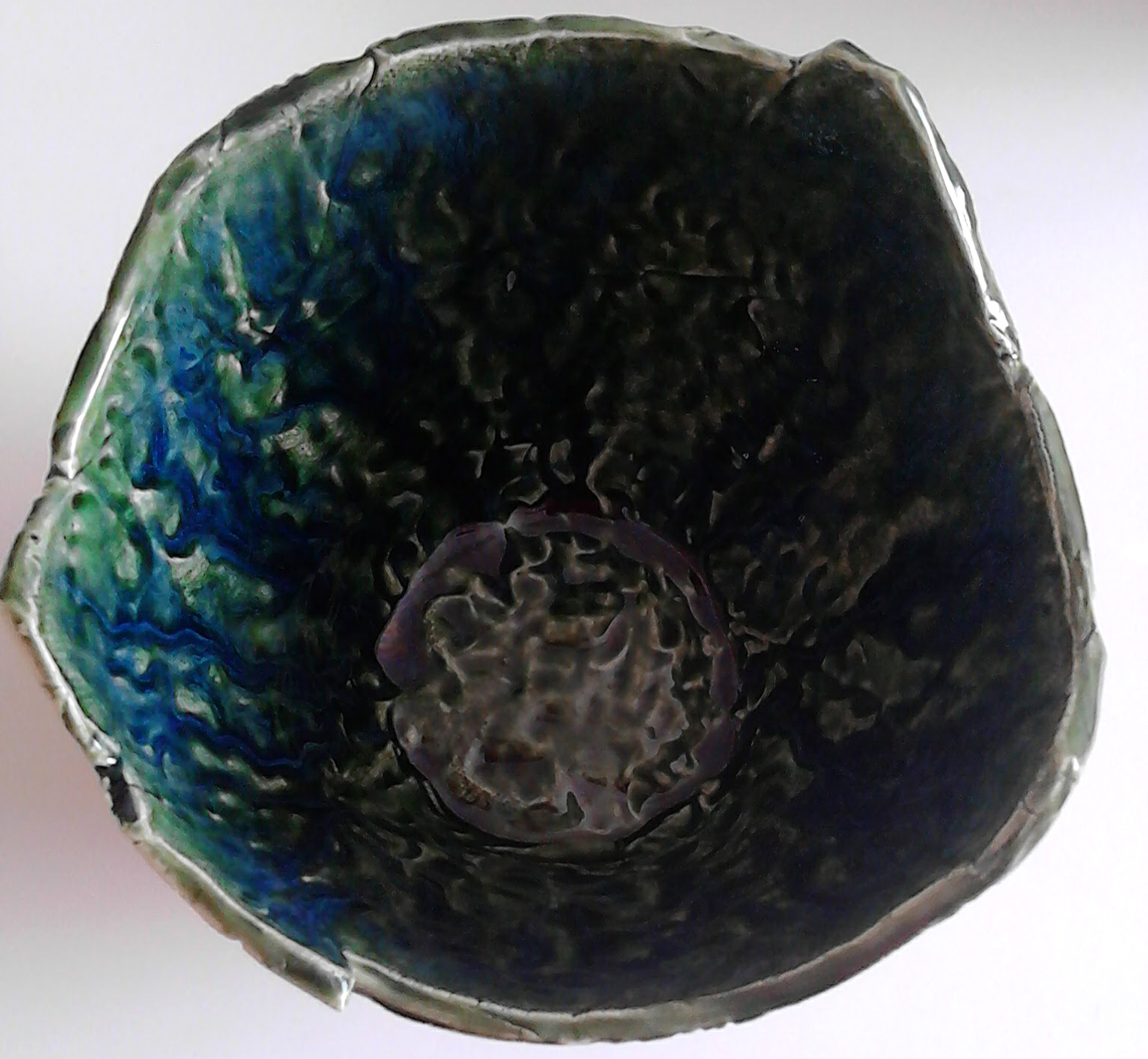
Another participant in the workshop has been getting beautiful results with several glazes mixing and running into each other when heated. Although there is the risk of the glazes running too much and a pot sticking to the kiln shelf when these glazes are used on the exterior of a pot, I was hoping that there would be no trouble if the glazes were used on the inside of the bowls. There were three glazes painted on the bowl interior: a base colour of green and then more random painting strokes of a particular blue and another green.


The extra swirling effect is caused by initial pressing of the clay when creating the bowls. It is the wild rose leaf bowl interior above and the fern bowl interior below.


The ferns presented a completely different pattern than the wild rose leaves, but again, there is lighter and darker lines reflecting the depth of the crevices which held the glaze. In each bowl there is also a subtle glaze under-pattern caused by the wrinkles in the cling film from the initial forming of the bowls.


Wednesday, 25 July 2018

Foliage bowls - Part 1

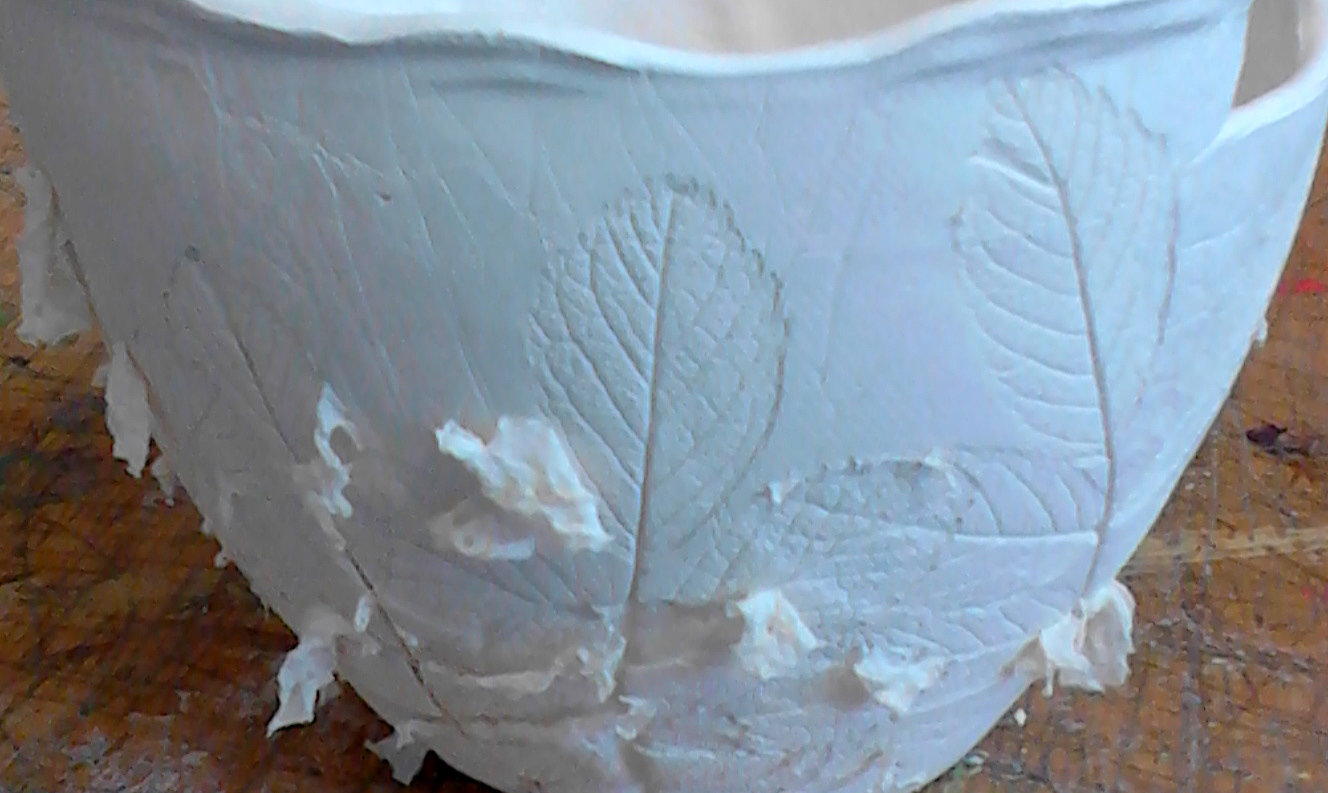
In the ceramics workshop at Signal Arts Centre in Bray, I decided to try out a new way of designing handbuilt bowls.  Still using the pudding bowls as formers (lined with cling film so that the clay doesn't stick to the bowl) I brought in ferns and wild rose leaves from my yard. I rolled out slabs and cut random shapes that I pressed into the bowl formers, which were also lined with the foliage.


My plan was that I would press the clay into the foliage hard enough that the patterns would remain once the foliage was removed. Though the bowls were free standing alreay, I wanted simple "feet" on them to increase the elegance of the finished bowl, lifting it from a table surface. The feet for both bowls were made simply from slabs that curved around the bottom of the bowls and joined with the scoring, slip and vinegar technique.


Both bowls have their feet, the ferrn bowl is upside down to show off it's foot.


Though the fern bowl's foot is slightly taller, the bowls are approximately the same size at 12 cm.


I carefully removed most of the foliage before putting the bowls in the bisque firing, but any that seemed too embedded was left to burn off in the kiln. This is the bisqued wild rose leaf bowl showing the fluff from the foliage that burnt off in the kiln. This fluff is easy to remove by blowing off or brushing off before glazing. I was thrilled at the detail from the foliage, which provided a great pattern. I immediately knew how it would be glazed -- details next post!