Wednesday, 27 April 2022

incognito 2022

Annually, for quite awhile now, I've participated in the annual fundraiser for The Jack and Jill Children's Foundation. I first got involved with the fundraisers for this charity in 2013 with The Big Egg Hunt Dublin. I blogged about the creation of my egg here, here, here, here, here, here and here. From the number of weeks it took to do that piece, it's understandable that artists could not make an annual committment, so it is with some relief that "incognito" took over. The premise is simple: the artist turn three cards into any type of art they choose and sign only on the back of the card, the artworks are all photographed and put on display for a uniform price, buyers are not aware of who made which piece until they've bought a piece and turned it over! All funds go directly to the charity and it continues to be able to do its good work. The artists are happy to donate their time and talent, the purchasers are happy to receive a piece of art for their monetary donation, and Jack and Jill is happy at the success of these fundraisers. It is a win-win situation for all involved!


Once again this year was a huge success! All works cost the uniform price of €65 and there were over 3000 works in total. Due to covid, the sale was online both this year and last year. This year the work was sold out in one day! Now that the sale has happened, my three collage cards are winging their ways to their new owners and I can show the work that I submitted. 

Last summer I was purging some shelves, including my magazine collection. However, before I recycled, I went through each magazine to save interesting pictures (colour, texture, etc) for use in future collages. During my residency at Signal Arts Centre last fall I made a number of collage cards for future use and created the small artworks, using the collage method, for my contribution to incognito 2022. I decided to use floral imagery and this is my collage representation of a section of my xmas cactus. I thought the background desert (from a magazine) was appropriate for this subject.


Again from a magazine, the background colour decided that I would make an image of an iris.


I liked the contrasting colours of the cave as a background for this wild rose.


I blogged about previous incognito fundraisers here and here (2021), here (2020), here (2019) and here (2017). I don't know why I didn't blog about 2018 but I did participate!

Wednesday, 20 April 2022

A Growing Enquiry at the RHA Gallagher Gallery, part 2

In last week's post I did an overview of this exhibition and spoke specifically about a few of the artists. As it is a large exhibition I thought I would mention a couple more of the artists.


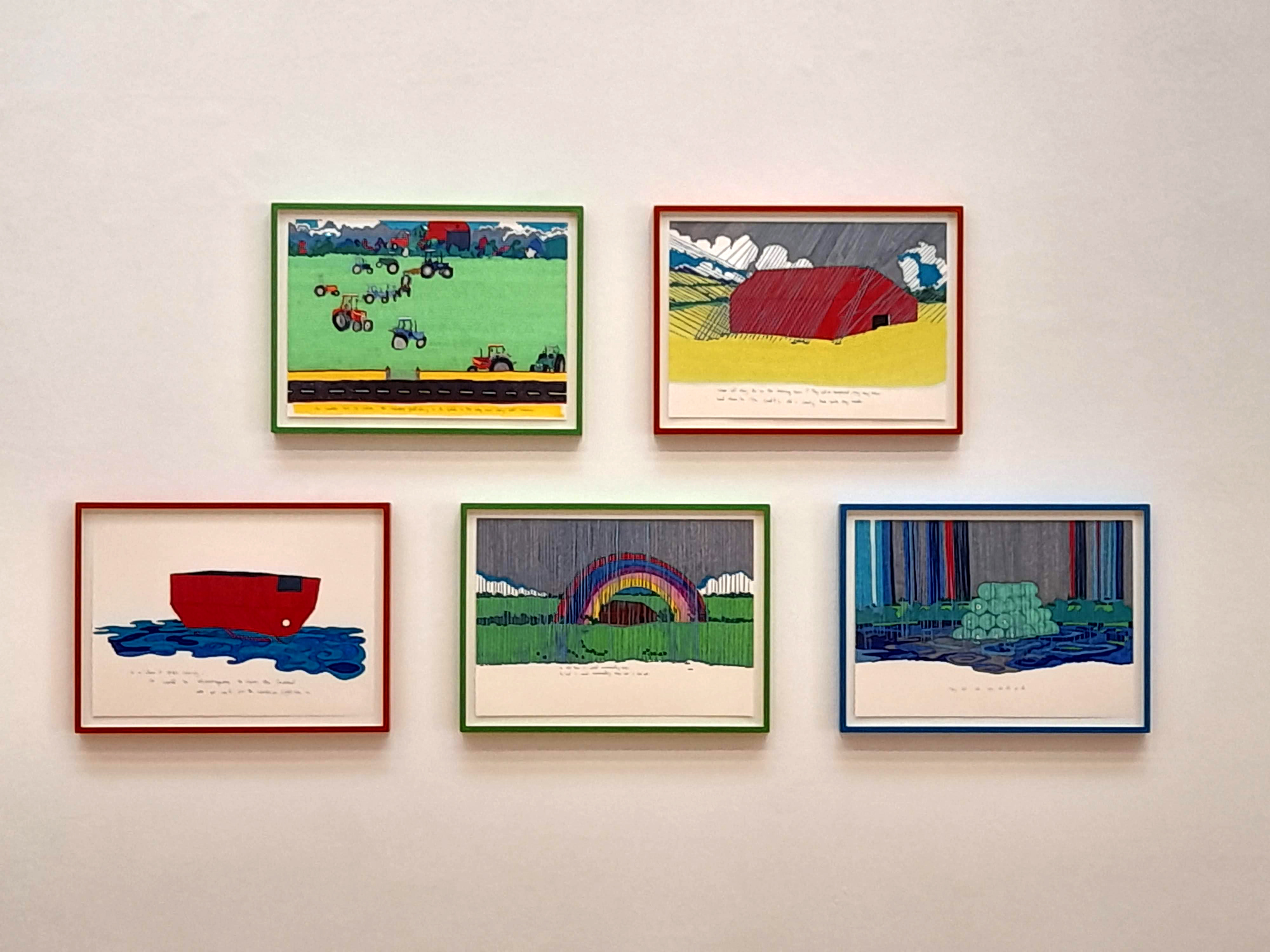
On entry to the gallery I could see Laura Fitzgerald's 2D works on the wall across the room and from that distance thought they were embroidered works - they seemed so fine and precise. But no these were not embroidery (though no less painstaking); they are certainly fine and precise, but these are witty drawings done with Sharpie pens! I looked at the accompanying didactics for this group and indeed the titles also are full of good humour: (clockwise from upper left) Restless Tractors, More Weather, but I do still care, Powerful People Promises and The Ark.


Here's a closeup of Restless Tractors.The back and forth drawing of the field with the Sharpie mimics plowing field and draws the viewer into both the making and the meaning of the work.


The panoramic landscape scroll A Mountain for Venice also has a witty didactic in which Fitzgerald details each item used in the work's creation - not just the material but where it was purchased and how (and in the case of the specific paper, how long it spent in customs before she finally received it!).


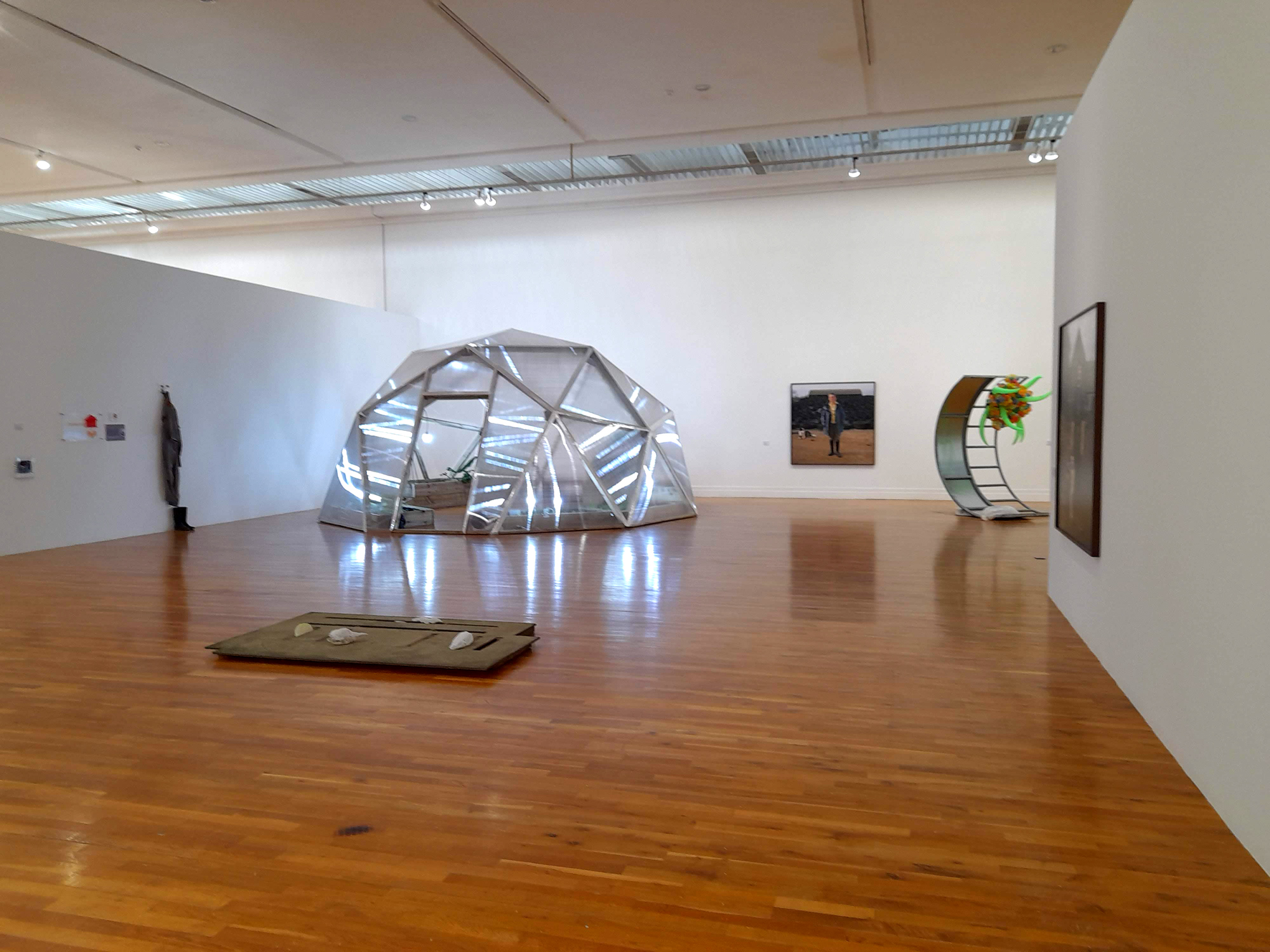
Jane Locke's Consumer Farmer (which could only be seen once one was fully in the gallery) is also a witty work with an eye to the future. I was especially looking forward to her contribution to the exhibition as I have experienced her work on several occasions in the past (and wrote about one in CIRCA Online here). Locke's installation comprises of a futuristic geodesic dome greenhouse where the plants are sparse but alive and well, a worksuit, which again seems futuristic as it has a farmer's patch on it very similar to what one might expect on a NASA spacesuit, and the product catalogue for the spring of 2123 full of Locke's beautiful drawings and surreal product descriptions.


The exhibition A Growing Enquiry - Art and Agriculture, Reconciling Values continues till April 24, 2022.

Wednesday, 13 April 2022

A Growing Enquiry at the RHA Gallagher Gallery, part 1

I was delighted to see, in person, the large group exhibiton, A Growing Enquiry - Art & Agriculture, Reconciling Values at the RHA Gallagher Gallery in Dublin recently.


The exhibition consisted of new installations by seven women artists - Miriam O'Connor, Laura Fitzgerald, Orla Barry, Katie Watchorn, Jane Locke, Maria McKinney and Anna Rackard. Two of these women (Barry and O'Connor) are farmers as well as artists, and Rackard's large photographs, portraits of women farmers, are scattered throughout the exhibition, certainly reminding the viewers that agriculture is NOT an exclusively male environment.


The exhibition, curated by Patrick T Murphy, responds to questions about how does one create value systems around art and agriculture.


The exhibition is impressive with its wit, artistic response and sheer scale. The didactics were a pleasure to read, giving insight into each artist's personal response to the enquiry and allowing the audience to enter into the dialogue.


The gallery is huge, which allows one to wander the space and engage with each installation (except Rackard's which appear throughout the space) as a separate entity.


There was also some overlap as I could hear the song/chant, which was part of Orla Barry's installation that was not immediately visible until one turned a corner in the gallery.


Barry's installation also included raw sheep wool and a large printout of an Aran knit sweater. Barry's work spoke of commodity, hierarchy, production and language as both the printout and cane crooks were embedded with words. The song itself was evocative.


The song, which was a collaboration with composer Paul Bradley, could be heard throughout the gallery, and the lyrics were written on rough wood - a mirror split of a tree adjoined to resemble the shape of a Celtic cross.


I'll talk about a few more of the artists and their work in next week's blog. A Growing Enquiry - Art & Agriculture, Reconciling Values runs till April 24.


Wednesday, 6 April 2022

magnolias

 I was walking around a neighbourhood in Dublin one day last week and was delighted to see a number of magnolia trees in bloom. It's definitely springtime. I had never actually seen magnolia trees until I moved to Ireland, though I was familiar with their existence from Billie Holiday's amazing song "Strange Fruit" (and I also enjoyed the Siouxsie and the Banshees post-punk cover in my youth). Since my move to this side of the world I have often seen these trees at this time of year and just love them.


What really surprised me in that neighbourhood though, was a magnolia hedge - something I had never encountered before.


In front of another house I saw a hedge that I almost identified as magnolia but then dubbed it an imposter as I thought the open blossoms were definitely not correct. I was wrong! When I got home I did a google search and discovered that this is simply a different species of magnolia with which I was unfamiliar. You really do learn something new every day!


I fully admit that I love magnolias and find them inspirational. There is a fabulous magnolia tree in the middle of town, in Bray, just down the street from where I lived for a few years. I did sketches of the tree and in 1999 my acrylic painting Magnolia (3' x4'//91.5 cm x 122 cm) was included in my exhibition Blessings. The painting was bought by my husband's uncle in the USA and is beautifully framed and residing in Iowa City.

Wednesday, 30 March 2022

The Map - exhibition at Rua Red Gallery, Tallaght

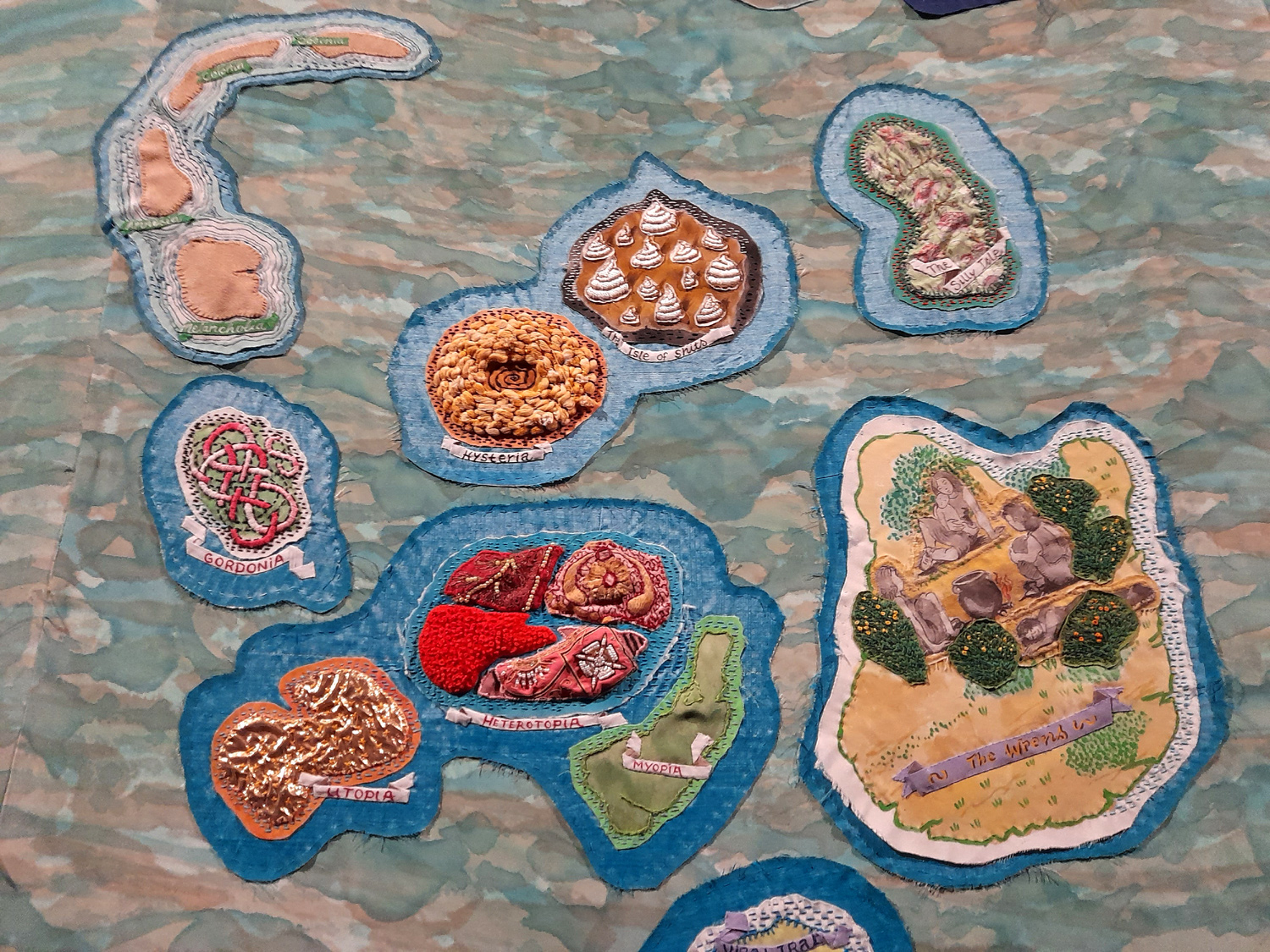
A couple of weeks ago I went to see The Map at Rua Red Gallery before it closed at the end of that week. The work was an enormous collaborative commission by Alice Maher and Rachel Fallon, in response to the "history and legacy of Mary Magdalen".


In Ireland any response can only be nuanced -- not only as the name of the female disciple of Jesus, but as a concept attached to the systemic abuse and incarceration of women, with the collusion of the church, since the founding of the State some hundred years ago. 


Thus Maher's and Fallon's response is politically, historically, as well as artistically charged. Using traditional concepts of "women's work" - needlework of all kinds (appliqué, embroidery, crochet, sewing skills) -- as well as paint and print, they created a huge work of art, a textile sculpture, using the language of cartography. 


There are islands, winds, constellations, flora and fauna in abundance throughout The Map and the details are exquisite.


There was a documentary video outside the gallery in which Fallon and Maher spoke of their collaboration as having its starting point in the banners they created a few years ago for the "Repeal the 8th" marches prior to the referendum regarding the 8th amendment (whereby a fetus had the same rights as a living being, making abortion criminal under any circumstances).


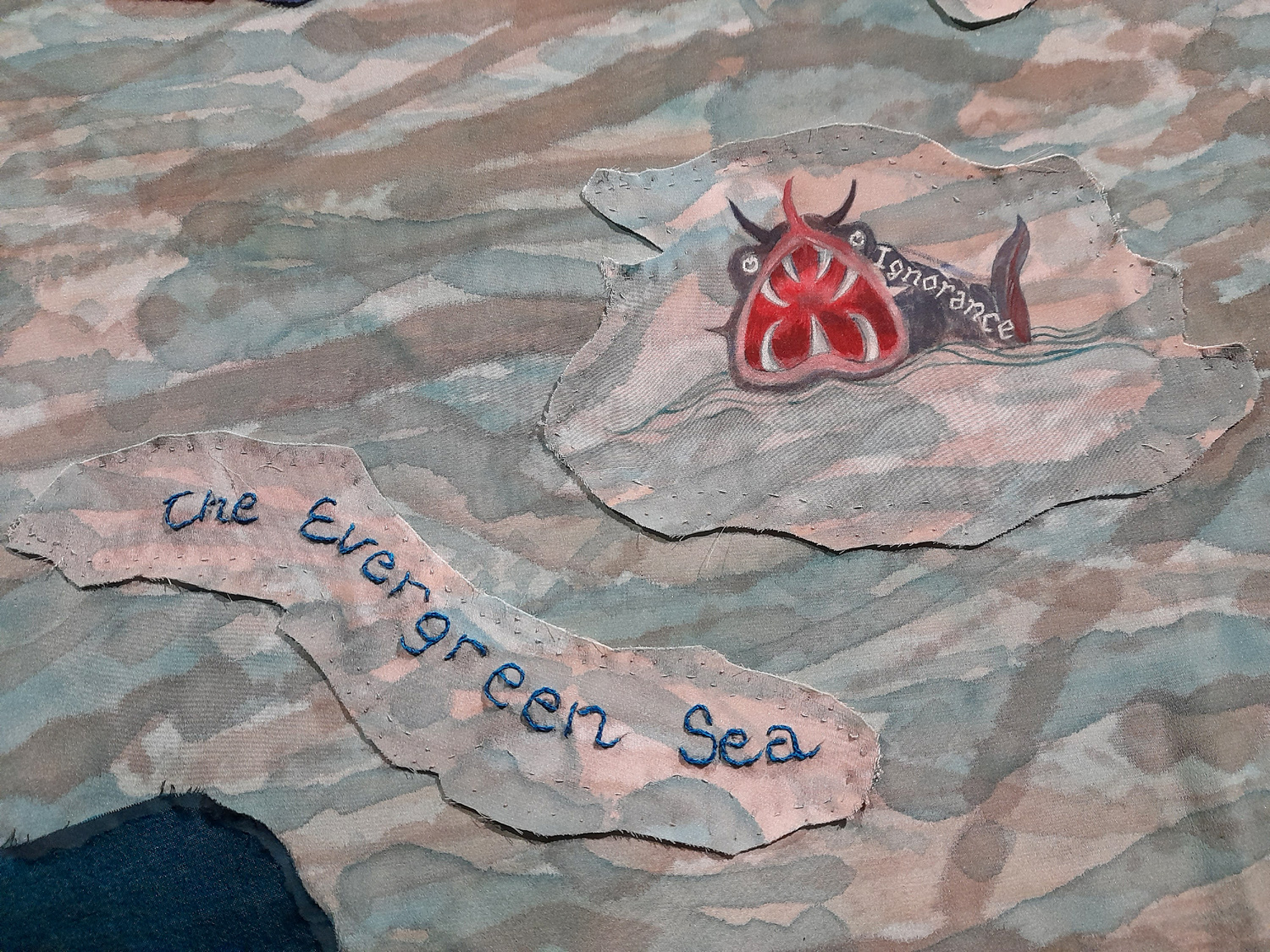
As with maps of old, various sea monsters roamed and Maher and Fallon used these as both witty and pointed decorative devices.


Each detail in The Map is important, so I found myself examining portions and trying to get a handle on it, while stepping back periodically to take in the whole view of this work full of wonder and awe!


As I am not tall, I couldn't quite see all the details at the top of the work. The only other way I could imagine it being displayed is on a huge table that I could walk around.


I agree with Maher's description of the work as one of "material culture" and I hope there is the opportunity to view it again.  I do think it belongs in one of the State collections - at the National Museum, National Gallery or the Irish Museum of Modern Art (IMMA). I hope someone has the foresight to see the importance of this work, both artistically and historically.


In gallery two was the accompanying aural work We Are The Map, an ekphrastic poem by Sinéad Gleeson with music composition by Stephen Shannon. It was both pleasant and enlightening to hear the writing wander through The Map after having seen it. In a darkened room, the aural hopping from island to island became a meditative experience as I was able to gain a fuller understanding of the imagery within the artwork. Of course, I appreciated the beautiful writing of Gleeson with whose work I am already familiar.


Wednesday, 23 March 2022

Cora Cummins and Saoirse Higgins at The LexIcon Gallery

 A couple of weeks ago I realised that I was running out of time to see an exhibition that had been on my radar for a few months! With the way these past two years have gone, at least I can forgive myself for losing track of time. But at least I got to see the exhibition at The LexIcon Gallery prior to its close. On Steady Ground/Unsteady Ground was a 2-person exhibition by Cora Cummins and Saoirse Higgins. While there was some collaboration in process discovery and prior to exhibiting work (as indicated in an artist talk by Cummins) the exhibition itself is not of collaborative work, rather work by two very individual artists.

Entering the gallery from the adjacent library, the viewer is brought face to face with a number of prints by Cora Cummins and the variation in scale - from tiny mezzotints to the multi-panel etching - is immediately apparent.


The common denominator between the works by the two artists seemed to be landscape and a concern for the environment. However, this is only a surface reading of the works as both artists are really addressing issues of isolation and responses to the pandemic seem to seep out of the works.


As I knew something of Cora Cummins prior to listening to her artist talk (via Zoom the week before I saw the exhibition) I was not surprised to find out that Cummins was also finding creativity from insurmountable grief (her husband died, far too young, several years ago). 


Even had I not known this, I would have looked at the fractured image in the multi-panelled print Monument as something more meaningful than simply the image of a mountain. Because of the artist talk I was aware that this labour-intensive piece subverted the whole point of printmaking itself - it was a unique piece and would always remain so:


Cummins, after printing those unique panels, used the copper plates to form the sculpture Fallen. Together the two works complement each other in a heartbreaking expression of sorrow and survival.


The space around each work allowed that necessary room to hold the emotionsal impact.


I thought, at first, that this wall hanging was another of Cummins's works, but the creator was Saoirse Higgins. It was a good bridging piece between her and Cummins's pieces. The central image had that feeling of landscape but its actuality could not be placed. Perhaps it was a detail? Within the larger cloth it took on several aspects of appearance and connotation: a shroud, a blanket and a screen. So any emotional reading was confused by a multiplicity of meaning.


And then one is drawn to the flickering video in the small room at the back of the gallery where the changing shoreline and racing clouds of timelapse are mesmerising. I was unable to attend Higgins's artist talk but from hints Cummins gave in her talk, I surmised that the landscape filme was of a remote island in the Orkneys where Higgins spent much time in isolation during the worst days of the pandemic.


At some point the video/film becomes multi-split-screen and, aside from the saturated blues of sea and sky, one is aware of the propellor movement from a small aircraft. Both Higgins's and Cummins's work deal with the passage of time and leave the viewer with a melancholic hope. I was glad I had the chance to view the work in this incarnation, at this venue.
 

Wednesday, 16 March 2022

Memory Is My Homeland at Rathfarnham Castle room 3: The Dining Room

 The third room of my exhibition at Rathfarnham Castle is accessed by walking across the back of The Saloon from The Pistol Loop Room and entering through the curved door. To see works related to this exhibition and in-progress, simply do a search for Memory Is My Homeland on this blog.

While it is furthest from the door that one has just entered, Kingswood is the largest piece in this room and being so colourful one tends to walk over to it first. 


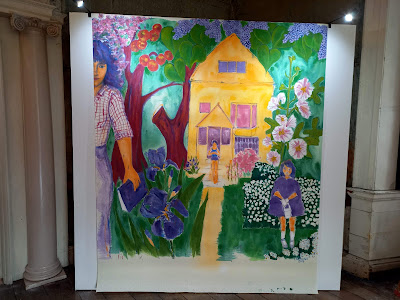
This is my representation of the house in Toronto that I grew up in, the three figures representing moments of my life: a young child stands on the front lawn by the hedge on her Communion Day, wearing the purple cape that her mother made for this occasion, a young teen reading and tanning on the steps (every summer for several years) and the young woman in her early 20s leaving home to start her life as an artist and writer. The house had much flora in the front yard, back yard and side garden. One of the lilac trees in the back yard was hit by lightning when I was a child so there was a stump that didn't flower, but the other side of the tree remained healthy. I didn't put everything in the picture but as much as I could... 


Moving away from the big picture, on a false wall of its own is Home. Although this piece is much earlier than the others (it was created in 2009) and began as part of another series of works, I thought it belonged with these works. The little icon is based on a drawing my child did, of my current home in Bray, when my child was about 6 years old.


Turning away from Kingswood and Home, one is attracted by the bay windows and the plasterwork on the ceiling. There are two false walls in niches to either side of the bay windows and these contain the last pieces in the exhibition.


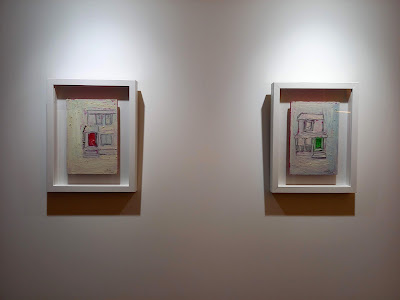
The House with the Red Door and The House with the Green Door are representations of the earliest homes of my life, in Cabbagetown, in Toronto's inner city. I actually remember a few things related to each house but mostly I differentiate them by the colour of their door. We moved from the former to the latter when I was 2 years old and my family moved from the latter when I was 4. The print Swing Chain, in the Pistol Loop Room, specifically relates to the low chain fencing separating the front lawn of The House with the Red Door from the footpath. I had remembered swinging on a chain fence as a toddler and thought this was a false and impossible memory until one day, as an adult, I passed this terrace of city housing while on the streetcar in Toronto and saw the low chain fences as they appeared in my memory! Cabbagetown got its name because in the late 1950s and early 1960s there was a huge wave of Irish immigrants who ended up living in this area (my parents and siblings among them).


The final piece in the show, Kingston Road: Waiting, is a representation of me in my twenties at my bachelor apartment in the upper beaches area of Toronto (West Scarborough), where I lived for several years. The curtains behind me are actual sheers that I had painted for an installation about HOME that I worked on while completing on my BFA at York University. I was, of course, waiting for my career and life to really begin. A few years after finishing uni, I moved to Ireland, where I had my first solo exhibition in Dublin at Temple Bar Gallery & Studios in the spring of 1989.