Showing posts with label pottery. Show all posts

Wednesday, 8 July 2020

draped slab dish - crackle white

Last week I blogged about the draped slab dish I had made and decided to glaze with a glaze I hadn't used before "crackle white". That blog can be seen here. When the dish came out of the kiln, it simply looked like it was glazed with solid white glaze (the underside had a clear glaze, so the terracotta clay showed through, as it does on the edges as can be seen in this photo).


To complete the crackle effect, some India ink and a paintbrush are necessary.


The ink is painted on the plate.


Make sure the whole plate is covered,


Using a damp cloth, wipe the plate


but if any spots are missed, the process can just be repeated.


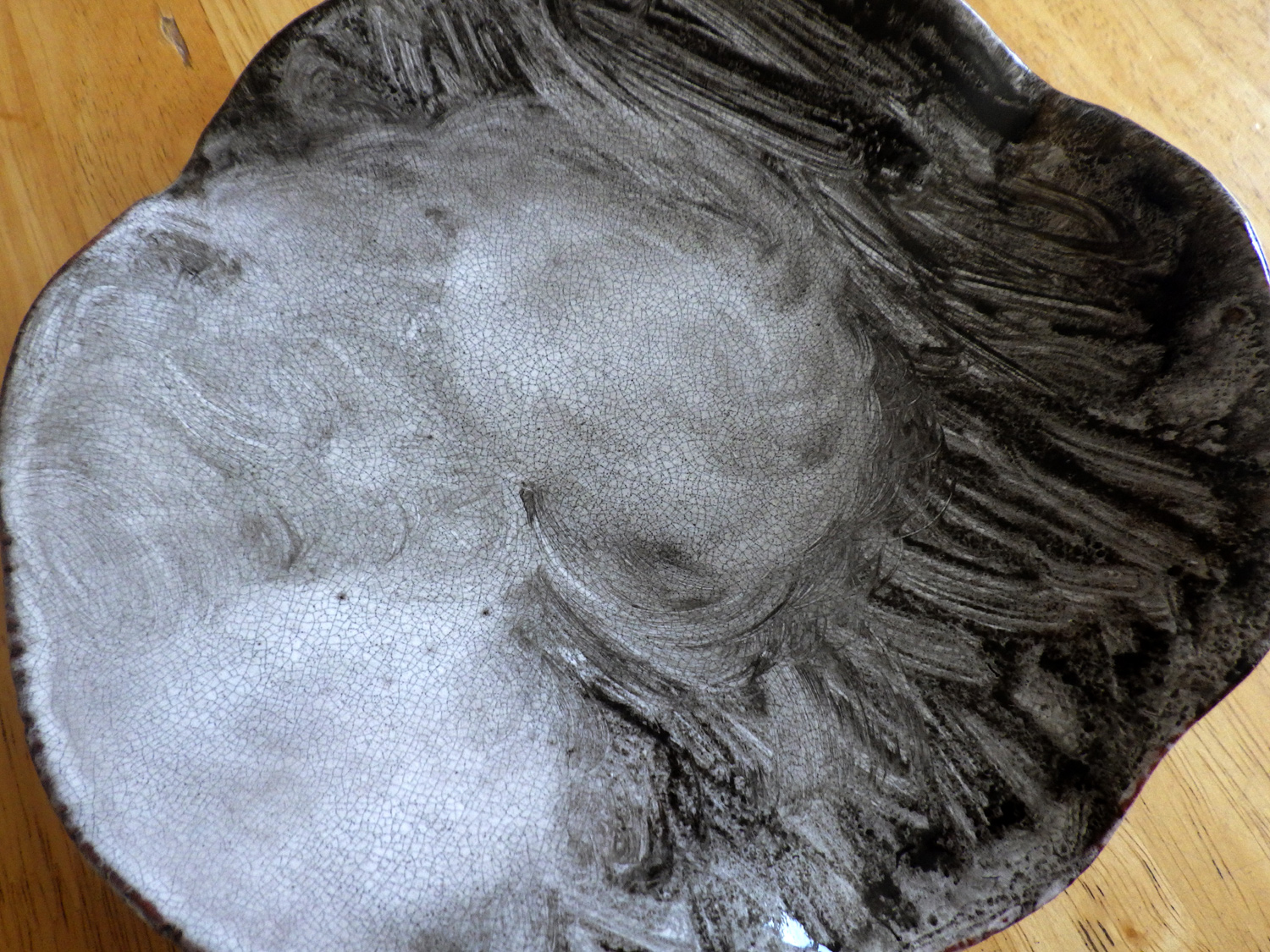
The finished plate has a lovely crackle effect on the white glaze.


Here is a detail of the crackle white on this dish!


Wednesday, 1 July 2020

draped slab dish - glazing

Of course it was all so long ago that I was at the ceramics workshop. Everything went into lockdown in March and while workshops haven't yet resumed, the facilitator returned, with other staff, to prepare the building for a return to activities in the coming weeks. This enabled loading the kiln a few times to fire pots that had been languishing on shelves for the past three months, including some of mine! 

For these terracotta draped slab dishes, I decided I would glaze the undersides with a clear glaze so that handling the finished dishes would not be a rough sensation.


I hadn't tried the crackle white glaze before but decided it was high time that I did! This glaze is a two-parter: the pot is glazed solidly with the one colour and then after firing India ink is rubbed in to produce the crackle effect.


It is not apparent, when the dishes are fired, that there is anything special about the glaze - it will just look white. This is the view from the kiln of one of the dishes.


The clear glaze on the underside makes for a smooth finish. Next week I will show what happens with the India ink and the crackle white glaze.


Wednesday, 29 January 2020

Draped slab ceramic serving dishes

In the late autumn last year I started making some draped slab serving dishes. My intention was to make them quickly and sell them at the xmas craft in December. Of course, things always take a bit longer than I expect, but they worked out fine. I had two formers, one of wood and the other of plaster, bowl-shaped and I overturned them in order to simply drape a slab over them, with a cling-film layer between the clay and the former.


I've been doing a new style of foot lately, in two pieces - two arcs making dishes "float" above a table surface.


I never took photos of how I attached the feet to the 2019 dishes, but I did for recent ones (note the date). After deciding where the clay arcs would be placed and tracing their outlines, the areas would be scored and slipped.


The feet are also scored and slipped, and after affixing to the dish, I lightly paddle them down (with a wooden paddle) in order to ensure that there is no air between the dish and the foot. This is usually apparent when some slip oozes from the joint.


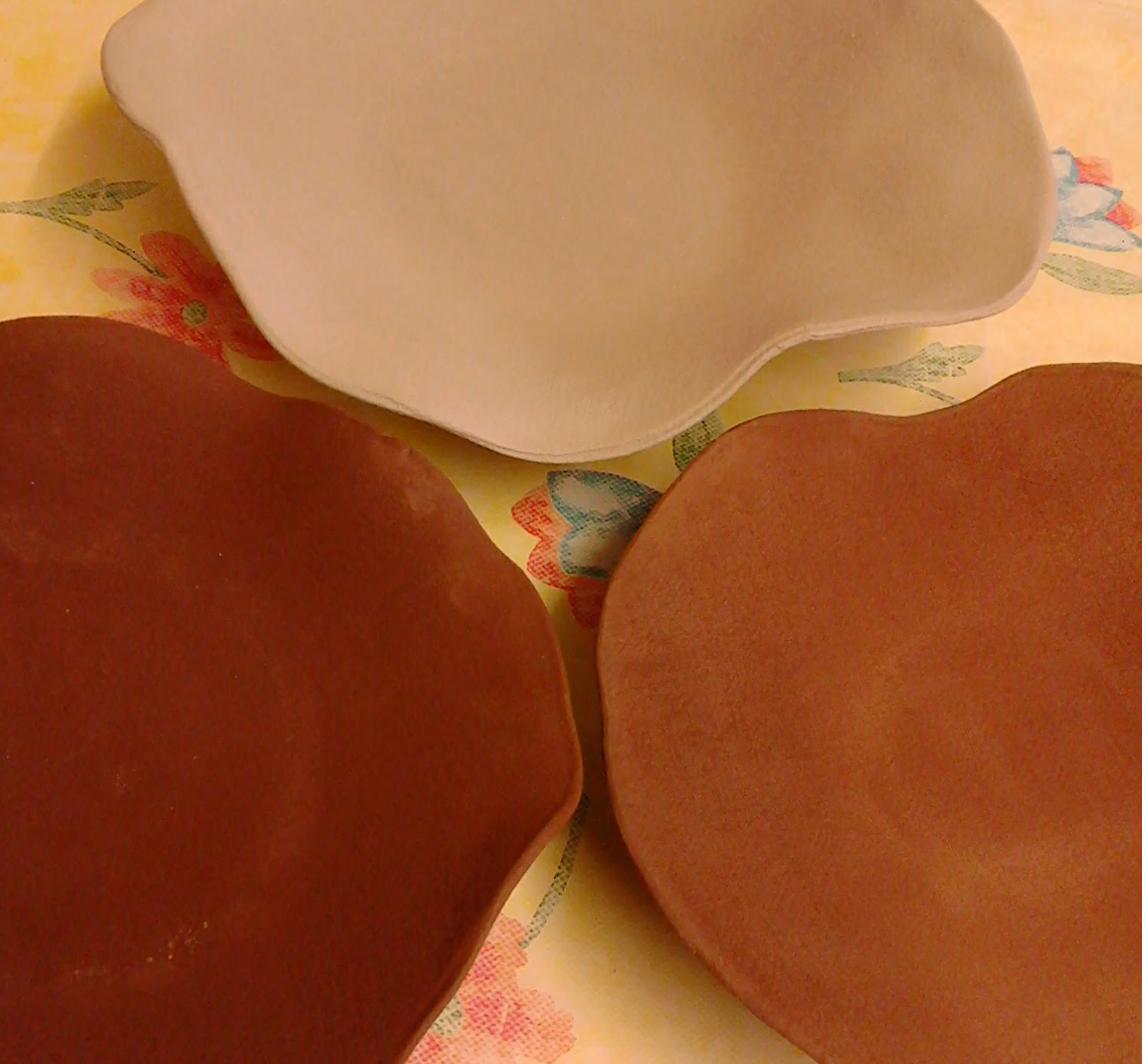
Dried and ready for the first firing, here are two terracotta and one white buff draped slab serving dishes.


After bisque firing the pots are ready to glaze. I decided to glaze the underside of the dishes so the texture when handling wouldn't feel abrasive.


Though this may look like only one glaze, there are actually three different glazes on the terracotta dishes: a base layer of cobalt blue with splashes of two runny glazes (aquamarine and sea green).


I had already witnessed these colours interacting in a lovely way, and was not disappointed.


Both dishes were bought within two days of being for sale, so again I was pleased.


While I made a draped slab dish from white buffclay, I later made two smaller dishes from grey buff. I decided, since I was including them in the xmas fair that I would glaze paint a holly design on them.


I forgot to take pictures of the finished grey dishes before they sold, but they had a white glaze underneath the holly. The white buff dish simply has a clear glaze underneath the holly design. This dish is larger than the grey ones and I'll see it again on my Christmas table setting!


Wednesday, 11 September 2019

Tulip bowls

In previous blogs I have described the making of bowls and plates through handbuilding, rather than throwing on the wheel. One of my main projects this year, in the ceramics workshop, is to create a dinnerware set. Details of the large and small plates of the dinnerware set can be found here, here, here, and here. Here are two of the bowls for the set after I put the feet on them, using two thin semi-circular slabs.


When the four bowls (it is a quartet tableware set) came out of the bisque fire, I drew the tulip designs directly on them with a pencil. I talk about the bowls and my plans for glazing here.


I started with glaze painting the flowers - two different colours of yellow.


I glaze painted the leaves and stems with "tropic green" a speckly green that I particularly like, but I painted a coat of "apple green" over the stems as I wanted them to vary from the leaves, but still have that nice speckle.


Since a glaze fire was announced, I worked at getting one bowl completely glazed. The background and inside of the bowl are glazed with the same "speckled turquoise" that are on the plates.


I was very happy with the firing results of the bowl! I found out that the tropic green is one of the runnier glazes and really liked that gravity pulled it down a bit to accentuate the terracotta lines. I also enjoy the random dripping into the stem from the leaves.


Here is another view of the first finished tulip bowl. The "speckled turquoise" is a consistently beautiful colour and the interior of the bowl is very smooth.


Another view of the finished bowl! Once I finish glazing the other three bowls, I will start work on 4 mugs to complete the dinnerware set.


Wednesday, 10 July 2019

raku bowl decoration

The end of June raku event was a lot of fun and exciting. If you didn't see the post last week, you can check it out here. I focussed more on the process in that post, but now I will discuss the two bowls I made specifically with raku in mind. Both bowls are handbuilt in low-fire white clay. You can see the herringbone pattern left on the clay from the tea towel on which I rolled it. I like this effect (some tea towels have deeper patterns than others). On this, the larger bowl of my two, I pre-glazed areas in red and white and left other areas that I expected to go black in the "smoker". The black pattern on this was created with a feather, but I was disappointed that the "smoker" did not do its job - the lower area of the bowl should have been black.


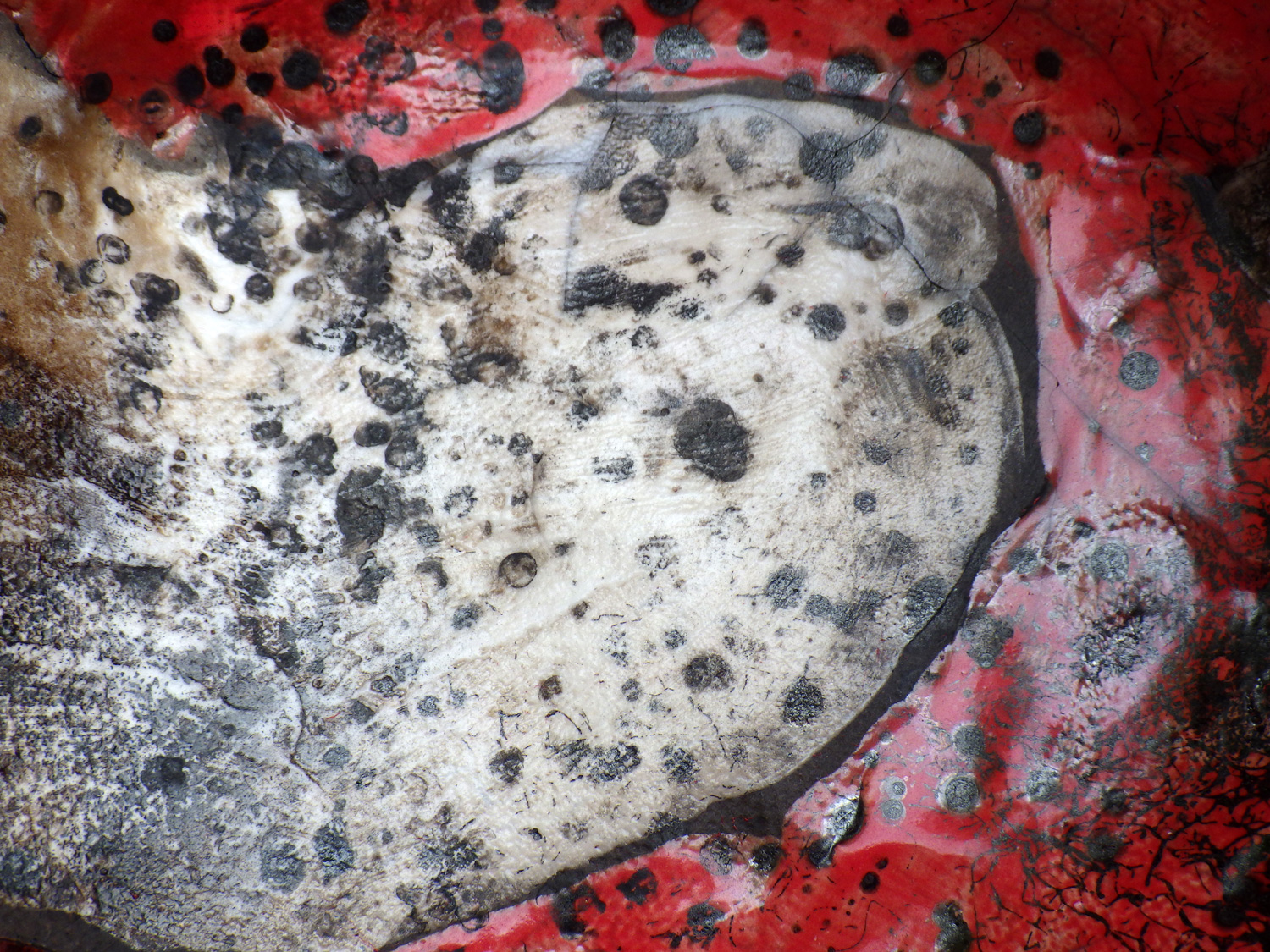
On the inside of the bowl I threw large clumps of my offspring's thick, straight hair. I also threw sugar, which burned and created the black spots. There was some crackling in the glaze that allowed some dark lines from the bowl's time in the "smoker".


After a light scour with water and a scouring pad, the applied textures (sugar and hair) look more satisfying.


On the suggestion of another woman at the raku event, I painted on some India ink to areas that I wanted blacker. I was much happier with these results and it also made some of the crackling lines in the glazes more apparent.


The smaller bowl had been pre-glazed with red, white, yellow, and clear areas of glaze, again leaving large areas that I expected to turn black in the "smoker".


After I painted some India ink in areas that I wanted to be black, I was happier with the contrasts in the bowl's decoration.


I used hair that I had been collecting from my hairbrush before the event in order to get these fine and squiggly lines. I had tried a few other techniques on this bowl (a mini "smoker" using pine needles, dried lavender) but they did not produce any results. The point of raku is to be open to experimentation and chance, but if the results can be altered by India ink (or anything else!) I am quite open to that too!


Wednesday, 3 July 2019

Summer raku event!

In the ceramics workshop last week, I glazed two handbuilt bowls in preparation for the summer raku event that took place a few days ago. The patchwork design of the bowls simplified the glazing with several different colours (red, white, yellow, and clear) and leaving areas to go darker in the "smoker".


There was lots of excitement among the participants (there were five of us) on the day. We had lots of sunshine and prepared a delicious potluck lunch to coincide with the event while the first firing was on. When ready, the facilitator demonstrated decoration techniques. Water spritzed on the hot pot would cause more crackling in the glaze as it cooled.


Feathers and other dry materials could be carefully applied (don't touch the hot pot!) to glazed areas of the pots.


Even sugar could be randomly sprinkled on the pot. It would ignite and carmelise on contact with the pot, and leave dark brown or black flecks. Pots could either be decorated first and then put in the "smoker" or just simply put in the "smoker". The "smoker" is a bin full of shredded paper (or other flammable material) that ignites when the hot pots are put in it. The lid of the bin is put on immediately and the fire goes out, filling the bin with smoke. Unglazed areas of pots become black in the "smoker" and the crackling of glazes produces gorgeous black lines.


When pots are removed from the "smoker" they are dunked in water to cool off. It does not take long for them to cool enough to handle.


We were all delighted with the results of two raku firings at the afternoon event!


Wednesday, 8 May 2019

Handbuilt tableware set, ps - part 4 of 3...

This is the last of the four large terracotta plates for the tableware set, it didn't make it into the previous glaze firing. One thing I realised when the others came out was that I had to apply a clear glaze on the lines between colours. The raw terracotta lines looked great but would not be useful if I was going to use the plates for dinnerware, which I am! So with the already fired plates, I just had to apply some clear glaze and re-fire. With this plate I could apply the clear glaze before going into the kiln, thereby doing the glazing in one step (as it should be).


Wednesday, 1 May 2019

Handbuiilt tableware set, part 3 of 3

I was delighted when the first five plates came out of the glaze fire.  


The colours of the glazes were as I had hoped and planned. The lighting with my husband's camera is very true (he is the workshop facilitator and always takes pictures of each kiln shelf as he unloads a firing).


Though there is a yellow tinge to pictures taken with my camera phone, the closeups show the linework


and glaze textures on the plates.


These closeups also show the individual designs of each plate and the different lighting


makes it apparent that there is also a texture on the plates, from the initial rolling of the terracotta.


The clay was rolled out between two cotton cloths with a herringbone pattern, and though this is subtle, it is quite lovely.