Showing posts with label Fabriano paper. Show all posts

Wednesday, 12 December 2018

Signal Studio - winding down

At the end of the seventh week in the studio, I finally finished my paintings. I was able to sign the larger one below a bit of scrim on the front, but for the smaller paintings I just signed the back as it would be impossible to paint my signature on the heavy texture which covered the canvas.


On the Monday of week 8, I used the last piece of grey paper on which I had been doing pastel drawings. Though I could have brought more of that paper in, I decided that it was a good time for me to refocus. Besides, all the pastels needed a spray of fixative - so I did this at the end of each day before I left.


I took down all my reference photos and pastel drawings and hung up the finished paintings (and the canvas on the right, which had not been painted!).


During the final three weeks I decided to stick to my routine of at least having three things that I would focus on daily. I continued doing a self-portrait in the morning and started a series of tiny watercolour pencil drawings. I had a small pad of Strathmore watercolour paper postcards.


I was thinking of doing a series of drawings where I would use an eraser to draw on a ground of graphite. However, the toothy Fabriano paper I was using did not allow for a solidly dark ground and made it impossible to erase back to white. Though I was happy with the final drawing of persimmons, I decided not to continue with a series at this time.


Instead, I decided my time would be better served by doing sketches for possible lino block prints -- a projected series for 2019. In order to get started, I taped several sheets of paper to each drawing board.


For the most part, I fitted two to-size drawings on each page. I realise that the more detail that is in the initial drawing, the more successful will be the final print. I am looking forward to continuing this work in the coming year.


Wednesday, 8 November 2017

Sticks - accordion book

I conceived of "Sticks" as a simple accordion book for a single, long format intaglio print with ceramic covers. The print is a horizontal image of sticks based on some sketches I had done of wood debris floating in the Glencullen River in Knocksink Wood.


I had created a unique protype, "Shinrinyoku", of this image as an accordion book in June. I made the prototype to figure out how an accordion book could work, using handmade paper for the drawing and for the covers.


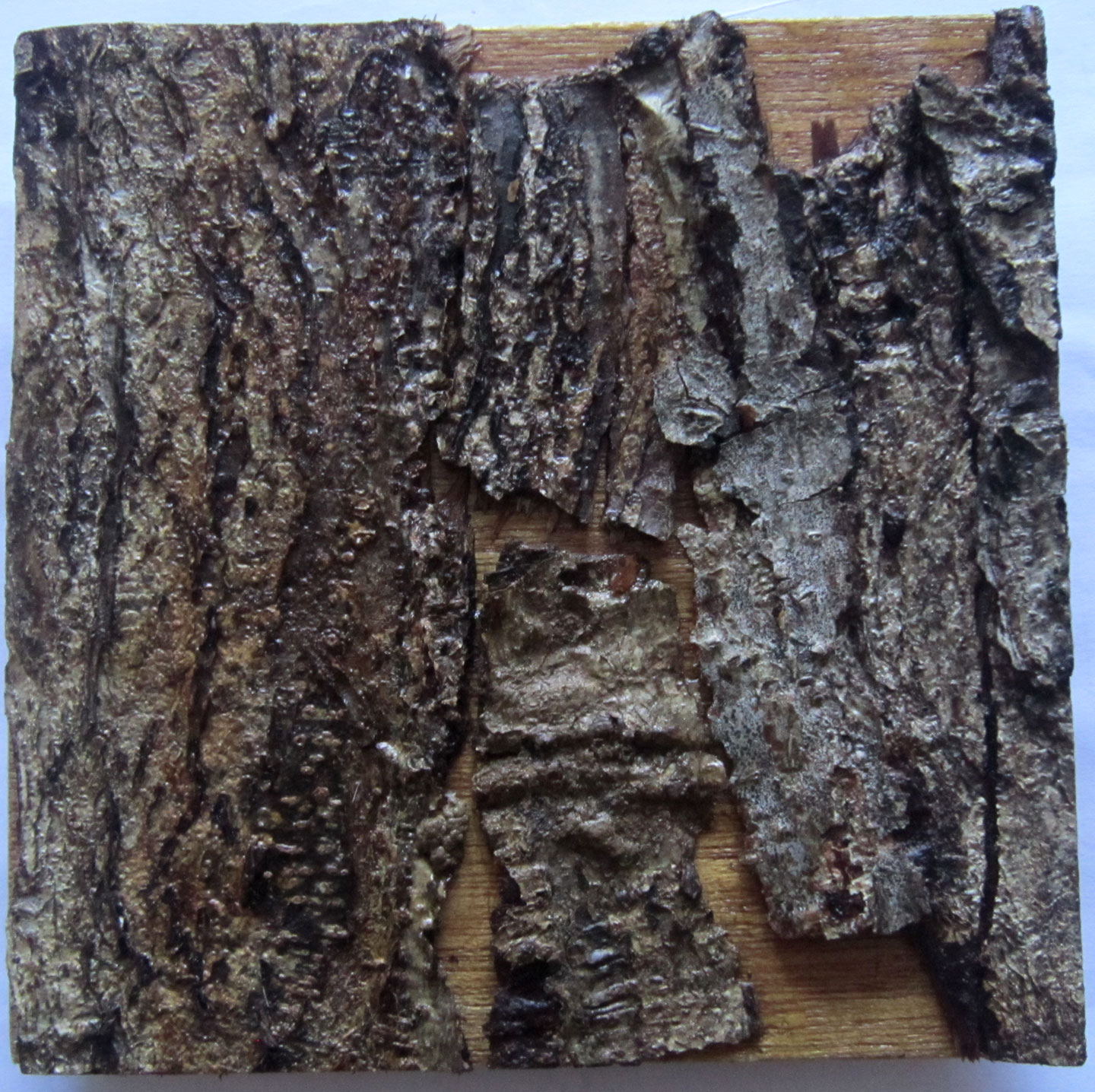
Because I wanted the front cover of the "Sticks" book to have some relationship to the future intaglio print, I created a bark stamp that could be pressed into the clay slabs that would be my book's front covers


The stamp itself was simply made from some scrap wood and the bark affixed to the front of the stamp with pva glue.


Although I coated the entire stamp to seal it, when using it on the clay it worked better to have a layer of cling film (Saran wrap) between the stamp and the clay slab. For the back covers, I simply used a rubber stamp kit to press my name in the clay slabs.


I was doing an edition of ten books, so needed 10 final intaglio prints of the image. I have detailed how I converted a pasta machine into a flatbed press in a previous blog (here). The small prints created using this press are only limited in size in one direction (in this case the length is shorter than the width). The prints are on Khadi 100% acid free handmade Indian rag paper.


When the prints were ready I did a general layout of how I would like the completely open book to appear, with both the front and back covers visible. This would give me an idea of how to fold the book.


Or rather, giving my trusty assistant the idea of how to make the folds (I fully recognise that my husband tends to measure more accurately than I!).


The prints were affixed to the background of Fabriano with pva, along the top only, prior to making the folds.


Components ready to be turned into books!


A view of the back of the accordion book.


A view of the front of "Sticks".


Wednesday, 1 November 2017

Ghost - accordion book

I conceived of the book Ghost as a complex accordion book vehicle for a series of  prints that utilised the blind embossing print technique (i.e., embossing with no ink or colour added). I have shown images of this technique and the prints on a previous blog a few weeks ago (Oct 4 2017) and full details of how to convert a pasta machine to a small printing press on Sept 20 2017. The main  thing was to methodically go through all the steps in creating the book once I had the prints done. I started with the cover, which is made from heavy weight 100% acid free blotting paper with the title stitched using white embroidery thread (6 strand cotton).


After designing the lettering I used a heavy card template, first poking the holes in it, and then poking through those holes to the blotting paper cover below. Pre-holing the covers made for easy stitching.


Here are several of the covers prior to stitching.


As there were five prints to accommodate, my book required a long background page for folding. I realised I needed to glue two pieces of the Fabriano paper together to create the required length.


Lots of measuring and use of my trusty bone folder!


An accordion page.


I made a clear general layout before going near any pva glue!


I had already glued (pva) squares of thin acid free paper to the front and back covers and weighted them overnight so that they were affixed firmly. I wasn't taking any chances with trying to glue my accordion page to blotting paper covers. The half ends of the accordion page were firmly affixed to the covers via the paper already on the cover.


The Fabriano paper has a front and a back, so where the company sticker was already on the back I left it and marked other pages lightly with a soft pencil. When the book was complete I removed all stickers and gently erased all markings.


Here the books are all together, with the blind embossed prints waiting to be affixed to their ordered part of the accordion.


The finished book with all the prints affixed to their pages.


Wednesday, 11 October 2017

Lithography workshop

It is probably becoming fairly obvious that my interest in printmaking techniques has become very pronounced over the past two years. When I heard about a weekend lithography workshop at Blackchurch Print Studio in Dublin, about two months ago, I was quick to sign up for it. Lo and behold, the time flew and the workshop, led by Alison Pilkington, took place last weekend. 


There were only four of us taking the workshop, so it was quite intense. I had brought some sketches of things I had been working on, and spent Saturday morning developing these sketches on a larger scale.


I had another look at my branches images, but decided on beachstones for the litho stone.


Saturday afternoon was spent drawing on the litho stone with a variety of litho crayons and then painting on tucshe in specific areas. For the small stones, I applied the tusche by flicking so that their texture would be totally different from the surrounding linework. Unfortunately I was too busy working, and did not have a camera with me anyhow, to take pictures of the stone in progress. On Sunday morning there were a few applications of nitric acid in gum arabic on the tusche areas and in the afternoon I printed up an edition of four on beautiful Fabriano paper. It was an exhausting but invigorating day!


Wednesday, 27 September 2017

Encaustic


 In the early 1980s, I was doing some experiments with wax in both painting and drawing. I was not doing anything methodical, so I can't exactly say I was working with encaustic painting, but my own experiments led me to some knowledge of the technique and curiosity about it that has stayed with me over the years. This piece from 1983 is paint, collage and paraffin on paper.


This piece, also from 1983 I think, is collage and wax paper on board. The image of the hand, as a metonym for a person, is relevant to the embossed prints I am doing now for my book "Ghost".


So when I read about an introduction to encaustic painting workshop being facilitated by Joanna Kidney at Outpost Studios here in Bray I jumped at the chance to attend. Lucky for me I secured the last place on the intimate workshop, and had a nice stroll across the park last Sunday morning to Outpost Studios. After an introduction to the technique, Joanna offered the participants a choice of wooden blocks to use as mounts for our workpieces that would allow us to learn a variety of techniques. 

As a starter, I chose a fairly small piece of wood and thinking of The Skipping Project, used the form of two jumping feet with which to experiment. After a quick sanding of the sides, we applied a clear layer of beeswax mix, and then two layers of whitened beeswax mix. After any layer of beeswax (coloured or clear), the block must be heated to fuse the wax to the layer below. For the first block we used a variety of tools to scrape, incise, carve, etc. the block in between applying colours (in heated wax). There was also a good supply of fat oilsticks, oil pastels, and a hot wax drawing tool to use in conjunction with the pre-mixed paints (with various sizes of brushes) warming on the hot surface of a flat type of "griddle". Joanna pointed out that an important tool to have is a specialty flat thermometer on the griddle to ensure that the wax paint does not overheat and fume, as this can be quite toxic.


In the afternoon, with another block, we learned about collage techniques for embedding objects and images (in my piece below there is a pictue of two rocks, wool, thread, and cous cous). We also learned how to transfer an image from a photocopy or print out directly onto the wax; in my case below I transferred the image of some pebbles from a colour photocopy of a photograph I took, as reference for the Stones book of prints that I am making.


In the afternoon of the workshop, Joanna also gave a demonstration of monoprinting in encaustic. A space was cleared on the griddle and one could brush on paint or draw with oil pastels or oil sticks (the drawing/painting melting on the warm griddle) and there were a variety of papers to choose from to experiment with how the different grounds interacted with the wax, also depending on which wax medium was used!

This is Fabriano paper as a ground for a mix of brush work and oil pastel drawing.


Again, a mix of brushwork and oil pastel for my "Dreamboat" image, but pulling the card away from the griddle leaves a pattern.


I only added a bit more wax colour to this rice paper Dreamboat.


I was thinking of Fort Carré when I brushed out this simple image of light and dark on Fabriano paper. The turquoise was drawn with oil pastel.


What a fabulous day for creative play with an interesting medium and a wonderful facilitator!


Wednesday, 31 May 2017

Preparations...

While I am busy working on the new painting, I am also doing the background preparations for the Sticks n' Stones books I am planning to make in the next few months. I have mentioned this project before: companion books - an accordion book and a stick book. I definitely needed some paper for printing and was delighted to be able to order some Fabriano and Indian rag online from Evans Art Supplies. Along with some other supplies, the items were delivered to me in two days. I was impressed by the careful packing (in fact, extricating the paper packs was a bit Fort Knox-ian!). 


I knew some adjustments had to be made in my pasta machine printer in order for it to handle a long intaglio plate (800 micron acetate). Because of the base on the machine, and the shape of the table it would be clamped to, only a small rectangle plate could be used, so I imagined the base would have to be cut so that it hovered above the floor from a height - a long plate could then go through the machine. The birds eye view shows that the printing plate can go through the press vertically and there is about 3 feet distance to the floor -- plenty of room to accommodate a long plate (though my print won't be THAT long!).


However, and thrillingly so, the base was removable/adjustable such that it could be turned around and hover over the floor without having to make any cutting changes. I just need to use an extra clamp for balance an security. The side view shows how the machine will cantilever from the table.


Wednesday, 5 April 2017

Intaglio and Chine collé printing

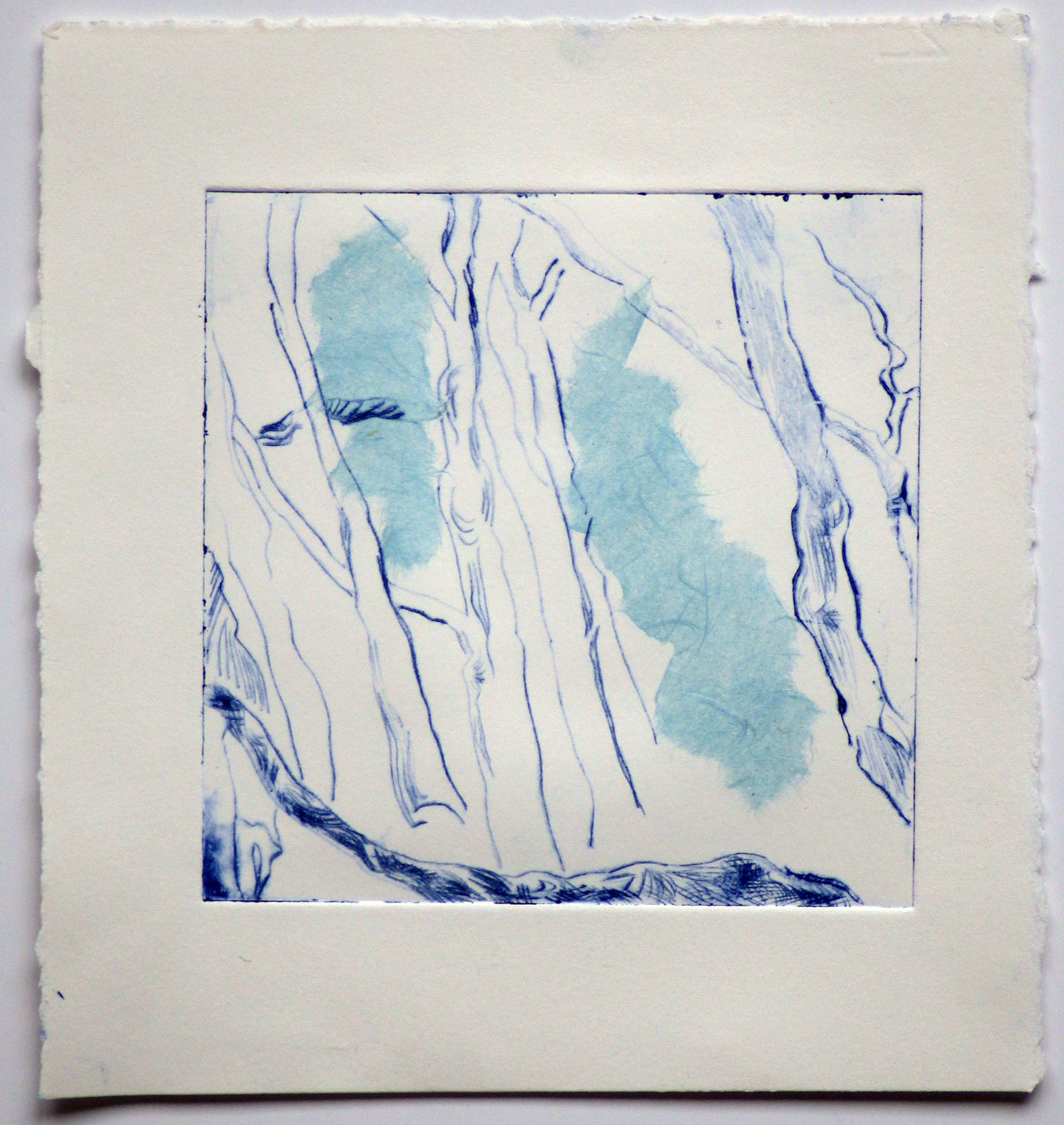
I was out early on Sunday to head into the National Print Museum in Dublin in order to attend a printmaking workshop given by artist Elaine Leader. I signed up for this workshop because the technique of "Chine collé" was featured and I have been curious about this technique since I became aware of it about 20 years ago (I had never heard of it in printmaking classes I had in art school in Toronto). To start the day we were given some pieces of thin plastic (or thick acetate?) referred to as "axpet" (which I had also never come across before). Once I removed protective film from the axpet I could use it as a plate to do an intaglio sketch on. My tool of choice (we had our pick of several  etching tools) was a converted large sharpened nail. I ended up with two plates, the first one, done in the morning a city ruin sketch and the second, done in the afternoon based on one of my stick sketches.


The plate was inked with a dark ink, cleaned and then given a "roll-out" layer of translucent colour. For the Chine collé I ripped two random pieces of a light weight handmade paper. Wallpaper paste is thinly spread on the back of the paper and they must be placed upside down on the plate (so that the glue will adhere to the print paper). The Chine collé is the last thing to do before going to the press as the paste must be very thin and thus can dry out quickly -- make sure your paper has been removed from its water bath and blotted before you prepare the Chine collé paper!


We were printing on lovely Fabriano paper, so it needed to be in the water bath at least 10 minutes before blotting.


This is a close-up of the sticks print, with two pieces of Chine collé.


 Although I had the sticks plate ready to go, Elaine Leader was talking about the embossing technique, and I wanted to quickly try it out. I cut several pieces of sandpaper into "natural" shapes, got my paper ready, and at the press itself, placed the shapes onto the back of my first piece of axpet. A piece of tissue paper is placed between the plate with shapes and the paper, which keeps the paper clean (and in my case, it was a great barrier between the paper and rough sandpaper I was using for incredible texture).


I was thrilled with the way the embossing worked and wanted to see if Chine collé could be worked with it, so I started the process again. 


I thought the workshop was fabulous! I learned so many things in such a short space of time and can now think about how these processes can be used in other works.