Showing posts with label oilstick. Show all posts

Wednesday, 12 April 2023

Rooftop archive 11 late 1990s

For previous posts from the so-called "rooftop archive" look at the most recent here, which gives links to all the others.

In the late 1990s there was a major fire at a printing company near to where one of my sisters lived. She told me that there was a big skip outside the establishment and reams of paper were being thrown into it. My husband (also an artist) and I drove over to check things out and came away with an abundance of grey heavy stock card, 88 cm x 50 cm, and large sheets of all-purpose cardboard. Because of this supply windfall, I felt very free to sketch on a large scale. In 1998 I had an exhibition planned for the following year, but was still unsure of what a new body of work would look like. I was fondly remembering my time living in rural Kerry, which had come to an end in the fall of 1996. One of the most amazing memories of this rural time was my sighting of Comet Hyakutake from the field in front of my house, Knockeen. On a clear night the stars in Kerry were magnificent. 


I must apolise for the sheen on these drawing/paintings, I was using gloss medium to thin the acrylic. I gessoed the grey card first and worked in thin layers of colour to build up a certain (unphotographable!) luminosity. In front of the house, there was a gate leading to a large field beyond and it was from this field that I viewed the comet above the outbuilding ruins beside my house.


I thought the gate itself was an important image and began combining it with other familiar imagery from my work. The figure here was the outline of a life size cut out I had made of my body using the all-purpose cardboard.


Again, this is an example of how I was combining past imagery with the image of the gate (which for me echoed the trellis that had appeared in earlier paintings and drawings).
 

Once I had started using flowers in my work, however, there was no stopping me. Grounding the heavy card with gesso, I decided to do some drawing with oilstick and graphite -- a combination that I still enjoy. I realised how much I like drawing and painting flowers and decided that this would be the subject of my next exhibition. I suspect that due to the size of this piece I could not afford the framing so it did not make it into Blessings, which showed first at Signal Arts Centre, Bray, in 1999 and then Cavan County Museum, Ballyjamesduff, in 2000.


The exhibition Blessings consisted of large acrylic paintings on canvas, medium sized oilstick & graphite drawings on paper and very small monoprints of both wild and cultivated flowers. This is an oilstick & graphite drawing from that exhibition. “Honeysuckle”, 43 cm x 37 cm, 1999, is framed and hanging on the wall in my bedroom.


Wednesday, 22 March 2023

Rooftop archive 9 - early 1990s

Yes, this rooftop archive is pretty big, but it has served a purpose to go through everything that was there taking measurements and photographing past work, and best of all PURGING work that I don't need hanging around to haunt me! I have recently blogged about the archive (installments 7 and 8) here and here. In installment 6 - here - I have also given links to all the previous installments.

As this piece is undated, I am relying on memory and circumstances to suggest that it was either from 1989 or 1990. It was created after my first solo exhibition in Dublin while I was living with my parents in Bray. It is of course based on dream imagery except for the crazy complicated lightning bolts – lightning configurations that I actually saw during a storm in Ontario  in the 1980s! This untitled work hung on my Mum’s bedroom wall (which had been my room when I lived there) for many years and was returned to me after her death in 2016. This untitled, mixed media work is 157 cm x 150 cm.


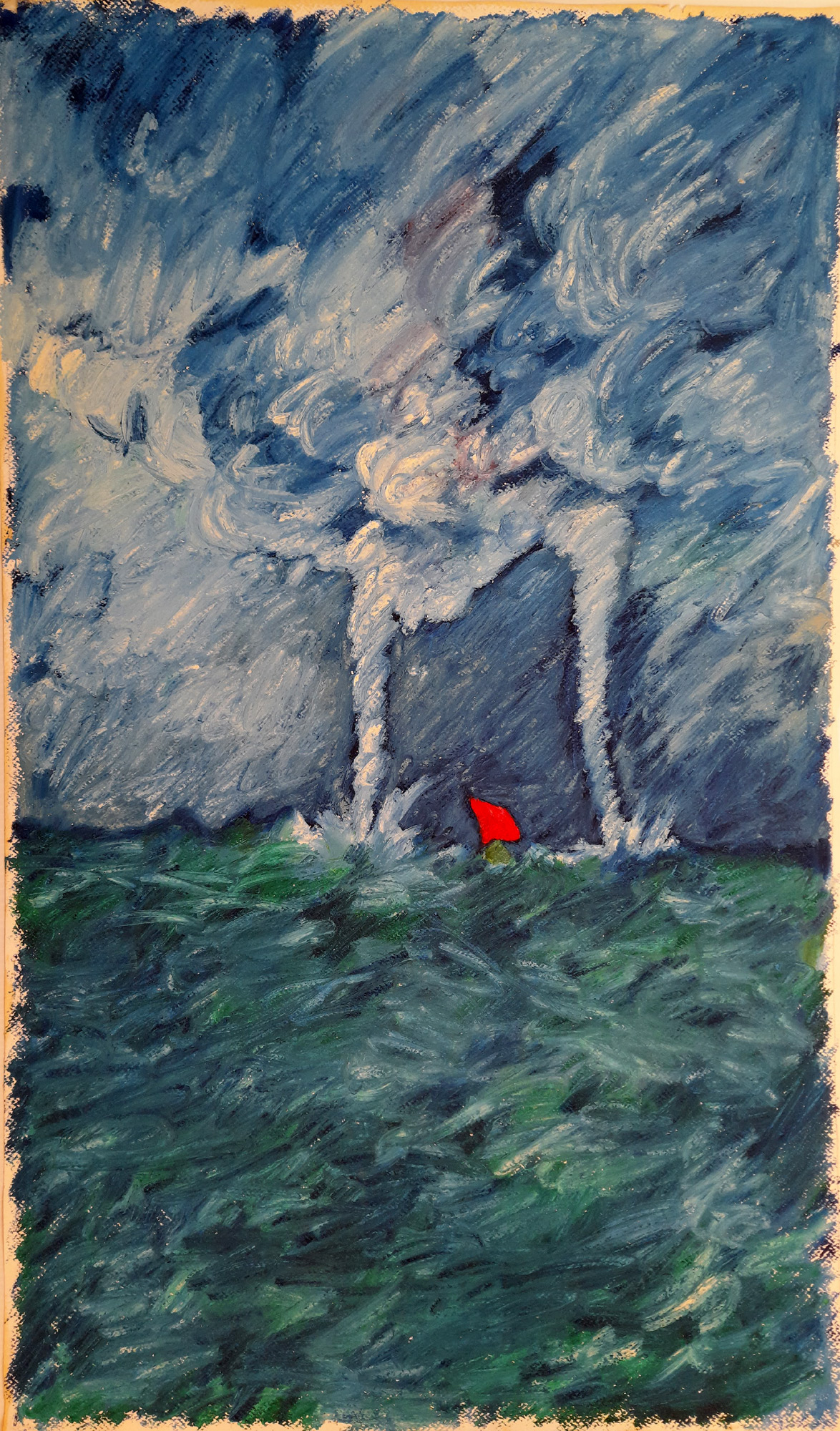
In either the spring or summer of 1990, I returned to Toronto to be in a group show with nine other young artists. I created the sculptural element of a work to exhibit while I was in Ireland (a trellis table holding a house with a fimo figure dancing among stars who could be viewed through a bay window on the second floor of the house). Behind the sculptural element was this oilstick drawing, Two Waterspouts. Amazingly, I still had the huge roll of Strathmore paper my mentor professor (sculptor Hugh Leroy) gave me while an impoverished art student at York University, Toronto, some years before. I gessoed the paper before drawing the waterspouts, 107 cm x 63 cm. The sculptural element had live roses added to it for the exhibition; that part of the artwork was sold and I do not have any pictures of it! 

I was living in Toronto, perhaps in turmoil, when I drew this work on Oct 20 1991 (very specific date written on the back of the drawing!). Tornado, graphite on paper, 102 cm x 66 cm.


Two mediums I still enjoy a lot are combined in this drawing that I created while living in Toronto in the summer of 1992. Foxglove, oilstick & graphite on paper, 76 cm x 49 cm.


 In the early 1990s I was quite obsessed with stonework and windows in both ecclesiastical and secular ruins around Ireland. I think this obsession started when I was on holiday here in 1992 and visited a friend who had moved to rural Kerry and ruins nearer to where my parents lived on the east coast as well as ruins in Clones, close to where one of my sisters was living at the time. I did large, loose sketches of a number of windows using monotones from acrylic black paint and I later used these sketches as research for a new body of paintings that I entitled My Tower of Strength (taken from the motto on my family coat-of-arms). These painted drawings are all untitled, acrylic on paper, 76 cm x 56 cm (or 56 cm x 76 cm), the specific ruins that they are based on can be found in Clones (a church ruin), 


Kerry (outer wall of Ballycarbery Castle)


and Wicklow (Killadreenan near Newcastle). 


It is only the stonework in the drawing of the church window at Clones that I recognise as making its way into a future painting. 

Wednesday, 1 February 2023

Rooftop archive 4 - dream drawings

Continuing with sorting through the rooftop archive, I took great delight in tearing up loads of life drawing exercises removing the proof that I can draw but really, at this point I hardly need proof! Of more interest to me, and thus kept, are the left-handed drawings I was encouraged to do while studying art at York University in Toronto. I think the following three drawings were from 1984 or 1985 when my professor for independent studies was sculptor Hugh Leroy. They are based on dreams/nightmares and I remember the b&w drawings being exhibited in the display cases of the fine art building at the time.

charcoal on paper, 56 cm x 76 cm


charcoal on paper, 56 cm x 76 cm


charcoal on paper, 76 cm x 56 cm


pastel on paper, 101 cm x 66 cm


Once I had regained my confidence and proficiency with my left hand, I was able to go back to my regular right hand and not be inhibited. I enjoyed using tackier media, such as this dream drawing in crayon, 101 cm x 66 cm, 


And of course, luscious and beloved oilstick!  Along with another two oilstick drawings (no longer extant) the following two works were exhibited on the walls of Calumet College lounge in 1985 as part of a two-person show with my friend Elizabeth Canfield.

101 cm x 66 cm

I didn't hear The Cure song till a few years later, but "A Forest" always made me think of this dream.

101 cm x 66 cm

For previous posts on the rooftop archives, look here, here and here.

Wednesday, 10 February 2021

Sea of Roses

When I first moved to Ireland in the late 1980s, I lived with my parents in their house in the centre of Bray. My room for two years was the middle upstairs room and, unbelievably when I think of it now, it was also my studio. All of the work created for my first solo show in 1989 was drawn and/or painted on the floor between my bed and the fireplace! Sometimes, for very large pieces, I was allowed to take over the house's front room and work on the floor there. In 1989, after my exhibition, I wanted to work very large on an idea inspired by a dream. Sea of Roses, approx 140 cm square, oilstick, 1989.


Even after I left my parents house this large work remained affixed to the wall of the middle room. This room later became my Mum's bedroom after my Dad died and an elder sister with her family moved in. After my Mum's death in 2016 the piece made its way back to me and has been rolled up, taking up space in my studio ever since. At this point the oilstick has permeated the paper (good Canson stock!) making it brittle. It was always destined for purgation, I just had to figure out when and how. In my January clean-up of the studio, my husband set it up to photograph as its time for destruction neared.


There were some scratches through the oilstick medium in different places but otherwise the drawing has held up pretty well over the years.


It was difficult to get the colour nuances, in the roses especially, to show up in the photos.


A picture of the reverse of the drawing, where I signed, dated and titled the piece, shows how the oil has permeated the paper.


I used a ruler to tear up the piece, which took about an hour! I couldn't resist saving about nine of the roses, in their surroundings, as individual keepsakes but otherwise Sea of Roses is now a memory.


Wednesday, 16 September 2020

Aos Dara/Umha Aois Symposium 2020 Part II

I started writing about the Aos Dara/Umha Aois combined symposium, in which I was a participant, last week. Details of the symposium and my preparations for work can be found in that blog here. As I had the paper prepared with graphite already, I began drawing with my trusty Staedtler eraser, as per my proposal. I was glad to have some green graphite, because after being in Tomnafinnoge wood, I did not want to limit myself to dark, grey works. However, I was  very pleased with this drawing and the subtlety of the green graphite on the tree worked. I did several other drawings on graphite, which I was not happy with, so of course, I am not showing them! (They'll be binned soon enough.)


My original intention, when preparing several sheets of paper with black acrylic, was to paint images in white only. However, as I mentioned last week, the colour of the forest so impressed me that I didn't think such a minimalist approach would work. I really liked that image of the lightning tree and got out my oilsticks to do more justice to the colourful tree.


When I make collages I tend to tear the paper into shape rather than cut. This facilitates a certain amount of unexpected results in the intended shapes as well a beautiful deckled edge, showing off the original colour of the paper (in this case, a creamy white).


Another image that I repeatedly used as inspiration, was that of the small mushrooms which could be seen in networks growing from mossy, fallen tree limbs, and I even spotted a circular Faerie Ring of small mushrooms. While I definitely did not think my graphite, and black & white acrylic drawing experiments with mushrooms actually worked, the jury is still out on the collage.


The acrylic collage that I thought worked best was Saplings. I had experimented with this image several times in other media, with always problematic results, yet I kept on working on it as I really liked the image of trees and ferns that could be seen at one of the forest entrances.


I was guaranteed that one piece would be displayed in the group exhibition, but I chose two to frame as I couldn't decide whether I preferred the sombre Lightning Tree or


the colourful Saplings. I brought both of them to the gallery and said they could choose either. Happily both pieces will be in the group exhibition that launches on Culture Night 2020.


Wednesday, 12 August 2020

life during lockdown Part 2


Time during this lockdown is totally bizarre! Even things that happened recently seem long, long ago. I am just re-capping here a couple of highlights of May and June, and I feel like I am looking back at years ago. At the beginning of May I was happily working on some oilstick drawings in my studio, as part of the Memory Is My Homeland series and finished this piece, Kingswood Iris. I have previously blogged many times about different pieces for this series, and I have posted those links in last week's blog, which can be found here. I have specifically talked about Kingswood Iris here.


Signal Arts Centre re-opened in June so that staff could prepare for a public re-opening in July. Because of this, a number of firings were put on as there was a plethora of ceramics from the workshops that were waiting patiently since March for something to be done with them. One of the first things of mine that came out of a glaze firing, was the large glaze-painted tulip vase. Three years ago, I had meticulously painted a tulip design on a vase but the results were disastrous as what I thought was a white glaze was, in fact, a glossy white paint! The results sat idle for a number of years until I decided to revisit the vase in the New Year. I blogged about the process of reclaiming this vase here, including giving links to the initial work and failure.


In the latter half of June, I took a 2-part silk fibre paper-making workshop via zoom. I was completely unaware of this process for paper-making but loved it and could immediately see the possibilities for my future artmaking! I blogged in more detail about this workshop here.


In addition to my tulip vase (above), I also had a number of draped slab dishes come out of the kiln in June. I had glazed several of them with a crackle white glaze, the crackle in this glaze only becoming apparent after India ink is applied and rubbed off. I blogged about this process here.


Also in June, I took part in the "Grasp the Arts" campaign. The point of the campaign, for me, was to highlight the role of artists in society's general mental well-being. Many art practitioners, in the widest sense, have lost work and opportunities during the lockdown. An under-acknowledged field of work, the arts are the mainstay of civilisation and survival and it is during lockdown that people have turned to the arts for entertainment - through binge-watching tv shows, streamed music, fb & instagram music &  poetry gigs, theatre, opera, literature, etc - to mentally survive this crisis. I discuss this campaign further here.


Wednesday, 24 June 2020

Kingswood Iris

In February 2019, I started preparing some canvas pieces with a view to creating some smaller works in the Memory Is My Homeland series. Further details and images related to this series, including additional links, can be found here.


As usual, I applied a ground coat of quinacridone violet acrylic paint. My plans were to do a piece using oilstick & graphite, so while ensuring that the canvas ground was protected with gesso, I also expected some colour may show through and I wanted colour as opposed to white.


This particular canvas piece was long and narrow and I knew the finished work would be vertical rather than horizontal. After finishing the large painting, Kingswood, I was leaning towards making hollyhocks my subject. However, other flowers in that painting, which are meaningful to me, are the purple iris, a clump of which were situated by the steps at the front of the house for the duration of my growing-up years. This summer my daily coronavirus short walks take me past some beautiful iris in my current neighbourhood and I decided that I preferred to make them my subject again (iris have appeared in MANY works over the years).


Work-in-progress in the studio.


Kingswood Iris
oilstick & graphite on unstretched canvas
approx 87 cm x 30 cm
2020


Wednesday, 6 May 2020

Room-Mate

Last year, shortly after I started the Home Project, the beginnings of which you can see here and here, I stretched several small pieces of canvas on wood with the intention of doing more oilstick drawings. I got sidetracked by deciding to work on a large painting, rather than work small again, which resulted in the large painting of the main house of my formative years, Kingswood. I have since entitled this body of work Memory is My Homeland. 


After stretching the canvas on the wood, I gave it several coats of gesso. This is especially important as the media I was planning to use was oilstick.


For many years now I have painted a ground coat on a gessoed canvas in quinacridone violet. I think there is a luminescence to this colour and I don't mind if it shows through in a finished work, so I can leave edges rough if needs be.


In my current series my desire is to show more than simply the architecture of a place where I lived, but things associated with those places. Over the year that I haven't worked on the small canvases, I have kept them in mind. When I came across a Polaroid of an oil portrait I had painted of a woman who was briefly my room-mate in a shared flat in 1981, I thought to take that memory and do something with it. I have previously spoken of this place and its relation to the series here.  The Polaroid of the painting is all that exists of the portrait of a room-mate whose name eludes me, though I remember quite a few things about her with fondness.


Room-Mate, oilstick on unstretched canvas, 41 cm x 34.5 cm, 2020


Wednesday, 15 January 2020

Home Project - Memory is My Homeland

Last spring I finalised a title for the body of work, which I had been alternately thinking of as "The Home Project" and "Stories of Home". I finally settled on "Memory is My Homeland", a phrase which I extrapolated from a quote by artist Anselm Kiefer. The beginnings of this work can be seen in previous blog posts here and here. The third small piece in this series is based on the view from my window, from the first time I moved from the family home - I lived here for one month, and almost would not even include it in thinking of my various homes, but for the number of stories that I associate with this one month. I think this work gives an indication of some of these stories!

Dunn Ave, oilstick & graphite on wood, 25.4 cm x 25.4 cm, 2019


In July I did a sketch for a larger work related to the house that I grew up in. I would describe it as being about "growing up, leaving home, and trees & flowers". Kingswood, in the east end of Toronto.


I finished the large painting before the end of 2019, but that will provide a blog post on its own. I used the image from the corner of this painting (a memory of my Communion Day, though for the painting I removed the veil) to feature in some prints.


I previously blogged about going to the Trinity Arts Workshop to learn about carborundum (which can be found here) and it was after printing out the carborundum prints that I decided I wanted to include some linework in the final print. I returned to the TAW to etch a corresponding copper plate and was shown how off-setting a print from the carborundum would facilitate a perfect correspondence. I had never encountered this process before, so it was like magic!


While I was resident at Signal Arts Centre at the end of last year, I did a few more test prints of the carborundum plate. I still have access to a small press and plan to finish the copperplate in drypoint before combining the plates for a final print edition.


I used the Communion image again for a monoprint, but unfortunately I think I applied too much pressure when running through the press, and the ink stuck to and ripped the paper. This is the actual plate before I put it through the press.