Showing posts with label installation art. Show all posts

Wednesday, 15 March 2023

Rooftop Archive 8

I'm returning now to the so-called "rooftop archives", that is the portfolios and rolls of work that I pulled from the roof in the last few months of 2022 in order to actually see what was there and hopefully do some purging! The purging was successful in that I destroyed a lot of things whose moment had definitely come and gone, including all the chalk pastel cut-outs and drawings that I did while on residency at The Tyrone Guthrie Centre at Annaghmakerrig during the spring of 1989. I talk about about my first solo exhibition in Dublin here, the main reason I was on art residency but since I had most of the work done for the show by then, I spent most of my time winding down and having fun. This link also gives all the other links to previous posts about the "rooftop archives" or simply do a search for them on this blog.


I was surprised to find that I kept the irises as I had already thrown out tulips and roses at some other point! But dry pastel is very messy and I have no plans to ever install this work anywhere again, so it was easy enough to make a "trash" decision.


Though I like the drawings well enough, should I ever want to recreate the installation I would use paint rather than pastel.


I loved working large and freely, but there was no reason for me to keep these works once a picture and measurements had been taken (the rectangular drawings are approximately 100cm x 150cm or 159cm x 100cm).


I had made friends with painter Pat Moran (who I blogged about here) while at Annaghmakerrig and he called my studio “the playroom” as each day for several weeks I did large pastel cut-outs of flowers, whales, dolphins, swans and stars and affixed them to the wall. My studio became a space where my dreams could be immersive. Here is the dream imagery on the walls of my studio at Annaghmakerrig.


I can't remember how I affixed things to the walls -- I don't remember having blue tack, but perhaps I did or else just use loops of masking tape. The size of the cutouts is apparent from the chair and the sink area alcove. The figure caught in the trellis is the same figure which appeared in a lot of work and I associate with myself and the sea (as she turns into a red-sailed boat in the original series of drawings, which I talk about here).


I also made some of the stars green in colour as a nod to American poet Wallace Stevens, whose poem Our Stars Come From Ireland was a poem that I had been obsessed with for a few years by this time. 


At the corner of the room I decided to affix another drawing, mixing land, water and air (flight) together in the same space. Sure the stars had already prepared the way...


The final image in the studio is the rose rain area between the two windows. The next area leads to the start again: the drawing of the swan over the sea leading to the big cut-out swan flying over the flowers at the radiator.


Wednesday, 21 September 2022

PULSE at Limerick City Gallery of Art


Though it seems ages away now, on the way home from The Burren (which I blogged about here) at the end of August, we took the route that would lead us to Limerick as I especially wanted to see the PULSE exhibition at Limerick City Gallery of Art. This was organised as a covid response to the fact that recent graduates (2017-2021) of art colleges had missed out on opportunities for end-of-year exhibitions and/or other exhibiting opportunities that normally follow graduation. There were 16 artists in total, most getting space to show a few pieces of their work.

The artists are: Paul Cashin, Paddy Critchley, Judy Foley, Shane Hynan, Aisling Jelinski, Grace Loughlin, Day Magee, Sinéad McKillican, Katie Moore, Daniel Murray, Andrew Neville, Jonathan O'Grady, Bara Palcik, Sorcha Frances Ryder, Niamh Schmidtke and Nicola Sheehan. *Apologies to any artist whose work is in my pictures below - justice has definitely not been done - my pictures are simply to give an idea of the scope of the exhibition.

The exhibition took up most rooms on the ground floor of the gallery. After entering the gallery, where work was visible the foyer walls, taking a right turn I ended up in two adjoining smaller spaces. In this picture the main entrance is visible with some of the photos from the foyer as well as work of Grace Loughlin in this small room.


Judy Foley's two wall-mounted icon pieces and the tableaux installation to mend an aorta (which won an Irish Research Council Award) were also in this gallery. 


In an adjoining area of this room was Kate Moore's Entropy, an installation of dried gypsophilia flowers.


Several artists with large works were located in a large gallery space. 


I realise I lost the sheet that connected the artists names with their work. There were also several video artists represented in the exhibition, but I could not photograph a screen to give any sense of the work. 


Another large gallery contained the work of two artists, each having space to present mini bodies of work.


These are paintings by Paddy Critchley.


I think the show seemed like a graduate group show, but there was a high level of competence. It was exciting to see most art forms being represented: sculpture, painting, photography, video and installation art. The artists were chosen by Patrick T Murphy (Director, RHA) and artist Aideen Barry.

Wednesday, 23 March 2022

Cora Cummins and Saoirse Higgins at The LexIcon Gallery

 A couple of weeks ago I realised that I was running out of time to see an exhibition that had been on my radar for a few months! With the way these past two years have gone, at least I can forgive myself for losing track of time. But at least I got to see the exhibition at The LexIcon Gallery prior to its close. On Steady Ground/Unsteady Ground was a 2-person exhibition by Cora Cummins and Saoirse Higgins. While there was some collaboration in process discovery and prior to exhibiting work (as indicated in an artist talk by Cummins) the exhibition itself is not of collaborative work, rather work by two very individual artists.

Entering the gallery from the adjacent library, the viewer is brought face to face with a number of prints by Cora Cummins and the variation in scale - from tiny mezzotints to the multi-panel etching - is immediately apparent.


The common denominator between the works by the two artists seemed to be landscape and a concern for the environment. However, this is only a surface reading of the works as both artists are really addressing issues of isolation and responses to the pandemic seem to seep out of the works.


As I knew something of Cora Cummins prior to listening to her artist talk (via Zoom the week before I saw the exhibition) I was not surprised to find out that Cummins was also finding creativity from insurmountable grief (her husband died, far too young, several years ago). 


Even had I not known this, I would have looked at the fractured image in the multi-panelled print Monument as something more meaningful than simply the image of a mountain. Because of the artist talk I was aware that this labour-intensive piece subverted the whole point of printmaking itself - it was a unique piece and would always remain so:


Cummins, after printing those unique panels, used the copper plates to form the sculpture Fallen. Together the two works complement each other in a heartbreaking expression of sorrow and survival.


The space around each work allowed that necessary room to hold the emotionsal impact.


I thought, at first, that this wall hanging was another of Cummins's works, but the creator was Saoirse Higgins. It was a good bridging piece between her and Cummins's pieces. The central image had that feeling of landscape but its actuality could not be placed. Perhaps it was a detail? Within the larger cloth it took on several aspects of appearance and connotation: a shroud, a blanket and a screen. So any emotional reading was confused by a multiplicity of meaning.


And then one is drawn to the flickering video in the small room at the back of the gallery where the changing shoreline and racing clouds of timelapse are mesmerising. I was unable to attend Higgins's artist talk but from hints Cummins gave in her talk, I surmised that the landscape filme was of a remote island in the Orkneys where Higgins spent much time in isolation during the worst days of the pandemic.


At some point the video/film becomes multi-split-screen and, aside from the saturated blues of sea and sky, one is aware of the propellor movement from a small aircraft. Both Higgins's and Cummins's work deal with the passage of time and leave the viewer with a melancholic hope. I was glad I had the chance to view the work in this incarnation, at this venue.
 

Wednesday, 11 August 2021

Bite The Hand That Feeds You

 A few weeks ago I went to Rathfarnham Castle to see the PhotoIreland Festival group exhibition Bite The Hand That Feeds You. In that very large space I was delighted to see that the exhibition was a smaller group show than I expected, where each artist was given ample room to stage individual installations of work around this year's themes (food consumption & human-animal relationships being the bigger ones). The first installation that one comes across (due to Covid the system of masked movement is, understandably, very particular) is by Finnish artist Hertta Kiiski. Milky Way consists of goods (cloth and clothing) that reference her video (not in the picture below) of two very bored looking teens, dressed alike and cradling large, oddly-shaped, clear bottles of milk, which they periodically drank from. There was no dialogue in the video (at least while I was watching) and the ennui was infectious, so I did not stay for the duration. I definitely had the sense of teen insecurity (in the way the bottles were cradled), boredom, and the ability to consume as something to be taken for granted. I assumed this was cow's milk as opposed to human milk and it highlights that, perhaps somewhat dubious, human-animal relationship where human's are the beneficiaries of an animal product.


In the next room one is also confronted with the treatment of animals, again cows, in the large digital data drawings of DĂ¡niel Szalai, Unleash Your Herd's Potential. Using assorted surveillance and computer techniques, Szalai brings to the fore a number of issues concerning the human-animal relationship. 


However, I have to admit, that it was the imagery and painterliness of these computer drawings that attracted me to this work.


Accompanying these works is the strange-seeming abstract floor sculpture; this, however, is a piece constructed from actual shapes of salt cow-licks and brings the element of reality into this hi-tech installation.


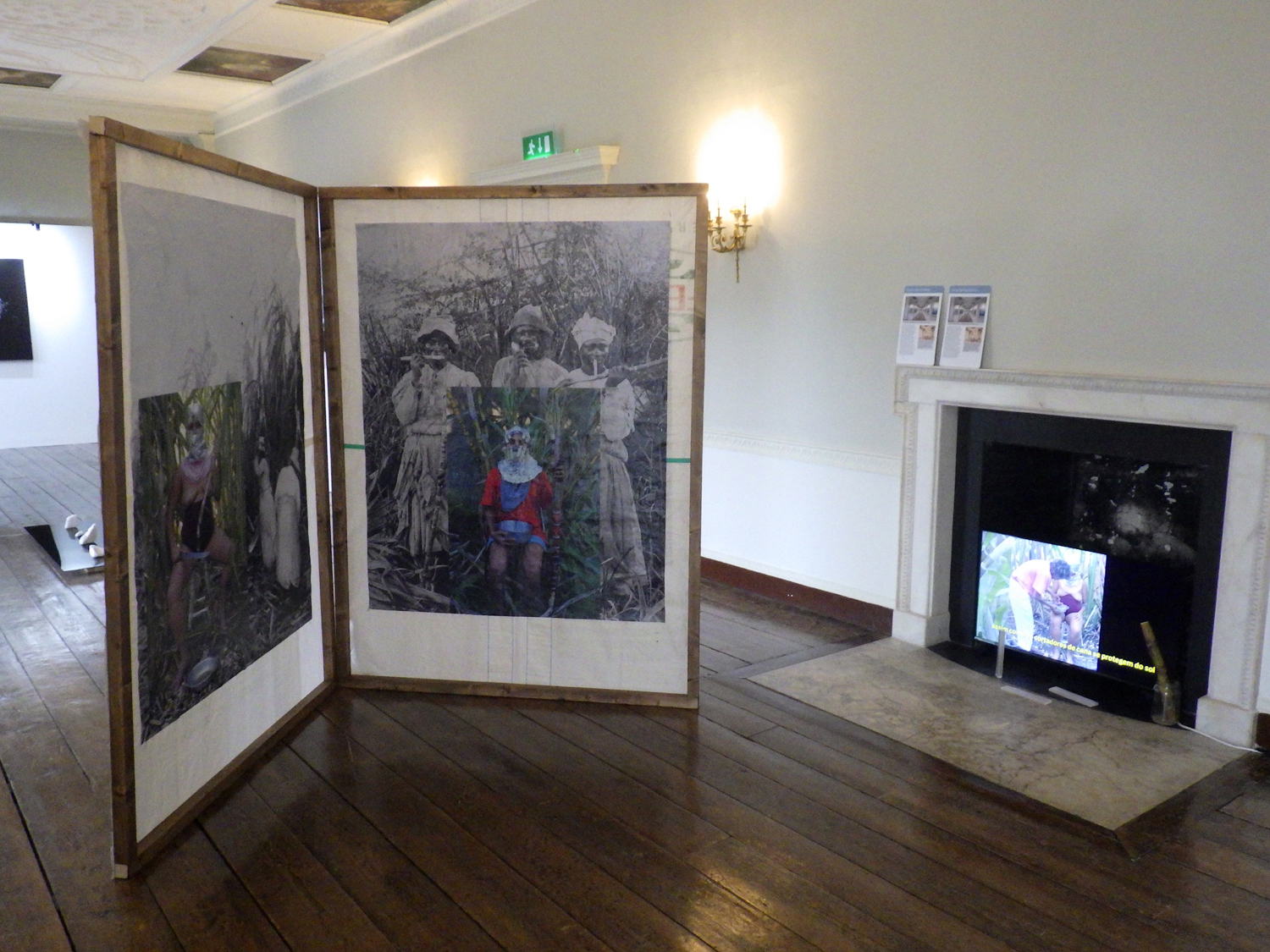
Sharing the room with Szalai was Overlapping Histories, a mixed media installation by GĂª Viana.


The video seems to be of the artist setting up a posed National Geographic style "authentic" cultural photograph, which is included and enlarged within the installation. There are clearly doubts about any authenticity, but also concerns about colonisation and cultural appropriation raised. While it is a thoughtful piece, I found it difficult to engage with.


Almost as an afterthought, Tuna by Sheng-Wen Lo, was placed in the same room as these two larger installations and really seemed out of place. According to the accompanying didactic, Lo's game is concerned with sustainability and the available bottle of hand sanitizer next to the video game attested to the fact that this was a hands-on piece. However, I found nothing in its presentation to tempt me to give it a go.
 

The smallest room allowed for Hans van der Meer to present a video, book, and related photographs of cows together as a single entity, Time to Change. The video, in which cows, in turns, enter a hoisting machine in order to have their hooves shorn/scaled for hygienic, health and safety purposes. The most interesting thing I found about watching this rather hypnotic process was that the cows did not in the least mind the noise (an angle grinder!) or being lifted from the ground by the machine, legs manoevred neatly in order to accommodate the human doing the work. Other sections of the video showed the cows systematically ignoring automated processes - the cows just went about their business as various machines went about theirs!


The wall of photographic portraits of these cows presents them in all their glory: ready for sale, for work (milking, procreation) or consumption (prime beef). The cows themselves do not really seem fussed at all - are they condescending or dumb?


The final, large room contained two installations. Spinebone Soup and Stuffed Rabbits by Ksenia Yurkova is a large, multi-media humorous installation where the seemingly innocuous concept of the recipe takes on absurd dimensions. From transparent, impossible and confusing recipes hung from a complex free-standing framing system (where ingredients may include sawdust and glue) to a vox pop video, where topics include thoughts on the point/pointlessness of meat flavoured substitutes for vegetarians and vegans to the possibility of growing meat scientifically from human tissue to end world hunger. I do not know if Yurkova's video was scripted and staged or a genuine vox pop, but it most certainly provokes a reaction of ethical proportions as one tries to figure out one's own answers to some of the queries. While the overall piece delves into the absurd and comical, it has a fundamentally serious edge.


The final piece before exiting the exhibition was Alan Phelan's A World Looted. The hexagonal pillar with light emanating from  some of its planes provided a TARDIS-like curiosity seen from the corner of my eye while viewing the previous installation.


On closer inspection, those back-lights illuminated individual Joly photographs* set within the pillar. Phelan's photographs are concerned with specific global, corporate fruit controversies highlighting concerns of how fruit is produced, consumed and the ethics of globalisation and colonisation.


While the display's execution is pristine, if it weren't for the didactic and the titles of individual pieces (such as Pineapple: let's depopulate and extract profit to make the perfect pineapple) I wouldn't have had a clue what Phelan's work was about.


*This explanation of "Joly photographs" was written on a didactic at the exhibition: This is a method of colour photography developed in the 1890s by John Joly, a physics professor at Trinity College, Dublin. It is an additive colour method, with a striped red, green and blue (RGB) colour screen placed in front of the film in-camera on exposure and then again on display. Colour information is recorded on black and white film and rendered as a colour image when the screen and film are put together. The film is processed as a positive and so what is displayed is the film that was in the camera, not a print or reproduction.

Wednesday, 20 November 2019

Venice Biennale - Arsenale pavilions

There was a lot to see in 2 full days spent at the Venice Biennale 2019! My last few blogs have discussed some highlights of the curated exhibition May You Live in Interesting Times both at the Giardini here and the Arsenale here. I also discussed some national pavilion highlights at the Giardini here, and now it is the turn to outline a few of the national pavilion highlights at the Arsenale.

This is only the second time that India has participated in the Biennale, and its national pavilion presents a 7 person group show thematically related to the ideals of Mahatma Ghandi. Jitish Kallat's installation both moved and impressed me the most. Walking into a darkened room, one sees a letter being projected onto a "smoke screen" (dry ice presumably) and reading, as the projection scrolls, there is the realisation that this is a letter from the peaceful, great Ghandi to Adolph Hitler imploring him not to start a war. This historical item is chilling, but seen in this context its essence is driven home. The surrounding darkness, the ephemerality of the words as they easily disappear in the undulating smoke as it wisps with the movement of viewers who come and go (the exit is behind the screen).


The letter is visible on the floor, but the words are linked with the vertical projection and therefore reversed. While the horizontal projection is clearer, it cannot be read because it is backwards. There is an inherent miscommunication; the message of friendship and peace that Ghandi offered was ignored - not understood in its simplicity, in its humanity - by the crazed, monstrous Hitler.


The Italian pavilion was also a group showing, though only of three artists, where the theme of the labyrinth was based on a 1962 essay written by Italo Calvino (The Challenge of the Labyrinth). It was the labyrinth itself - the setting, the meandering from space to space, being confronted with mirrors, lights and curtains - that I found more interesting than any of the work done by the specific artists, which at the time I found chaotic.


Luxembourg's pavilion consisted of Written by Water, a massive installation by Marco Godinho. There was a large quantity of water-damaged books visible on a slope that seemed to continue into the structure of the building with the implication that the amount of books was limitless. Books are a source of information and entertainment, yet the damaged books are silent in their inability to be read. A story is told, nevertheless, and it is the viewer who is challenged to "read" what they will. It is 2019 and there is more here than washed up garbage, but stories - histories, lives - are silenced by poverty, war, death. Personally I felt an overwhelming sadness and regret within the installation, yet a certain rightness to witness being borne.


I had read about the Ghana pavilion before going to Venice, so I was eager to see Ghana Freedom live. This group exhibition takes its title from a song composed for the birth of the new nation in 1957.  I enjoyed meandering through Sir David Adjaye's designed elliptical and earthy galleries, which housed the six artists. The design both allowed for individual exhibitions and unified the work.


While El Anatsui's large-scale works hanging on the pavilion walls may evoke traditional Ghanian decoration, it is their tactility that brings about inspection and discovery. The colourful works are intricate combinations of found materials, such as metal bottle caps and pull tabs from drinking cans, that have a painterly aesthetic.


The pavilion for Saudi Arabia hosted the work of  Zahra Al Ghamdi in a beautiful and peaceful exhibition of light pillars and organic objects. On entering the dim gallery I felt like I was underwater and did a double-take as it seemed opposite to any feelings of "desert" to me. However, I have never been to the desert, so maybe a sea of sand evokes the same feelings as a sea of water, to one who knows it. Al Ghamdi's After Illusion intends to be a "creative dialogue between [the artist] and natural material she associates with her home".


To me, the materials evoked sea life - one could even say the pillars of light were barnacled - but the objects were not specifically recognisable and brought me into the realm of dream.


There were, of course, many more pavilions of interest, but I am not writing that book! I certainly went away from Venice Biennale feeling amazed and privileged to have been able to go there and see such a brilliant array of internation artwork. I look forward to being able to attend another Biennale in the future.

Wednesday, 26 June 2019

Tomnafinnoge Sculpture Symposium

I visited Tomnafinnoge Wood last week, on the last day of a sculpture symposium. Five sculptors had been working in the woods, in mostly fine weather, for the past ten days. From  left to right they are Con Gent, Niall O'Neill, Dave Kinane, RĂ³isĂ­n Flood and James Hayes.


Niall O'Neill was busy at work on an enormous piece of fallen oak. The sculptors could only use hand tools in the forest, and could not damage living trees.


A local child enjoyed assisting Niall in brushing wood dust from the carving.


Con Gent carved an abstract face into one end of a large branching tree limb and the final touch was to stand it up as a tripod.


It appeared to be almost walking, spider-like through the woods.


Dave Kinane’s constructed sculpture was the culmination of ten days of measuring, hand-drilling holes, and carving custom dowels to put together numerous saplings into a curving, open-mesh structure.


Kinane's piece has an Irish title which tranlates to "The Sanctuary of the Hooded Crow". The sculpture is open-ended and may very well provide sanctuary to birds and other fauna in need.


RĂ³isĂ­n Flood’s work also required calculated thought and meticulous awareness as she wove together branches into a curved structure, which will eventually disappear into the woods.


When I visited, Flood was applying finishing touches of ferns and moss in the hopes that animals may build comfortable homes within her piece.


In addition to O’Neill and Gent, James Hayes was also woodcarving. He carved two blocky caryatid figures into short columns and they seemed to provide a portal into a glade.


The figures. male and female, represent a duality within nature, both benign and malign in its disinterest.


 The carvings are roughly chiselled and appear both ancient and contemporary.


The concern for the environment and importance of craftsmanship was obvious in the work of the five artists on the symposium. Both local artists and the general community are hoping that this wood symposium will become a regular event.