Showing posts with label Robert Motherwell. Show all posts

Wednesday, 28 May 2014

Black & White

The facebook page of the Museum of Modern Art informed me that it was Franz Kline's birthday a few days ago, and of course posted a picture of one of his paintings to celebrate. It reminded me of how much I like this painter's work. In general, I have a love for the painterliness of Abstract Expressionism and I think it leaks into my own work, figurative or abstract.


Here is another Franz Kline black and white painting. Is it completely abstract or is it a figure standing on a bridge? Actually, I was taught that "abstract" means "taken from" which is completely different from "non-objective" work that aspires more to music (such as the paintings of Wassily Kandinsky).


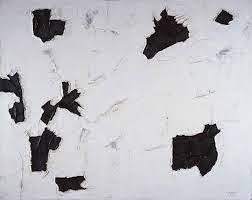
The elegy series of Robert Motherwell are another group of abstract paintings using mostly black and white to great effect.


In 1984 I was on holiday in Ireland, visiting my parents, so I was using the minimalist palette of black and white to created postcard size self-portraits. In fact I used old postcards acquired from the local shop of one of my aunts. These two pieces from the series were included in a retrospective show in Wicklow County Buildings in 2005, "Coming of Age: Work from the Past 25+ Years".


I had previously painted a few large pieces (3' x 4') of figures in relation to the canvas solely in black and white, but only the small self portraits have survived from this time period.


At the time, among my music choices was The Stranglers including this song from their album Black & White, "In the Shadows".


I revisited the minimal palette in the early naughties with "There She Goes" a large multi-panelled painting on card. The card panels were painted first with my signature magenta background, which is always allowed to peep through subsequent layers of paint. This piece too was exhibited in the Coming of Age exibition in 2005.


While I love bright colours in my paintings (browns never get a look in), there is also something about the possibilities of limitations which is fascinating. Last year I was completely taken with the Jean Charles Blais exhibition that I saw in Antibes, most expecially the black and white figure paintings.


Wednesday, 2 April 2014

Classic Abstraction

As I am preparing new abstract work, my thoughts are revisiting classic abstract artists whose work had a great effect on the way I like to paint. I love this picture of Helen Frankenthaler in her studio. I have never had a large work space but have always made good use of the space I have!


A gorgeous, ethereal Frankenthaler painting.


Mark Rothko's paintings have always appealed to me. About 1980 I read Lee Seldes' 1979 book, The Legacy of Mark Rothko, and was convinced that Rothko's suicide was a set-up. Bad dealings of galleries and corporate greed made interesting reading but unfortunately it was a well-researched factual book, not a novel.


I have only gotten to experience the Rothko Room once, when it was still at Tate Britain (it was moved to Tate Modern but must be in storage as the paintings are never on display when I visit London!). I was lucky to have no one else around in the room and was seated on my own. The paintings seemed to hum and open a door into thoughtfulness.


I think it was in 1981 when, with several of art school graduates, I visited the Albright-Knox Gallery in Buffalo. There is a large collection of Clyfford Still paintings there which are huge. I remember being hugely impressed by their colour and size!


Abstraction was also happening in Canada in the same time frame as the New York school of classic abstract expressionism (1950s) and being in art school in Toronto I became familiar with Canadian content! I liked the work of Paul Emile Borduas.


There was a huge show in the Art Gallery of Ontario of Gershon Iskowitz in the early 1980s. Again I could not fail to be impressed by the size and colour of his paintings.


Jack Bush is probably the best known of the Canadian abstract artists.


Another American abstract artist whose work appeals to me is Robert Motherwell.


I love seeing work from Motherwell's Elegy series. I can imagine myself painting the paintings with large brushes, plenty of space, etc. A painting fantasy!


I probably saw the work of Richard Diebenkorn on visits to museums in New York in the early 80s.


It is the application of paint and working out of composition in his work that really appeals to me.


It is Diebenkorn's work which is echoing in my mind when I am thinking of my next paintings Fever Afterimages.