Showing posts with label sgraffito. Show all posts

Wednesday, 17 January 2018

Ceramics workshop

It was very exciting to get back to the ceramics workshop last week and find that a number of items I had made in the last few classes of 2017 were bisque fired and now ready to glaze. I was busy with a new project though, and didn't have time to glaze these things last week, but hope to do so this week.

When working with clay, whether hand-building or working on the wheel, it is important to wedge the clay heartily; i.e. knead it to remove air bubbles (so finished pieces do not explode when fired!).

This is a plain draped slab pot: after wedging and rolling out some grey (stoneware) clay, I trimmed the sides and draped the slab over a paper-covered block of wood. I created two small rectangular feet to raise the platter form.


This is a more free-form draped slab pot. It was created in the same manner as the platter above, but I wedged some terracotta clay with the grey clay in order to produce a marbling effect. This will be glazed with a transparent glaze in order that the marbling remains visible.


This design of tree branches was created by the sgraffito method. After wedging, rolling out, and trimming a slab of grey clay, I painted the slab entirely with a terracotta slip. At the leather-hard stage. I scratched out the drawing with a sharp tool.


This tile of tree branches was also created using sgraffito.


The stone designs of the following three tiles were created using the mishima technique. After wedging, rolling and trimming the slabs, a design is incised in the leather-hard clay.


At this stage the clay is still moist enough to accept a layer of slip painted over its surface. I used a terracotta slip.


When the tile is nearly dry,  the slip is scraped away from the surface uniformly such that slip that had filled the incised design, remains to show the drawing. I plan to tint a clear glaze so that the designs remain visible after their final firing.


Sunday, 7 April 2013

Prague

 After Easter I went to Prague, to both visit relatives and to see the sites again (it has been a few years since I was there).  This is a typical view of the castle above the Vltava River (also called the Moldau).  The castle complex also includes St Vitus Cathedral, whose spires can be seen.


I went on an introductory tour of the city (which included coach, boat and walking tour), so I got a good sense of the four historical towns -- Staré Mêsto (Old Town), Hradĉany (Castle Town), Malá Strana (Lesser Town) and Novo Mêsto (New Town).  The first time I had been to Prague (1992) I also got a sense of the Communist-era outer city, which I don't need to explore again (very ugly block buildings outside the historical centre).  The building below is called The House by the Minute and is adjacent to the old town hall and astronomical clock tower in Staromêstská (Old Town Square).  This beautiful building with stunning black and white sgraffito-painted facade was Franz Kafka's childhood home.


The astronomical clock -- still accurate after several hundred years -- is a thing of wonder, as well as being a major tourist attraction.  Every hour, on the hour, small doors open above the main clock and there is a parade of carved wooden saints.  The skeleton on the side of the clock also shifts his hour glass so you can be more aware of your mortality...


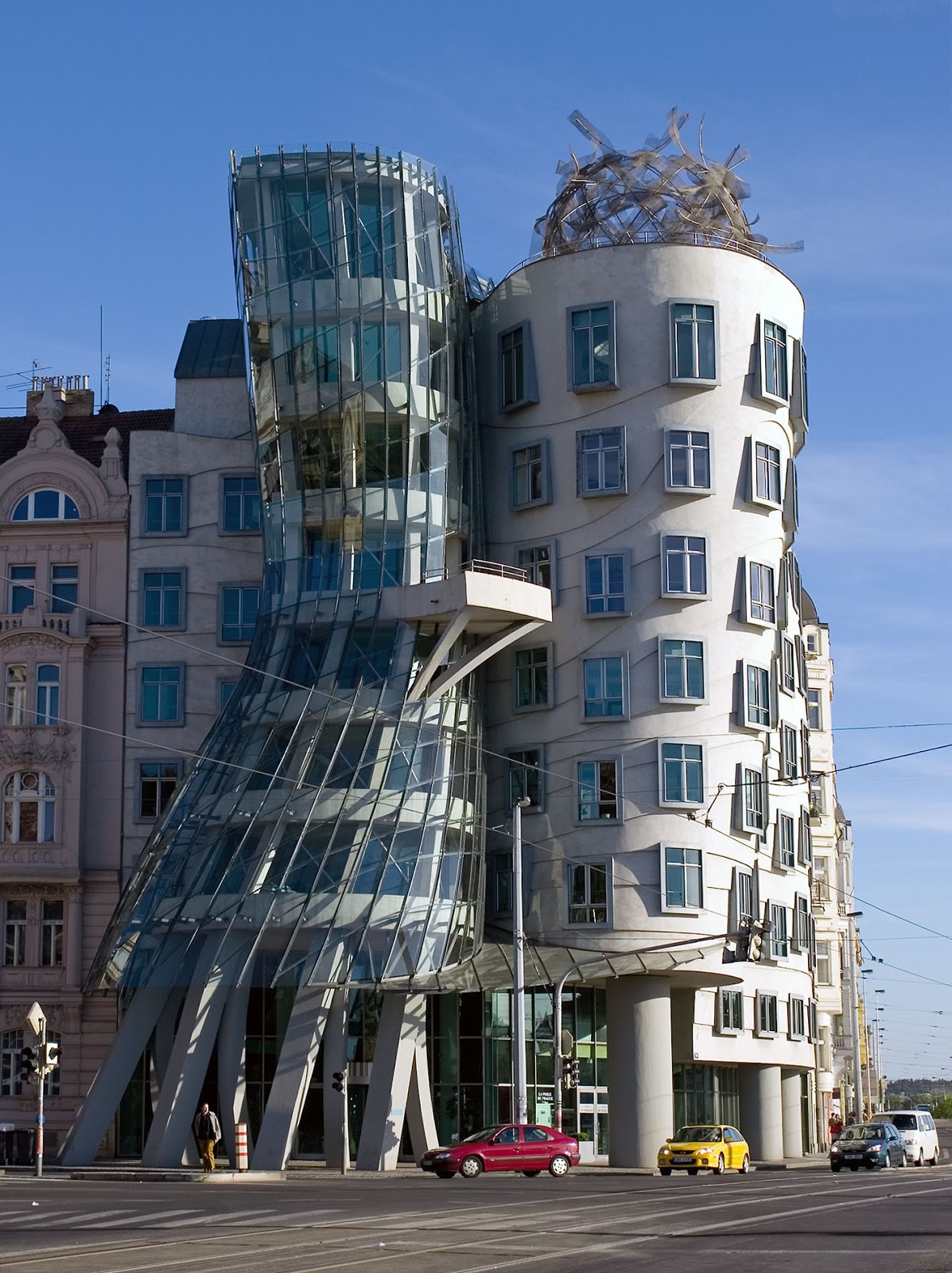
It's great to see some new architecture too!  This building is called The Dancing House, which I first spotted from across the river (I was staying in the Smichov area), is an office building designed jointly by Croatian-Czech architect Vlado Miluniĉ and American Frank Gehry.  It was built in 1997 with the strong support of playwright and former president, Václav Havel.


One day, after a visit to Strahov Monastery, I walked down Petřín Hill.  It is a very pleasant walk down to Malá Strana, and at the foot of the park is the Memorial to the Victims of Communism sculpture by Czech sculptor Olbram Zoubek.