Showing posts with label Umha Aois. Show all posts

Tuesday, 13 October 2015

More Bells!

As I mentioned in a previous post, my husband, sculptor James Hayes, has been experimenting with making bells. Although also working on these at home, he usually gets more concentrated time to focus on the annual Umha Aois (bronze age) experimental bronze casting symposium. This summer it was held in Skibbereen, West Cork. Still in a bell frame of mind, a recent trip to the National Museum of Ireland got us looking at different bells, especially noticing their handles. I have previously posted pictures of the 2-loop handled bells, but this bell also struck us because it was so curvy.


The handle on this bell seems to be a simple coil.


This bell was notable because it was sheet iron riveted together and possibly brazed.


While at Dublinia a few weeks back, there was a lovely rounded Viking hand bell in a display. The clapper can be seen in the photo, and this is worth noting as the typical Irish bells did not have clappers but were tapped like an instrument.


Here is a selection of bells my husband has made and a leather-wrapped bronze tool to sound a bell. The smaller flattish bell in the centre rear is made of sheet iron and has been folded and riveted together; a leather thong has been threaded through holes to make a handle. James plans to braze (bronze coat) that bell. The other bells are cast bronze.


Wednesday, 9 September 2015

National Museum of Ireland - Archaeology

In addition to visiting the Dead Zoo last week, we also dropped in to the National Gallery to give my visiting sister a chance to see the Sean Scully show, and then to show off the beautiful National Museum of Ireland - Archaeology building. The rotunda entrance is impressive.


My husband, sculptor James Hayes, has been recreating bronze bells using ancient techniques on the annual Umha Aois: Experimental Bronze Casting Symposium. So we took a closer look at the hand bells in the museum while we were there.


The double loop handles are intriguing.


The didactic says this bell is associated with St. Patrick, purely on the grounds of the inscription.


This is one of my husband's bronze bells; he cast it in Skibbereen this summer, where Umha Aois was held this year.


Wednesday, 13 May 2015

Sketching!

I have been enjoying sketching again lately and using the opportunity of receiving flowers to have a subject which I have always loved, tulips. I thought I would post a few of these sketches. The sketch below is done using a 3B or 4B pencil.


I am also having fun with watercolour pencils. A friend recently mentioned "water pen" to me, something I have not yet come across -- must investigate!


Tulips are sometimes exhibitionists!


Another soft pencil sketch.


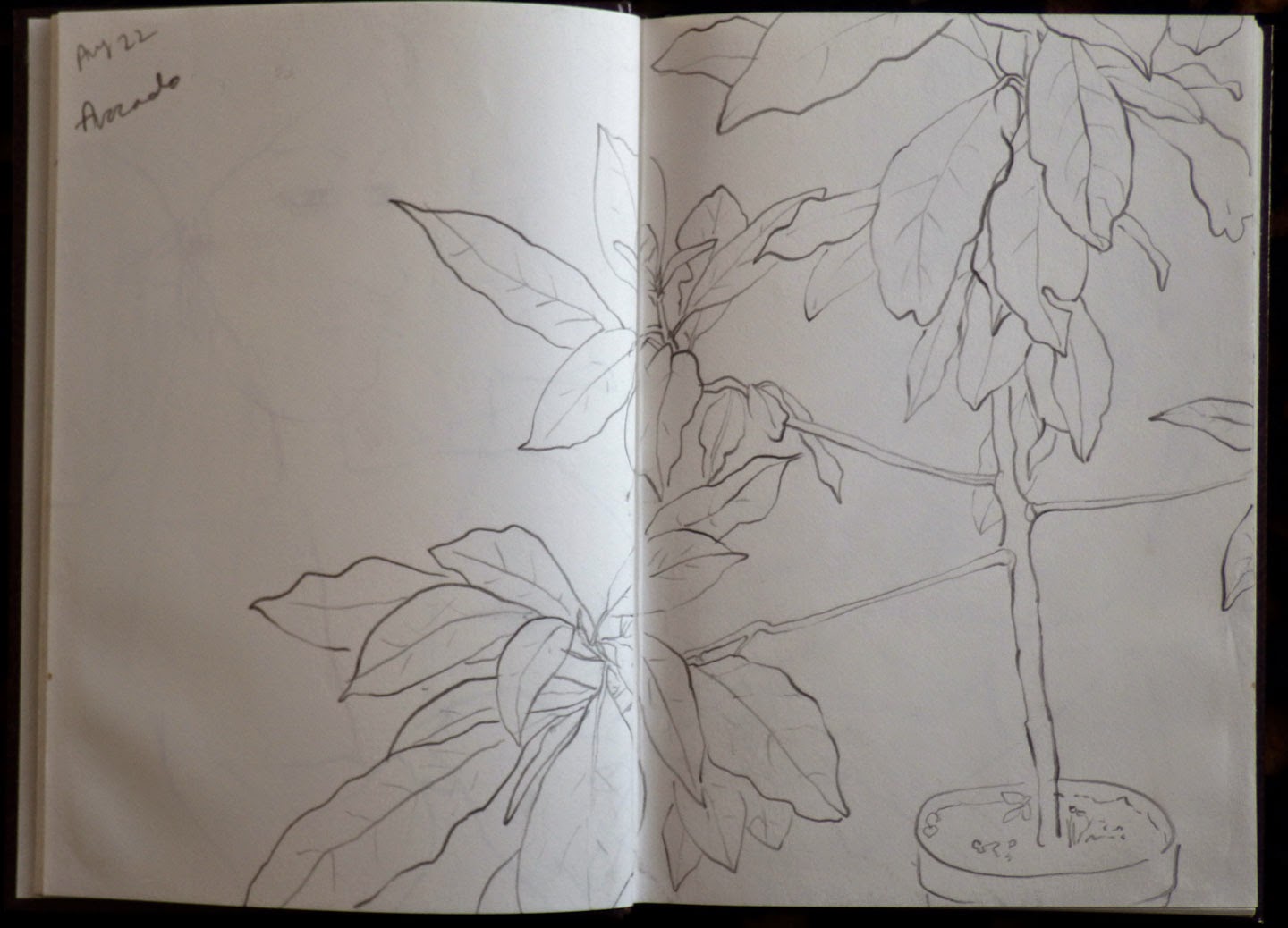
As I am reusing some old sketchbooks with blank pages, I am also coming across older sketches. This is an avocado pencil sketch from 2001.


This sketch is from the last Umha Aois; Experimental Bronze Casting symposium I attended (Ventry, Co. Kerry, Aug-Sept 2001). It is a drawing of my husband's pit furnace and handmade bellows.


Of course sketches may contain kernels for new paintings. My recent trip to Rome obviously inspired this as a counterpoint to my recent painting "Fractured City".


Friday, 10 April 2015

Carlow

On the way to Waterford from Bray, there were a few things we wanted to see. Our first stop was Newbridge, to show my Mum and my daughter my husband's sculpture "Sentinel" as they had not seen it yet.


Our next stop was Carlow. Many years ago my husband and I had tried to find Browne's Hill (or Brownshill) dolmen, but now it has been nicely marked. Although it is within a field, it has it's own fenced off space, with seating, an OPW didactic, a parking area and a path leading up to it from the road.


It is quite a spectacular dolmen, in my opinion it far surpasses the famous Poulnabrone dolmen for both size and accessibility.The capstone is believed to be several hundred tons in weight, making it the heaviest in Ireland.


There is no barrier to keep you away from the dolmen, therefore you can notice puddles underneath reflecting sunlight onto the dolmen's belly. It was beautiful!


We also wanted to check out Visual, the arts centre in Carlow, which could easily belong in any big city. It was both impressive in space and the exhibition showing, Cosmic Dust, a group show, In an upstairs gallery a triple film, The Floating World by Clare Langan, was haunting. Outside of Visual was a large sculpture, The Medusa Tree, by Eileen McDonagh.


Lennon's, the restaurant adjoining Visual, is a great place to have lunch. I thought the artwork on display in the restaurant looked very familiar, and taking a closer look realised it was the work of Karen Hendy, an artist who had stayed with us for a few days in January, as Umha Aois (a project with which both my husband, James Hayes, and Karen's partner, Holger Lonze, are involved) were giving demonstrations at the Ninth Experimental Archaeology Conference held at University College Dublin. Here is one of the paintings on view, from Karens "Littoral Series".


After lunch we went to take a look at Carlow castle which is beautifully impressive despite being only a ruin with two towers and one wall.


The castle is accessible by stairs from the street and then a winding path around it. Along the path are a number of etched plates which act as information didactics. Below, the plate is showing the two towers and wall still standing in relation to a floor plan of the original castle. The OPW (Office of Public Works) is responsible for the site, so I imagine they were also responsible for the clever planting -- shrubbery is being trained to take on the shape of the rest of the castle.


Across the road from the castle is a large sculpture. Unfortunately, I could not find any identifying plaque which gave any information on the piece nor could any mark be found identifying the artist. For the Newbridge piece (picture above) my husband taught himself how to electro-etch his name onto the back of the sculpture in order to have his identity clearly associated with the work. This is something I think that more artists are starting to consider as not every piece of public sculpture gets an information plaque.