Wednesday, 12 April 2017

Jai Jai launch

Though it seems like an age ago now, it was less than two weeks ago that my friend Jai Thorn launched his fashion-art label Jai Jai at an evening event in The Chocolate Factory, Dublin. Jai's exhibit was a tactile mix of organic matter and living material. 


Despite the use of a male and female model, the garments themselves are conceived as "gender non-specific" and the models are perceived as vehicles for the movement of the garments; the choreography of the interaction between materials is paramount.


While the guests were invited to wander the space throughout the event, one looked at the still environments as sculpures most clearly during periods of time when the models were absent from the space. 

During the first presentation, the individual models slowly moved around the warehouse space, interacting with the sculptural materials throughout,


 After an interval, in a second presentation, the models reappeared in different garments. There was a heightened sense of change as there was more interaction with each other while the models continued to visually and psychically explore the materials of the environment-sculptures.


Even while the sculptures were still, one always had a sense of movement because of dynamic forms and the use of living material -- soil and plants.


Wednesday, 5 April 2017

Intaglio and Chine collé printing

I was out early on Sunday to head into the National Print Museum in Dublin in order to attend a printmaking workshop given by artist Elaine Leader. I signed up for this workshop because the technique of "Chine collé" was featured and I have been curious about this technique since I became aware of it about 20 years ago (I had never heard of it in printmaking classes I had in art school in Toronto). To start the day we were given some pieces of thin plastic (or thick acetate?) referred to as "axpet" (which I had also never come across before). Once I removed protective film from the axpet I could use it as a plate to do an intaglio sketch on. My tool of choice (we had our pick of several  etching tools) was a converted large sharpened nail. I ended up with two plates, the first one, done in the morning a city ruin sketch and the second, done in the afternoon based on one of my stick sketches.


The plate was inked with a dark ink, cleaned and then given a "roll-out" layer of translucent colour. For the Chine collé I ripped two random pieces of a light weight handmade paper. Wallpaper paste is thinly spread on the back of the paper and they must be placed upside down on the plate (so that the glue will adhere to the print paper). The Chine collé is the last thing to do before going to the press as the paste must be very thin and thus can dry out quickly -- make sure your paper has been removed from its water bath and blotted before you prepare the Chine collé paper!


We were printing on lovely Fabriano paper, so it needed to be in the water bath at least 10 minutes before blotting.


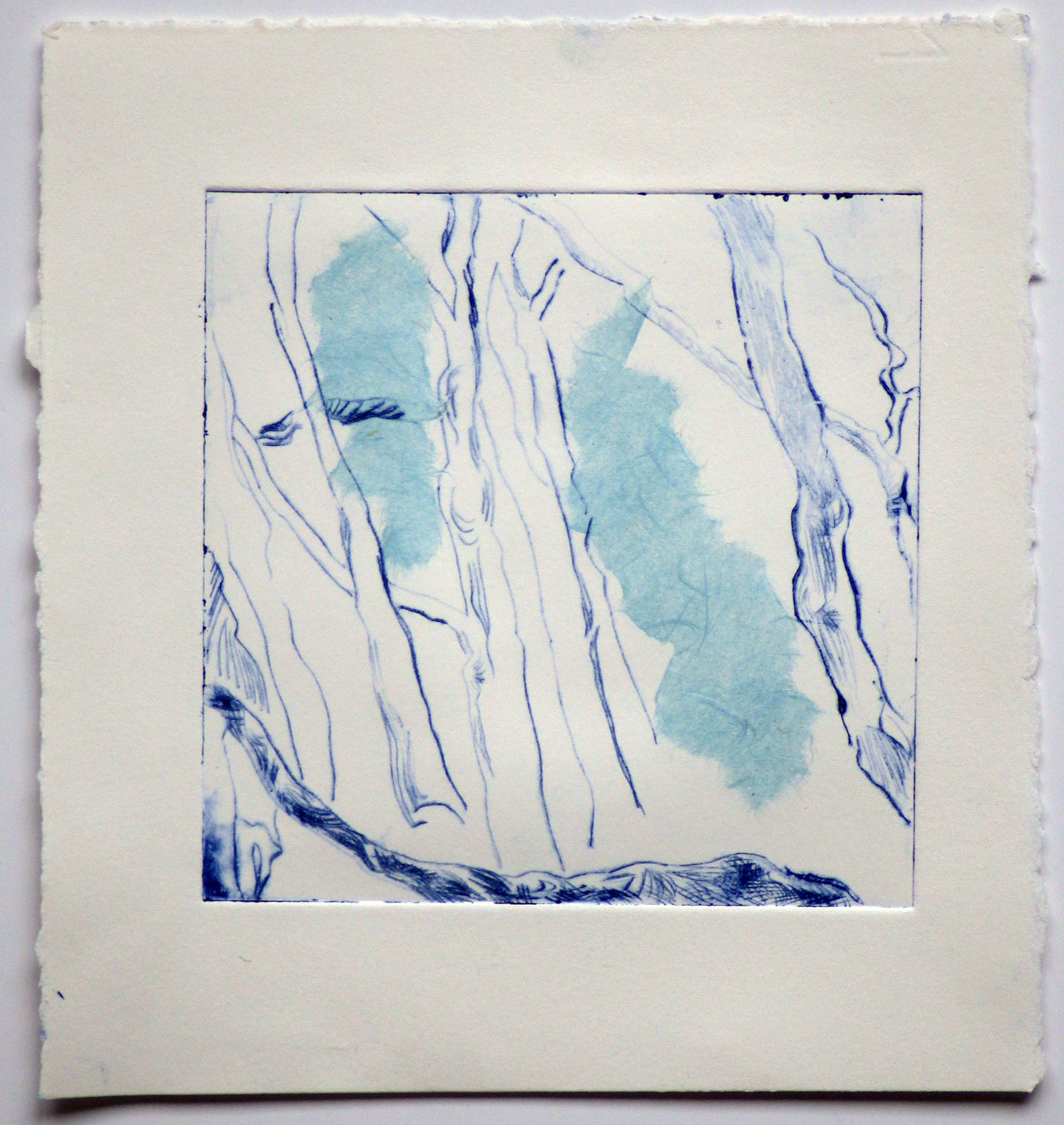
This is a close-up of the sticks print, with two pieces of Chine collé.


 Although I had the sticks plate ready to go, Elaine Leader was talking about the embossing technique, and I wanted to quickly try it out. I cut several pieces of sandpaper into "natural" shapes, got my paper ready, and at the press itself, placed the shapes onto the back of my first piece of axpet. A piece of tissue paper is placed between the plate with shapes and the paper, which keeps the paper clean (and in my case, it was a great barrier between the paper and rough sandpaper I was using for incredible texture).


I was thrilled with the way the embossing worked and wanted to see if Chine collé could be worked with it, so I started the process again. 


I thought the workshop was fabulous! I learned so many things in such a short space of time and can now think about how these processes can be used in other works.


Wednesday, 29 March 2017

Knocksink Woods - sketches

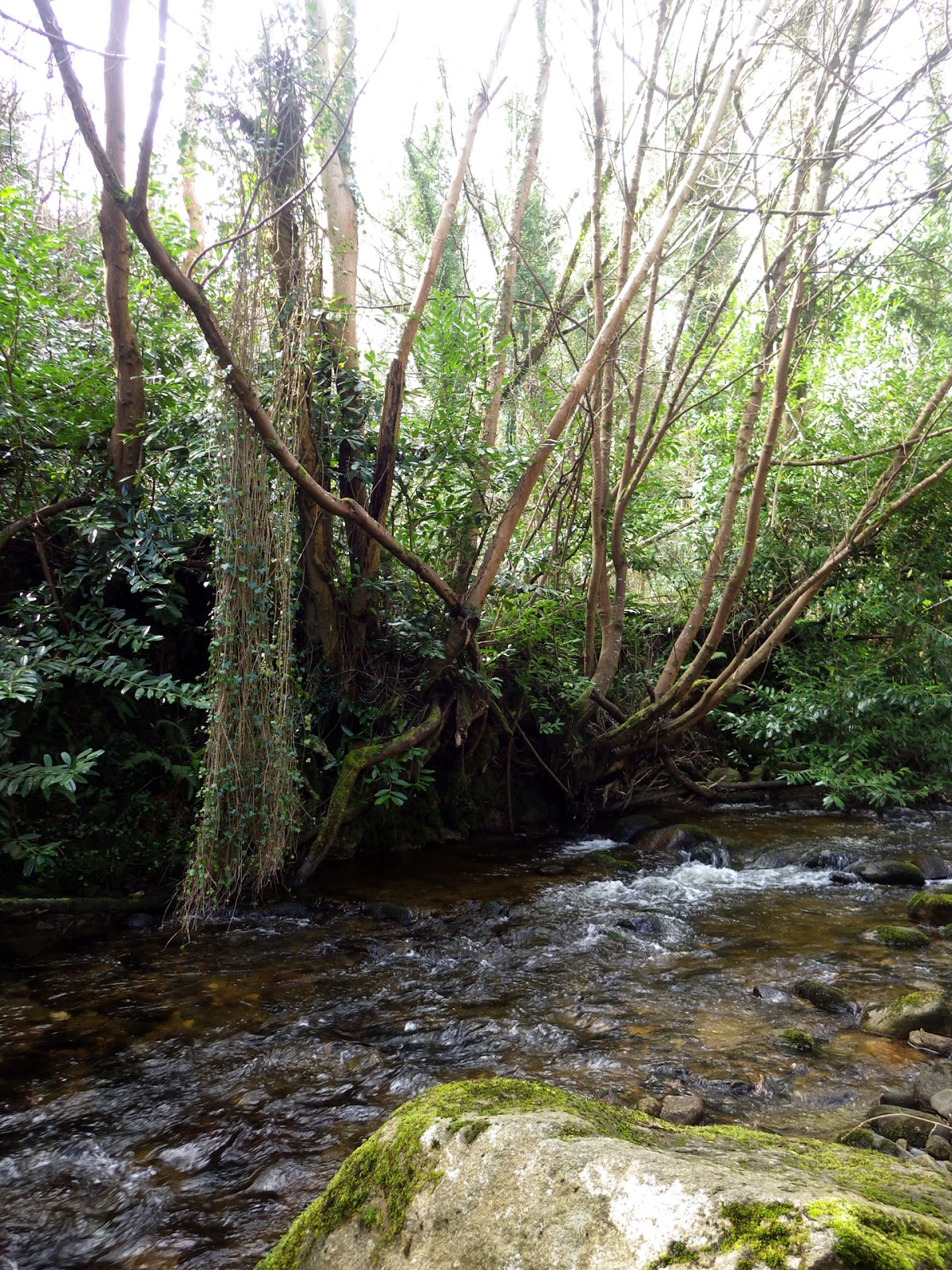
We have had some gorgeous weather over the past few weeks and, as I mentioned in previous posts, I have had the opportunity to enjoy some shinrinyoku in the nearby Knocksink Woods of Enniskerry. As well as foraging for wild garlic to make pesto, I have also been taking the chance to do some research for a project that I am at the early stages of.


I am excited to be going to a one day printmaking workshop at The Print Museum, Dublin this Sunday and in preparation I wanted some sketches of stick forms.


I am not sure if prints created at this workshop will make their way into my final project, but at very least they will be additional research.


 The project involves making books (these sketches are in one of my handmade sketchbooks), prints, and some natural elements like sticks and stones.


These pencil sketches are true to the stick forms that they represent, but by focusing only on the sticks, leaving out their surrounding environment, they have become very abstract.


Wednesday, 22 March 2017

Knocksink woods

The springtime weather is really becoming obvious over the past few weeks. Of course there are some glitches in the form of storms, wind and hail, but the longer days, flowers blooming, trees in bud and quite a few warm days give that great sense of renewal.


With decent weather, and despite the feet still bothering me (almost a year of plantar fascitis!) it was well beyond time for me to partake in some shinrinyoku (forest bathing for relaxation). A short drive inland leads to the lovely Enniskerry and Knocksink woods.


The sun was shining, the sky was blue and the ground cover of wild garlic was becoming apparent. We picked some young leaves (of which there was an abundance!), picked up some crusty bread on the way home and it was simple to whip up a batch of wild garlic pesto (recipe posted previously) and have an almost summery lunch of bruschetta. A perfect day!


Wednesday, 15 March 2017

Eugeen Van Mieghem: Port Life


A week ago I was in Dublin and, among other things, eagerly went to The Dublin City Hugh Lane Gallery to see the Eugeen Van Miegham: Port Life show. I was only familiar with this artist's work through facebook postings from The Hugh Lane and was intrigued. 


This is a close-up of the studio sketch in the upper left of the above photo. Mieghem's drawing is beautifully energetic.


There are a number of large paintings of ships in both wet and dry dock, which are fantastic, but the lighting made it impossible to take photos of them. I loved the gallery's "List of Works" as an alternative to wall labels; the list had colour thumbnails of each picture and as well as the usual details often had a little blurb of extra information.


The work in the show was quite attractive and I could see the comparisons to Edvard Munch, whom Mieghem admired. I have been to the Munch museum in Oslo, so it was easy to understand this comparison in style and subject matter. But the scumbling style of dry brush painting also reminded me of Canadian artist, David Milne, whose work I also love and have seen quite a lot of.


Miegham also did a large number of paintings and drawings of people working in the port, including these two (left in pencil, right in black chalk). The exhibition continues till June 11 2017 and is well worth a visit.


Wednesday, 8 March 2017

Day in Dublin

I had a few things to do on the north side of Dublin and passed by this drawbridge. Actually, I am not sure exactly what this is (formerly a canal lock?) but it seems to be a bit out of place. It reminded me of old Dutch landscape paintings and I thought this was appropriate as I planned to go to the Eugeen van Meigham show at the Hugh Lane Municipal gallery later in the day (which I will post about next week).


In the meantime I took the opportunity to have a closer look at the giant iris outside the NCI building. I had spotted this on a previous visit to Dublin, but the rain kept me from further investigation then.

This stainless steel piece was created by Vivienne Roche and commissioned by the National College of Ireland (NCI) and entitled NC Iris.


On the way to The LAB to see a couple of exhibitions, I came across this plaque on Foley St  in commemoration of specific women who had fought in various places in Dublin during the 1916 Uprising, and generally to all women who had taken part in the activities of 1916, the War of Independence, and the Civil War, which followed.


Although it was in the smaller gallery at The LAB, Lucy McKenna's exhibition, "Astronomical Mashup", was  definitely the main attraction (and totally perfect in the entrance exhbition space).


McKenna combines sci fi mythology with factual knowledge about Mars to examine the way information is understood about our neighbouring planet in specific and on a wider scale in general.


The exhibition is intriguing: it possesses both beauty and humour. McKenna's small scale painted images are delicate while the large graphics are in-your-face technical wallpaper! The overlaps keep perspective shifting while all the time the viewer is aware of the set-like tentacle streams (a la War of the Worlds) hanging from the scenery, and always in peripheral vision in this small space.


Like a moth, I was drawn to the curiosities of the light bulbs, which had subtle photographic images on their back surfaces: a darkened crescent moon on one and tiny spots (the Pleiades) on the other.


I also enjoyed the other exhibition, IAWATST (Interesting And Weird At The Same Time), which took up the main gallery (including upstairs space). It was a group exhibition of work from the OPW collection curated by students from an inner city primary school. I didn't get any pictures from this exhibition, but they are available online and further information is available on The LAB website.

Wednesday, 1 March 2017

Hummus recipe

My cousin and her partner will be in Ireland this week, and they will be having a dinner visit at my place on Friday. My cousin's partner is wheat intolerant, so everything I make for the dinner party will be wheat free. Both my husband and I have decided on a very yummy menu, with nothing glutenous in sight! One of the pre-dinner nibblies will be our family favourite hummus and crudités. As tends to happen with most of my recipes, I just eyeball everything. If using dried chick peas (like I do), soak overnight, rinse, boil for about 1/2 hour with a bay leaf, let sit an hour or so then rinse and drain before adding to recipe.


Sorry I cannot include accurate measurements, but here is my guestimate for the recipe: 1 tin chick peas (garbanzo beans) or equivalent, 1/2 cup yoghurt (I use Greek Style -- adding yoghurt makes the hummus lighter to eat!), 1/2 cup tahini, 1/2 cup olive oil, 2-3 cloves garlic. Throw everything in mixer and whizz till it is a smooth consistency. Add a bit more olive oil or yoghurt if it still seems too thick. When serving, drizzle a bit of olive oil and sprinkle some paprika over hummus. Serve with whatever crudités you like (celery, zucchini, red pepper, carrot and/or cucumber sticks, baby tomatoes, button mushrooms) and it is delicious also with crackers, bread sticks or crusty bread if you are not catering to wheat-free.