Showing posts with label installation. Show all posts

Wednesday, 21 September 2022

PULSE at Limerick City Gallery of Art


Though it seems ages away now, on the way home from The Burren (which I blogged about here) at the end of August, we took the route that would lead us to Limerick as I especially wanted to see the PULSE exhibition at Limerick City Gallery of Art. This was organised as a covid response to the fact that recent graduates (2017-2021) of art colleges had missed out on opportunities for end-of-year exhibitions and/or other exhibiting opportunities that normally follow graduation. There were 16 artists in total, most getting space to show a few pieces of their work.

The artists are: Paul Cashin, Paddy Critchley, Judy Foley, Shane Hynan, Aisling Jelinski, Grace Loughlin, Day Magee, Sinéad McKillican, Katie Moore, Daniel Murray, Andrew Neville, Jonathan O'Grady, Bara Palcik, Sorcha Frances Ryder, Niamh Schmidtke and Nicola Sheehan. *Apologies to any artist whose work is in my pictures below - justice has definitely not been done - my pictures are simply to give an idea of the scope of the exhibition.

The exhibition took up most rooms on the ground floor of the gallery. After entering the gallery, where work was visible the foyer walls, taking a right turn I ended up in two adjoining smaller spaces. In this picture the main entrance is visible with some of the photos from the foyer as well as work of Grace Loughlin in this small room.


Judy Foley's two wall-mounted icon pieces and the tableaux installation to mend an aorta (which won an Irish Research Council Award) were also in this gallery. 


In an adjoining area of this room was Kate Moore's Entropy, an installation of dried gypsophilia flowers.


Several artists with large works were located in a large gallery space. 


I realise I lost the sheet that connected the artists names with their work. There were also several video artists represented in the exhibition, but I could not photograph a screen to give any sense of the work. 


Another large gallery contained the work of two artists, each having space to present mini bodies of work.


These are paintings by Paddy Critchley.


I think the show seemed like a graduate group show, but there was a high level of competence. It was exciting to see most art forms being represented: sculpture, painting, photography, video and installation art. The artists were chosen by Patrick T Murphy (Director, RHA) and artist Aideen Barry.

Wednesday, 18 September 2019

Then & Now: Janet Mullarney at IMMA

A few weeks ago I was delighted to see the exhibition of sculptural work by Janet Mullarney in the hallowed halls of IMMA. Mullarney was one of the first contemporary Irish artists that really impressed me when I had seen an exhibition of hers at the Project Art Centre about 30 years ago!


Mullarney's figurative work straddles that precarious space between dream and reality, fact and fiction - a space close to my own heart.


I concur with IMMA's description of the exhibition: "Although the works presented are diverse in scale, form and materials, they clearly belong to the distinctive world of Mullarney's imagination. Her underlying concerns with the strangeness, darkness and fragility of the human condition also form a connecting thread." IMMA website


Looking at the pictures and thinking about Mullarney's work now, I see a positive affinity with the work of Louise Bourgeois, another artist that I admire.


Mullarney comes from a classically trained background (Florence, Italy) and divides her time between studios in Ireland and Italy. The exhibition brings together old and new work, though I was surprised NOT to see any of the work I remembered from that early Dublin show that had so impressed me. The exhibition runs till October 13 2019.


Tuesday, 12 March 2019

Inspiration from dreams, part 2

This is a very tiny gift sculpture I made for my boyfriend (now my husband) when we were separated by an ocean in 1988. It is based on a sculpture I made in a dream I had around that time. The chairs are moveable. I also think the dream itself was inspired by my mentor at university, sculptor Hugh LeRoy, who I had taken drawing classes with and also asked him to mentor me in independent studies in painting for my final two years in university. Before I had ever met him, I read a review in ArtsCanada about a sculpture he had made featuring an "order" chair and a "chaos" chair. Hugh was also profoundly interested in dream-induced creativity and introduced me to left-handed drawing as a useful method to encourage freedom in drawing.


In 1995 I was living in Kerry and amazed by all the calla lily plants on rural home lawns. But when I dreamed about them they were brightly coloured instead of white. I made a Father's Day card for my Dad that June, with an image of the dream calla lilies. My Dad died a few months later, and I created the piece "Dreaming for Dad" on 2 large net curtains and the companion small icon diptych. When I exhibited them the following year with other works, "Pastures Green", at The Basement Gallery in Dundalk (now called An Táin Arts Centre) I installed them in a separate room so that a life-death passage was clearly represented. I loved the way the lighting reflected muted images of lilies on the walls.


While at a studio residency in the spring of 1989, I enjoyed playing with my dream imagery to create a temporary installation in my studio space at The Tyrone Guthre Centre at Annaghmakerrig. Another painter friend referred to my studio of cut-outs as "The Playroom".


I had been granted the residency to finish work for my first solo show in Dublin, but I only had to complete one large drawing for the exhibition and then I was free to let myself go. I enjoyed drawing images with pastel, cutting them out and affixing them to every wall in the studio.


I know I created this piece sometime after the mid-1980s, based on a dream where I was surrounded by water (but remained dry, kind of like the parting of the red sea in CB DeMille's "Ten Commandments" film) and saw a red-sailed boat in the distance. This is a large (about a metre squared I think) painting/collage on Strathmore watercolour paper - a roll of which was given to me by Hugh LeRoy because he was fed up seeing me disrespect my own work by using newsprint for all my best drawings...I know this work still exists, and is beautifully framed, because it was bought in the '80s by a colleague who is now a very dear friend.


This is another piece, also painted on Strathmore paper (from a huge roll) around the same time as the one above, a variation on the same dream theme. However, I am pretty sure this work no longer exists, other than in my mind.


In my last year of university, 1986, I participated in a group show at the Winters college gallery (at York University in Toronto) and with some other work, presented these large paintings (each panel of the triptych and diptych is 4 ft x 3 ft) based on the red-sailed boat dream theme. Both of these paintings no longer exist, having fallen prey to one of my "Great Purges", a necessity when moving back and forth across continents.


These dream sketches managed to survive, having been recently discovered in my "Grey Box" archive. I know the drawing on the left is created on blotting paper (a nice blurry water effect) and the sketch on the right was created while on holiday in Ireland in 1984, presumably depicting a dream I had during that holiday.


Wednesday, 18 July 2018

Artists in conversation: Jesse Jones & Olwen Fouéré

A few weeks ago I was completely taken with Jesse Jones's exhibition, Tremble Tremble, at The Project Arts Centre. I blogged about it here.


I was delighted then when it was announced that Jones would be in conversation with Olwen Fouéré one evening last week. I made my way into Dublin to attend! It was great to hear the two women talk about how the piece developed and in fact, how it is continuing to develop. Each venue is taken into account as the work deals with installation specifities.  


I had already seen Tremble Tremble prior to the conversation but was entirely unaware that there was a water element until it was discussed by Fouéré and Jones! I must have been focused on something else on that first visit to the exhibition, but I did not miss it on a subsequent visit.


I really enjoyed that, during the conversation, Jones passed around two of the physical objects that were used during the elements of live performance in this exhibition. As with the previous artists-in- conversation events that I have attended, there is such great insight into the process behind the artwork that comes out naturally through conversation.

Wednesday, 21 June 2017

Grad show - IADT - Part 3

I feel like "Define the Line", IADT graduate exhibition, could provide a blog subject for some weeks to come. However, I will only discuss a few more artists and their works and leave Dún Laoghaire's art students till next year.

In the sculpture room display, one could not help but notice the huge, spider-like sculpture that imposed itself on the room. Spider sculptures have changed the art world forevermore, after Louise Bourgeois created enormous bronze works as symbols of the maternal instinct in all its ferocity and elegance.


 Ali Kemal Ali's "spider" is entitled Mind Map and speaks nothing of maternity. It sprawls, it moves (or has the potential to move), it seems more mechanically alien than natural despite the mix of well-crafted materials. Above all, it is beautifully made; a three-dimensional representation of thought processes.


I was drawn away from the imposing Mind Map by curiosity: small boxes were justting from a nearby wall and I wondered what they were.


On closer inspection I realised that these intimate sculptures were only partial "boxes" -- tiny tableaux spaced along the wall so that one could engage with each individually.


Tiziana Prigent-Piussi created tableaux that were meticulous, miniature sets; in my imagination they spoke of unknown stories. One of the sets was even devoid of furnishing such that it exuded the loneliness of an empty stage. When I returned to the exhibition a few days later for the student-guided tour I found out that these pieces, while strong enough as sculptures, were also used as sets for animations by Prigent-Piussi and I was somewhat disappointed  that none were on display.


Another piece that I thought straddled dimensions of thought and theatre, was Trudie Mitchell's predominantly wall installation, Teaghrán.


Difficult to photograph, this piece must have been created most impressively in situ, white cotton thread winding over the wall, creating permanence with glue (but a temporary piece!) it's patterns suggesting landscape contours, weather mapping, ley lines:  demarcations to represent meanings that are not visible to the eye, yet understood and known.


 I had to look up the meaning of the Irish word used for the title and came up with "string" and "tether". While the first may be obvious in the material used, the second has more nuance to it as both a noun and a verb.


As I said at the start, I  have barely touched on the work that was exhibited at the IADT grad show. The work coming out of the art college is exciting and inspiring. The grad show is always worth seeing and exploring; an annual event to look forward to on the art calendar!

Wednesday, 14 June 2017

Grad show - part 2

It seems like ages ago now, but there was quite a bit of good work at the IADT grad show "Define the Line" so I can't just let the blog last week be the sole representative of my musings! Although there was so much work worthy of discussion, I am just going to focus on three artists whose work straddles that in-between area of painting and sculpture, becoming installations in their own right. I was also especially interested in the materials used.


Sorcha Carey's work explored a variety of media (muslin, porcelain, paper) and architecture itself. I particularly was taken by her muslin works - material formed around a door and corner of a door. A complete ghost door hung from the ceiling as a challenge: did this apparition lead somewhere ethereal? What could it be a door to? The corner of a door frame formed on another piece of muslin was strewn on the floor, as if discarded. A fragment of an opening or closure.


Suzanne Daly painted portraits of friends and family on translucent cloth that hung from the ceiling, banner-like. The portraits were stylised and engaging. Familiar as banners, they were celebratory in their ordinariness.


Zunaira Khursid painted motifs based on Persian floral designs. This installation of polythene is part of her Hijab series. Khursid works beautifully within the limitations of Islamic art in a contemporary fashion. The draping of the large piece of plastic across the room from the ceiling and continuing along the floor expresses a welcoming fleibility; the translucent material is like a modern veil - not a barrier - arousing curiosity for what is beyond but not clear.


This is a temporary work - I have painted on plastic in the past myself: as the sun heats the floral designs, they will dry and crack and come away from the plastic ground. There is an element of pre-planned obsolescence and self-destruction in this work that is intriguing.


Wednesday, 7 June 2017

Grad show -- IADT, Dún Laoghaire Part 1

I attended the opening night of "Define the Line", the grad show of IADT Dún Laoghaire art students. As with most art opening nights, it is difficult to spend time with the work; one simply gets an overview. I was back at the college a few days later to attend a curatorial event, which included an optional tour of the show. I was happy to go on the tour, curious to hear what students would say about fellow students' work.


Given my return to some ceramic work in recent days, I was delighted that my "guide" was Emma McKeagney, who was sourcing clay for her sculptural installations and experimentations from her local area of Shankill (the next village north of where I am located). Though her work was collectively entitled "Glacial Till; removed, refined, dissolved, 2017" as if it were one installation with several elements, I had more of a sense that they were related works with similar concerns of time -- history lost and found. That is a big theme, but her clay works provide lots of meat for discussion; for instance, how the artefacts are moulded when left alone, their use, what they tell us, etc. There are material differences between the wet clay and the structure that shapes it (mild steel, white jersey, white yarn) but there are interesting differences between the wet clay in the mould and the dried bowl-form, which had been previously made in such a manner.


As McKeagney's work showed, time-based work does not have to take the expected media form one usually associates with it, i.e., film, video and photography. Several students were tackling the concepts of time and movement through sculpture.


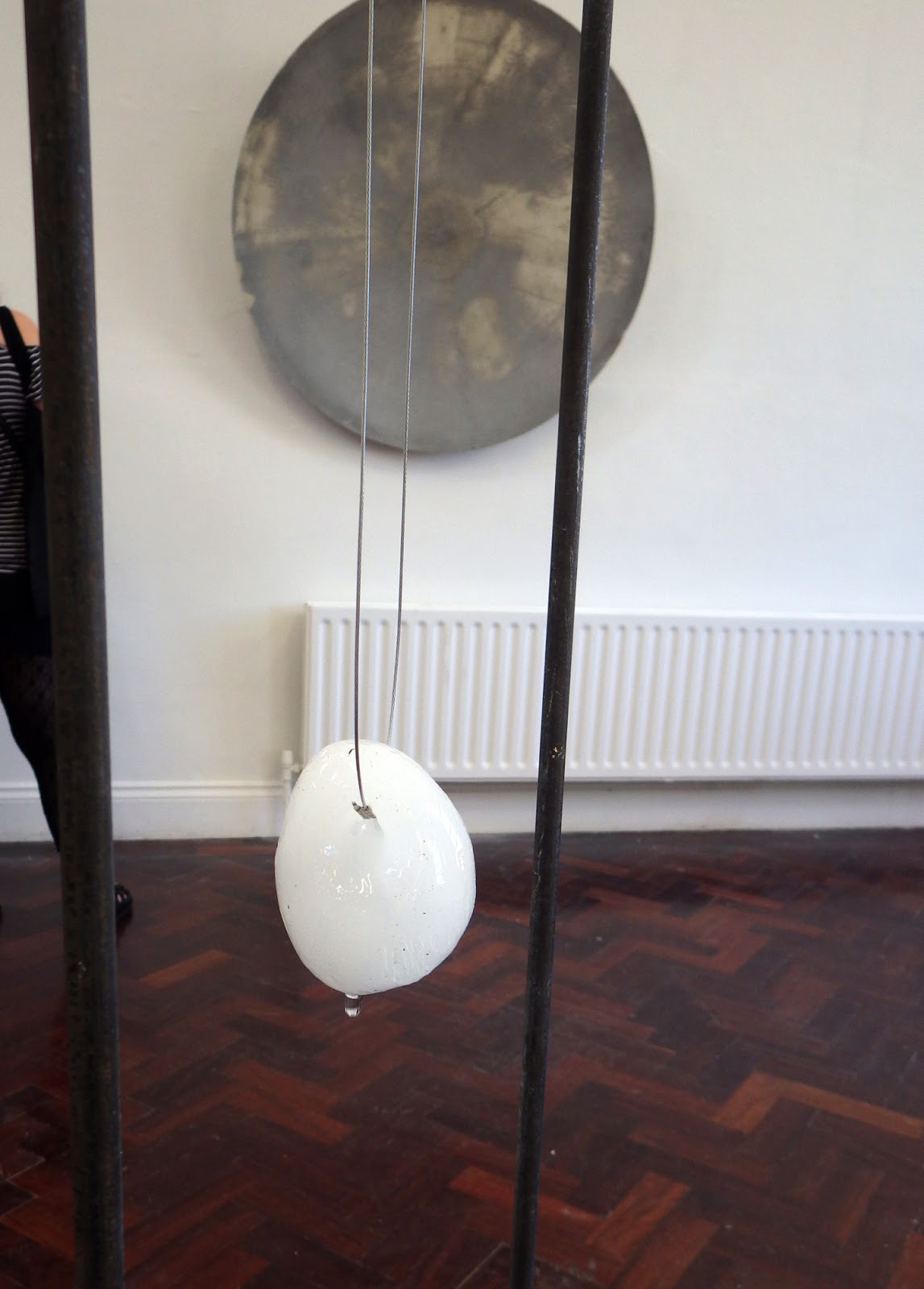
Lorcan McGeough also added sound into the mix of his interests. He had several large sculptures that resembled inner ear shapes, but I was intrigued by works that incorporated blocks of ice suspended over well-like structures: the ice would slowly melt and drips would create quiet, sporadic sounds that were dependant on how much melt had preceded them.


"Define the Line" was an exciting show of graduate art student work. There was much good work in the exhibition and I will discuss a few more of my favourite works in next week's blog!

Wednesday, 12 April 2017

Jai Jai launch

Though it seems like an age ago now, it was less than two weeks ago that my friend Jai Thorn launched his fashion-art label Jai Jai at an evening event in The Chocolate Factory, Dublin. Jai's exhibit was a tactile mix of organic matter and living material. 


Despite the use of a male and female model, the garments themselves are conceived as "gender non-specific" and the models are perceived as vehicles for the movement of the garments; the choreography of the interaction between materials is paramount.


While the guests were invited to wander the space throughout the event, one looked at the still environments as sculpures most clearly during periods of time when the models were absent from the space. 

During the first presentation, the individual models slowly moved around the warehouse space, interacting with the sculptural materials throughout,


 After an interval, in a second presentation, the models reappeared in different garments. There was a heightened sense of change as there was more interaction with each other while the models continued to visually and psychically explore the materials of the environment-sculptures.


Even while the sculptures were still, one always had a sense of movement because of dynamic forms and the use of living material -- soil and plants.


Wednesday, 2 December 2015

Grey Box Archive 2

 I mentioned a few posts ago that I discovered a box of drawings and sketches while looking for some paperwork. So I thought I would post a few more. The pencil sketch below is from the early 1980s, of the basement bar at the house where I grew up in Toronto. My parents returned to Ireland in 1983, so I was probably getting maudlin or nervous about the impending doom!


The wind is absolutely howling outside my window so this charcoal sketch seems appropriate. It is of the Irish Sea on a stormy day in either 1989 or 1990 when I had my earlier (second bout?) of living in this country.


In the summer of 1990 I returned to Toronto, and participated in a group show "Me & 9 Others" at the Orient Building at Queen & Bathurst. This is a sketch of the piece I later put together as part of an installation. It is an elongated house on a trellis. My Dad helped me build the house and the trellis (which in the final piece I painted yellow). In the final piece, you could peer in the window to see a figure surrounded by floating stars (made of fimo) and I wove live roses into the trellis, rather than scattering them; over the course of the exhibition they wilted and dried. Behind the sculpture was a large piece of paper, half left blank and the other half with an oilstick drawing of two waterspouts over a stormy sea. This piece is not documented very well -- I have a couple of polaroid details (somewhere...), The sculptural element was bought by poet Janette Platana, but that was 25 years ago, so I don't know if she still has it!


 This watercolour is from 1990 and was created in Ireland, but I don't remember exactly where -- Bray or Howth perhaps?