Showing posts with label etching. Show all posts

Wednesday, 25 January 2023

Rooftop Archive 3

For previous posts on the rooftop archive, see here, here and here. One of the large portfolios from the roof archive had some large prints that friends had traded or given to me – some even inscribed “Happy Birthday, Lorraine” or “To Lorraine”.

This is an etching my good friend, Elizabeth Canfield created in our final year at CTS art school (1981). Although it is undated, I remember her working on it in the print room. It is the second print of an edition of four and the image size is 60 cm x 45 cm. 


This print is also by Elizabeth Canfield and is an undated photo-etching from when she studied printmaking at York University in Toronto (1982-1986?). It is entitled “The Ride” and is 45 cm x 60 cm. 


This etching is by my friend Jay Dampf (RIP) and is from our final year CTS art school printmaking class. Though unsigned and undated, I remember Jay working on this and giftng me the piece. The image size is 60 cm x 45 cm. 

This is a unique serigraph by Scott Gwilliams, who went to the same art school in Toronto, though in a different year than I. It is entitled “David” and dated 1983 by which time I was attending the fine art department at York University. The diptych image is 50 cm x 70 cm and dedicated to me for my birthday.

Wednesday, 11 January 2023

rooftop archive 2

 A few months ago I decided to go through a number of portfolios that were in storage on the rooftop section of the attic (the other side of the wall from my studio). I blogged about opening the portfolios and finding things here and wrote about some of the early works here.

Going back a little bit further even, I was pleasantly surprised to see that I had held on to a few prints from CTS art school in Toronto. I think Blue Egg, an undated silkscreen print measuring 70 cm x 59 cm in an edition of 10 (this print is 10/10) is from late 1980 when I was in my third and final year. 


Also from my final year at CTS, though early the following year (1981) is an untitled etching. I did a test print of the linework before I added the aquatint.


 I remembered being teased mercilessly at the time by my friends/fellow art students for always painting and drawing sleeping subjects!

Although I did not pursue printmaking again till decades after art school, for awhile I enjoyed making monoprints - simply painting on the back of zinc plates and pressing them to paper with a wooden spoon as I didn't have access to a press. That summer of 1981 I became obsessed with tulips and I remember creating a series of monoprints of them in the basement of my parent’s house in the wee hours of the morning listening to an old record of Cream on a 1970s space-style Panasonic stereo. I loved the song Deserted Cities of the Heart, both the lyrics and Ginger Baker’s drumming. As I used the same zinc plate, the untitled works were all 38 cm x 28 cm. My good friend and cousin was visiting Toronto that summer and I gave her two from this series to take home with her – they are framed and on her wall in London to this day. Only those two, this one and one other from this series still exist. 


By time winter came along that year, my tulips became stemless and were more abstract. I remember creating this piece while minding a sister’s apt in downtown Toronto. It began as an oil pastel drawing within a matte frame and then I painted the surface with turpentine, so I am not sure how to categorize it (painting or drawing?). Untitled, 40 cm x 23 cm.

Wednesday, 14 July 2021

Anonymous Archive part 2 of 2

I blogged last week about anonymously and unexpectedly receiving some of my old work and you can read about that here, because I am now continuing from where I left off.

This print I was very happy to have back, as I do not have any other copies myself, but had never forgotten my work on it. Based on a sketch I did of one of my young nieces asleep, I wanted to recreate that variance in pencil linework and spent many hours of class time in the print room with my zinc plate in an acid bath to create this variance. I remember, in 1981 (my final year at CTS in Toronto) being so pleased that the test print showed the lines as I imagined.


My printmaking teacher convinced me to fill in my minamilist approach with aquatint, which I had never tried before. Although I took a similar attitude with the aquatint - giving it many "baths" in order to have a variance in shadow, I remember being hugely disappointed in the resulting test print. I thought the aquatint overwhelmed the linework.


I am not so disappointed now, though, as I think there is a good contrast between the lines and the shadows. I know I only made a very small edition, but since I have no idea of the provenance of the others, I am quite delighted to have one of the final prints in the edition.


After I finished at the Special Art Programme at CTS, I carried on with my own work as a developing artist. That summer I was very interested in specific flowers as representative of my self. I also made many monoprints, using the backs of zinc etching plates. At this point I do not recall whether these represented red tulips or rosebuds...
 

In the fall of 1981 I started working as a temp in an office in downtown Toronto. Because the employer had a policy that encouraged "staggered hours", I ended up starting work by 7.30 am so that I could go home in the afternoon before rush hour. As winter wore on I found myself at my desk watching the sun rise through the office blinds. I found this broken cityscape view quite inspiring and later did quite a number of sketches of it. I only finally did a large painting in 2015, Fractured City, which was inspred by this time and the sketches I did back then.


I was surprised to see this slightly later work in the Anonymous Archive. Still from the 80s, I did this mixed media piece as part of a series that ended up being exhibited in Winters Gallery at York University (while I was in my final year there in 1986) and then at Charyk Gallery in Downsview. At the time I was very interested in metonymy, visually as well as verbally, where part of the whole represented the whole. In the case of this series, the hand represented the body.


Wednesday, 19 April 2017

Lucian Freud Project at IMMA

I went to the Irish Museum of Modern Art (IMMA) recently to see the Lucian Freud work, which will be exhibited in the Garden Galleries for the next five years. While at the moment all the work is being exhibited as a large collection, I got the impression that over this period that the work may be exhibited in different curatorial permutations, so now was the time to see the work before there was any personal "agenda" attached to it! This etching is Self Portrait: Reflection, 1996. 


I have to admit that I was never particularly interested in Freud's (what seemed to me) hyper realistic painting before, but there is something compelling about seeing a collection of works together. And that I have long been interested in psychoanalysis. And that there is an unmistakable psychological element in his work that definitely is reflective of the work of his grandfather. So the name becomes part of the intrigue, and part of my reason for going to the exhibition. This etching is Bella in Her Pluto T Shirt, 1995.


The basement gallery was devoted to works on paper, mostly etchings. Given my relatively recent interest in printmaking, I was delighted to find the room full of work that was unfamiliar to me. This etching is Girl with Fuzzy Hair, 2004. I thought this print was especially interesting as I thought at first the white highlights in the hair were were created manually when wiping off the plate before going to the press. However, there was another print with similarities and the display included the metal etching plate; the highlighted areas were actually burnished on the plate itself! These burnished highlights in curly hair are a major feat of burnishing brilliance!


There were quite a lot of etching portraits in this exhibition, which had incredible detail and certainly did not speak of flattery; as I said above, something about psychology and the artist's name... This etching is The New Yorker, 2006.


Although most of the basement gallery exhibition displayed images of people, there were several landscapes, which also indicate Freud's meticulous translation of observation. This gorgeously detailed etching is Painter's Garden, 2003-2004.


Wednesday, 5 April 2017

Intaglio and Chine collé printing

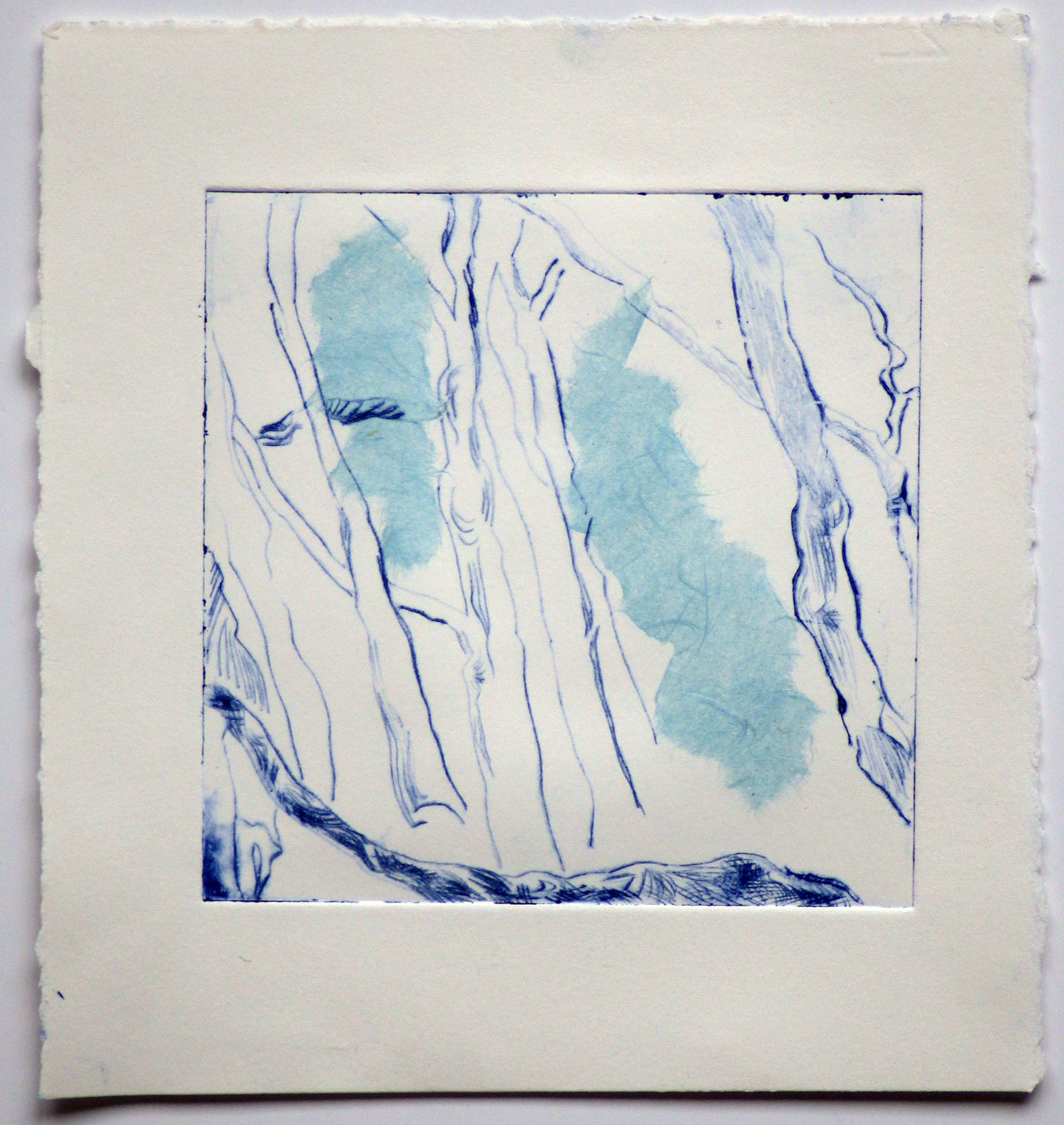
I was out early on Sunday to head into the National Print Museum in Dublin in order to attend a printmaking workshop given by artist Elaine Leader. I signed up for this workshop because the technique of "Chine collé" was featured and I have been curious about this technique since I became aware of it about 20 years ago (I had never heard of it in printmaking classes I had in art school in Toronto). To start the day we were given some pieces of thin plastic (or thick acetate?) referred to as "axpet" (which I had also never come across before). Once I removed protective film from the axpet I could use it as a plate to do an intaglio sketch on. My tool of choice (we had our pick of several  etching tools) was a converted large sharpened nail. I ended up with two plates, the first one, done in the morning a city ruin sketch and the second, done in the afternoon based on one of my stick sketches.


The plate was inked with a dark ink, cleaned and then given a "roll-out" layer of translucent colour. For the Chine collé I ripped two random pieces of a light weight handmade paper. Wallpaper paste is thinly spread on the back of the paper and they must be placed upside down on the plate (so that the glue will adhere to the print paper). The Chine collé is the last thing to do before going to the press as the paste must be very thin and thus can dry out quickly -- make sure your paper has been removed from its water bath and blotted before you prepare the Chine collé paper!


We were printing on lovely Fabriano paper, so it needed to be in the water bath at least 10 minutes before blotting.


This is a close-up of the sticks print, with two pieces of Chine collé.


 Although I had the sticks plate ready to go, Elaine Leader was talking about the embossing technique, and I wanted to quickly try it out. I cut several pieces of sandpaper into "natural" shapes, got my paper ready, and at the press itself, placed the shapes onto the back of my first piece of axpet. A piece of tissue paper is placed between the plate with shapes and the paper, which keeps the paper clean (and in my case, it was a great barrier between the paper and rough sandpaper I was using for incredible texture).


I was thrilled with the way the embossing worked and wanted to see if Chine collé could be worked with it, so I started the process again. 


I thought the workshop was fabulous! I learned so many things in such a short space of time and can now think about how these processes can be used in other works.