Showing posts with label Venice. Show all posts

Wednesday, 27 November 2019

Peggy Guggenheim Collection - Venice


On my last gorgeous day in Venice, I visited the Peggy Guggenheim Collection. It was fantastic! It was a lovely building with intimate galleries and a terrace overlooking the Grand Canal. The collection was superb - I felt like I was taking a stroll through the history of early to mid 20th century art, as I recognised a good number of the artworks from art school textbooks.

Guggenheim was very interested in collecting Cubist and Surrealist works when she first started collecting, so there are a number of works by Picasso, Braque, Giacometti, Magritte, Duchamp, Gorki, Richier and others. Indeed, Duchamp was one of her advisors at the beginnings of her project in London. This Picasso is from 1937.


I loved seeing this scrumptious painting by Grace Hartigan, whose work I did not remember learning about in art history classes, but who was apparently just as well-known in the New York art scene of the 1940s and 1950s as all the male artists who were written about later in texts. I am certainly very aware of how female artists (scientists, thinkers, etc.) seem to have been erased from the collective memory, but are now suddenly reappearing (reclamation!) as having been there all along.


Another woman artist whose work with which I was unfamiliar, is Lynn Chadwick. This small sculpture from 1955 begs to be a large, public sculpture but I really enjoyed the lighting which created defined shadows on the wall behind it.


It was also a joy to enter a room and see Constantin Brancusi's Bird in Space in the flesh (so to speak). A staple of modern art histoy, I have seen reproductions of this work so many times in books.


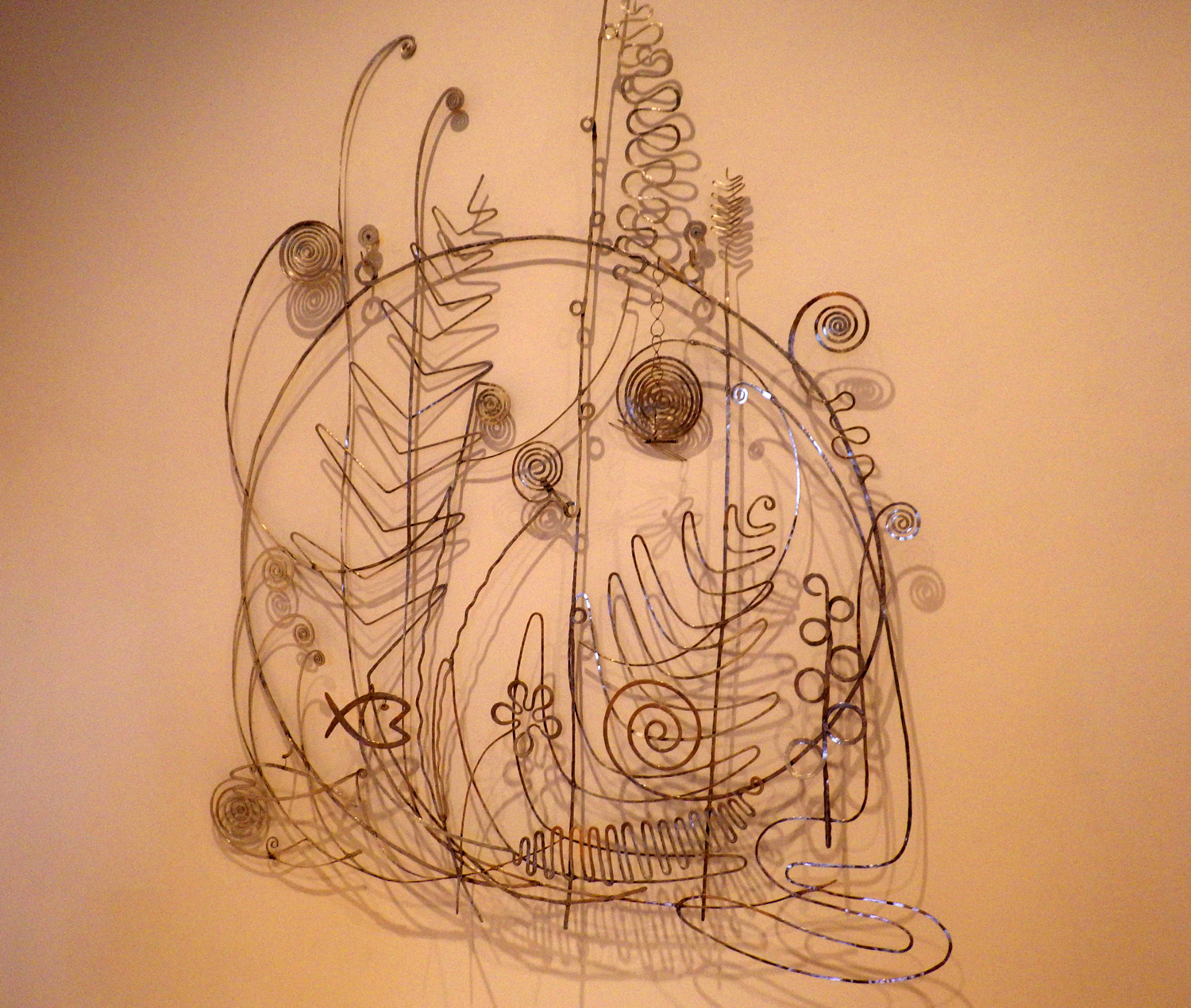
I attended the Gallery School on Saturday mornings when a teenager, after receiving a scholarship from the Art Gallery of Ontario, and one of the first things the class was shown was a short film about Alexander Calder, as an introduction to modern art and methods of a modern master. So it is always a joy for me to see Calder's work. This piece is unusual from other works of his, that I have seen, in that it is two dimensional and wall-mounted, as opposed to mobile and free-floating.

There were several large Jackson Pollock paintings, which are never a surprise to see in a major collection, but always a delight.


While there was minimal and geometric work by Vladimir Malevich, an artist whose paintings I have always liked, in the same room I found myself attracted to this piece, by another woman artist of whom I had never heard. The work of Irene Rice Pereira, while being two dimensional in form, appears three dimensional through layering and reflective surfaces.


I had to do a double-take when I saw the didactic for this work as I am familiar with the writing of English playwright David Hare but have never come across his American sculptor namesake before. Once again I found myself as much enamoured by the lighting and well-defined shadows as I was by the artwork.


The large 2017 sculpture near the café by Joanna Migdal gives proof that this collection continues to grow. Peggy Guggenheim bequeathed her collection in Venice to the Guggenheim Foundation and, though it is a magnificent historic collection, it is not static.


Wednesday, 13 November 2019

Venice Biennale - Arsenale curated exhibition

I had bought a 2-day/2 venue ticket in advance of going to Venice, and the first day was spent at the Giardini venue (see here and here for my blog reactions to this!) and the second day was allocated to the Arsenale. As with the Giardini, there was a mix of national pavilions and individual artists as part of Ralph Rugoff's curated exhibition, May You Live in Interesting Times. According to Rugoff's fascinating catalogue essay, the exhibition was divided into two "propositions" - A & B - in the two main venues in order to present different aspects of the artists' work and method of working. Thus, even within two very large group shows (80 artists!) I recognised the names of creators at the Arsenale, whose work I had seen the day before at the Giardini.

Though I did not recall seeing Yin Xiuzhen's work the day before, I was drawn to the huge figure in an airplane crash position. The figure and airplane seat made from dyed clothing was compelling.


One could examine the sculpture from all sides and get a full, claustrophobic sense by entering it from a small opening at the back. The interior was most alarming as sleeves and pant legs from the clothing hung above and around one at a touchable distance. I had the feeling that these clothes were metonymic, representing actual people, possible victims of air incidents. And further, this could be taken to have the larger meaning, which Laurie Anderson expressed in "From the Air" nearly 40 years ago -- "we're all going down together". Certainly Rugoff, and many artists he has chosen to exhibit, express a great concern for the current state of the world.


Wandering into the room housing Shilpa Gupta's installation, For, in your tongue, I cannot fit, I was taken by the crowd of viewers/listeners examining each individual section; I quickly joined them. Above each spiked, text page was a microphone speaker. There was something chilling about the voices, the spiked pages and the overall imagery.


I found out later (I read the didactic before leaving the room) that the pages and the speakers represented the individual voices and words of 100 poets, from the 7th century to the present day, who have been imprisoned for their work or political thought.


Along with Gupta, as an artist whose work resonated with me and stood out in my memory, as I had remembered her work from the Giardini (the destructive gate), I was also delighted to see more work by Christine & Margaret Wertheim.


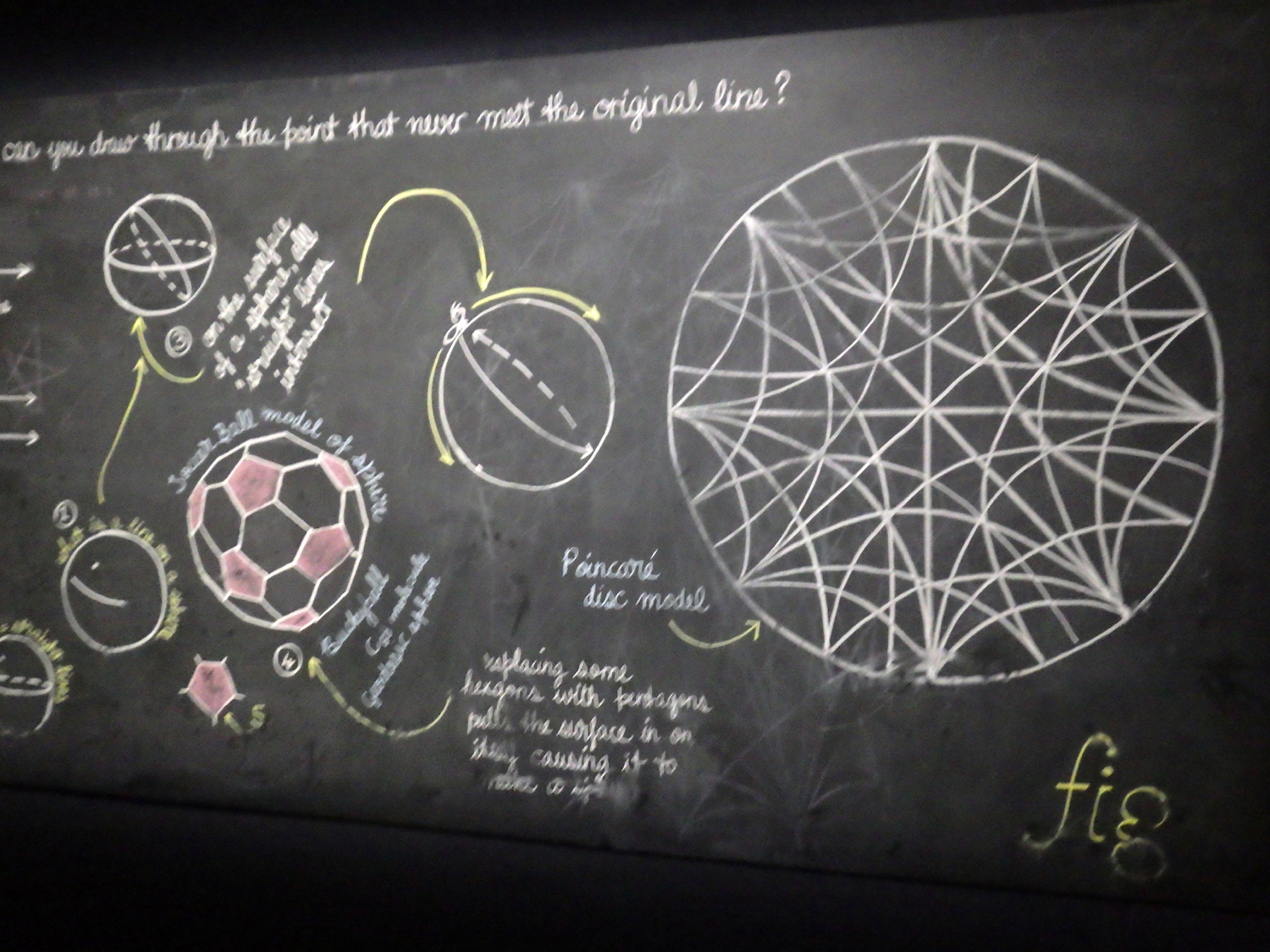
The craft of their crochet work was given a mathematical/philosophical explanation. Through the use of the old-fashioned teaching tool of chalk and blackboard, one started to have a learning experience (and to me this echoed the work of the likes of German avant-garde artist, philosopher, and political thinker, Joseph Beuys and American poetic physicist, Richard Feynman). The Wertheims are in venerable company with their working methods


and their work. The ropey spiral of crochet reaches up and up, to great heights of contemplation.


While some work seems to reach to the stars, other work has plumbed the depths. Quite literally. And emotionally. And controversially. Christoph Bȕchel's Barca Nostra is the actual migrant ship that sunk in the Mediterranean, after a botched rescue attempt, causing the deaths of possibly over a thousand people who were locked in the hold. The ghost ship is both a monument and memorial to the victims of human trafficking. It is a deadly reminder that in our world there is no freedom of movement for most.


While Barca Nostra most definitely is what it is, Alexandra Bircken's post-apocalyptic installation implies it's appearance: what appears to be hanging bodies or skins of hanging bodies, are latex dippings of cloth. Although the catalogue refers to an upward movement of the figures, their suspension from ladders indicates to me that the movement is downward. Birken's Eskalation provides an image of the end of humanity from a nightmare; Bȕchel's Barca Nostra, perhaps lacking the poetry of  Bircken, provides a fully awake image of the end of humanity.


There was so much amazing work in this exhibition, it is quite impossible to discuss in a short blog. This brief glimpse, however, serves to touch on the tip of iceberg and make one realise that there is much to discover at the Venice Biennale. I, for one, plan to return and see future exhibitions. The Biennale is an amazing showcase where one does not have to travel far to be amazed, exhilarated and challenged by current art and ideas.

Wednesday, 6 November 2019

Venice Biennale - Giardini curated exhibition

In addition to viewing nearly every national pavilion at the Giardini (one was closed and another had queues, so we didn't hang around!) the central pavilion contained Proposition B of the huge group exhibition May You Live in Interesting Times, curated by Ralph Rugoff. Before going to Venice, I had read a number of articles and reviews of the Biennale and one of them gave the information that there was an equal number of female artists included in the exhibition as male artists, and that "unusually" all 80 artists are still living. I kept this little nugget of information in a happy place, and wow! was I impressed by the work! 


As I have been very focused on printmaking of late, I took an especial interest in the giant manga-esque woodblocks by Christian Marclay. Marclay is an American living and working in the UK.


This large gallery also contained Mexican artist Teresa Margolles' wall, Ciudad Juarez, which is part of a real border wall containing bullet holes and its memory as a site for execution. It is a reminder of the reality of a wall amid absurd demands of the current American president to build a complete border wall between Mexico and the US.


The exhibition contained works in any and all media and within the spacious pavilion, divided into a multitude of galleries, each artwork held its own. There were a number of artists who were painters and it was great to see large and different approaches to painting. I was taken with Julia Mehretu's abstractions. Mehretu was born in Ethiopa but lives in the US.


Wandering into a semi-darkened gallery was like walking into a display in an aquarium. Indeed, the individually lit display cases had an aquatic feel about them until, taking a closer look, the "corals", sections of "reef"  revealed themselves as finely crafted, crocheted and beaded soft sculptures by Christine & Margaret Wertheim. In fact the Wertheims have spearheaded an international collaborative project to recreate the beauty of the reefs and highlight the fact of their destruction by pollution and global warming. They are from Australia but live and work in the US.


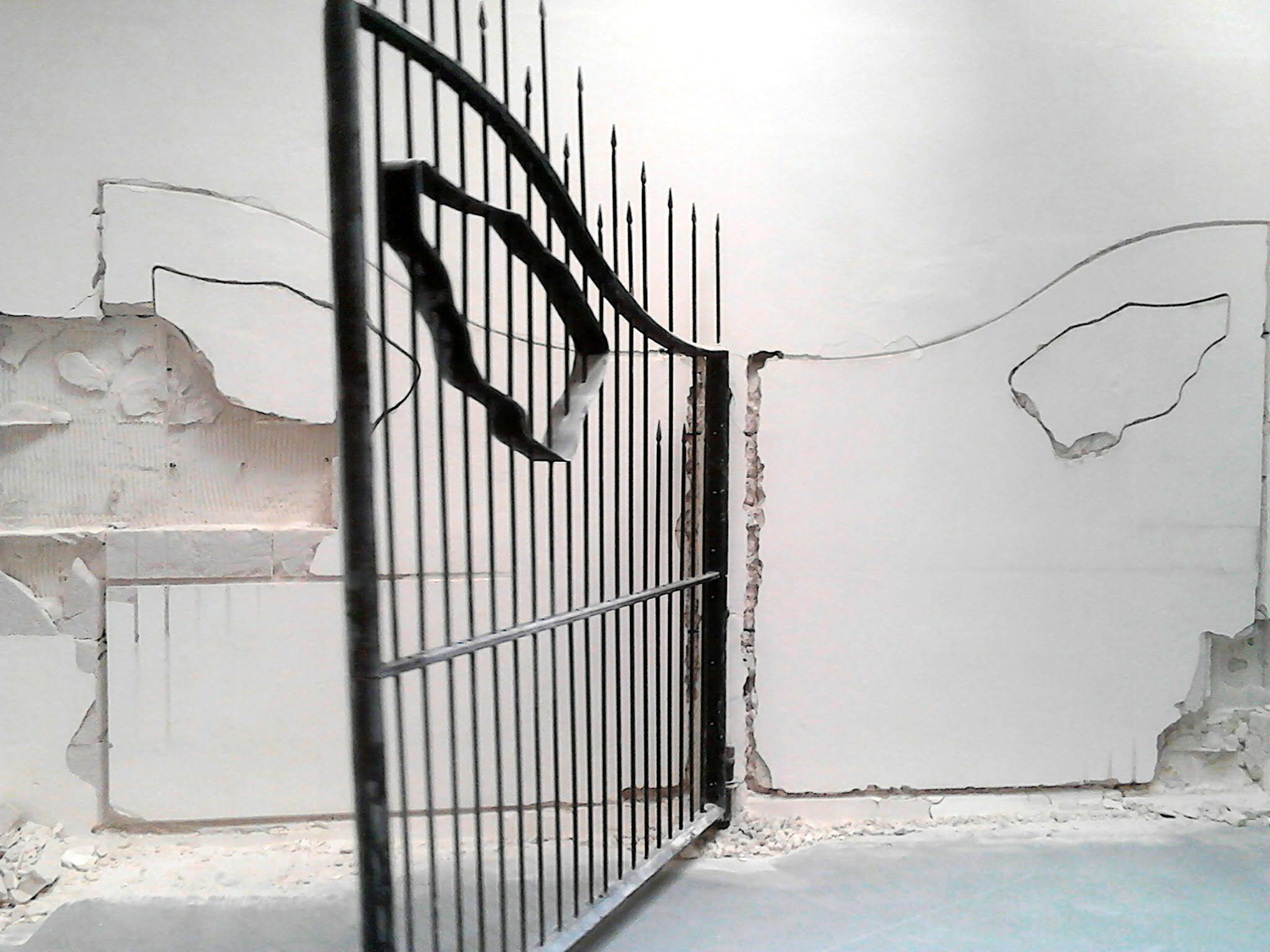
The popularity of destruction was very obvious, as I, along with a small crowd of adults and children alike, were mesmerised by Indian artist Shilpa Gupta's heavy gate slowly swinging back and forth and hitting the wall (fulcrum to the swing) with a noisy clang. The gallery wall shows the havoc caused by the gate and there is a measure of suspense as the viewers await further deterioration.


The exhibition was huge, varied, thoughtful and provocative. Rugoff curated an exciting and inclusive exhibition (and this was only half of it - Proposition A was at the Arsenale, which I would have the chance to view the next day and will take a peek at in next week's blog). There were many more artists whose works I found fascinating, but at some point I knew I could not keep taking pictures, rather, I examined and enjoyed without documentation in mind.

Wednesday, 23 October 2019

Venice

I felt like I was stepping straight into a Canaletto painting with this view of the Grand Canal from the Rialto on my first day in Venice! I hadn't slept at all the night before, so I was truly in a dream, but the photos prove my dream was very close to reality.


We had run to the back of the vaporetto so got a lovely view of the Rialto as the boat pulled away from the dock.


It was a beautiful day: sunny and warm and clear-skied. Public transport on a canal is so pleasant!


On the Grand Canal there are many gondola docks


and it is so lovely to compare all the styles of old architecture, various types of arch...


and excited tourists on their first ride in a gondola (I went on a night gondola ride, which was magical!).


I passed St Mark's Square and the Doge's Palace, as I was in for the longer haul trip to the Giardini, one of the main venues of the Biennale.


The Giardini is a large public park with most of the national pavilions of the Biennale and there are, of course, lovely canals and bridges along the way.


 It was a perfect day for being outside, walking between the pavilions and taking in the sunshine.


The next morning I experienced the Venice fog, but this too was atmospheric. It burned off by the time I got to the Arsenale anyway - the other main venue for the Biennale.