Showing posts with label archaeology. Show all posts

Wednesday, 14 September 2022

The Burren

The last Saturday in August saw me head to Clare for the Furnace Festival at Caherconnell Fort. It was a hot summery day for watchers, but especially hot for the iron smelters and blacksmiths! 

As a specific experiment was being tested, all the furnaces were of the same type and generally the same proportions, but the smelters individualised there furnaces with kaolin designs, such as the Sheela-na-gig design on the foreground furnace. The smelters were particularly happy with the quantity and quality of ore smelted from the midland bogs.


The site of Caherconnell Fort gave the blacksmiths the specific project of reproducing some of the archaelogical finds from there (an iron belt buckle, arrow heads and a sickle). Caherconnell is a stone fort, of the kind found in abundance in the West, though I was disappointed in the contemporary interferences (numbers corresponding to a self-guided tour booklet, ropes blocking off areas, etc), which I thought marred the site and lowered this fort in my esteem when compared to other stone forts that I have come across, especially when I lived in Kerry. (So I was hardpressed to take a photo of the fort.)


A drive through The Burren always makes me think of what it must be like on the moon. Except the land is NOT barren, it can only be described as unique.


The Burren is an area of exposed limestone, with very little topsoil, but the "grykes" - the fissure area between "clints" (flat, exposed rocky areas) - protect soil and allow plants to grow as well as small wildlife (I have seen an abundance of frogs there in the spring). For further information on The Burren check out the national park website here.


Of course, a visit to The Burren necessates a visit to the iconic Poulnabrone Dolmen. Lucky for me I had a chance to walk around it before the FIVE tour buses unloaded their curious cargo!

Friday, 22 July 2022

Printing on textiles - summer course at NCAD part 2

I previously blogged about the Introduction to Printing on Textiles course that I did a few weeks ago here. This is the second part of that account of my adventures at NCAD. I was thinking about French painter, Henri Rousseau, when I was figuring out imagery for my linen napkins. Here is one of his most famous paintings, The Dream.


After seeing the heat press demonstrations with foliage, I had an idea that I wanted the linen napkins to have a lush foliage design and I kept thinking of Rousseau's work. Here is another of his paintings showing what was in my mind.


I started out thinking that I wanted an overall background colour of green, so painted a sheet of newsprint (with the special ink for the heat press) that was roughly the same size as the napkins.
 

I used the negatives from the Yupo paper to block out the wild rose, and various bits of foliage to block out areas that I did not want the overall colour to go on. The Yupo paper, which is synthetic, melted in the heat press! But I decided it was an unnecessary precaution anyway as the fuschi screenprint of the wild rose was a stronger colour than anything to overlay it. I also decided that I didn't really like the white foliage areas, even if I did like the foliage shapes.


So I painted some other greens on newsprint and ripped pieces to make a sort of collage of colour, including cut-out leaf shapes and real foliage.


This random collage and colour was more satisfactory to my sensibility and my plans were then to just keep layering as I went along.


The class was a small group, so by time my collage layer was ready, the heat-press was free and it was my turn to do another sixty second countdown.


Up until it was time to clean up on the last day, I was working on my layers. I photographed the finished napkins on a bench outside the work room and the sun was absolutely streaming through the huge windows.


These pictures give some sense of the finished napkins. The colour seems fairly correct on the wild rose, but the individuality of all the foliage is easier to discern in real life.


As well as Rousseau for the foliage, I think I was also channeling Botticelli's Birth of Venus by having the silkscreened goddesses emerge from the wild rose. It was an intense, productive and fun week learning this process!

Wednesday, 13 July 2022

Printing on textiles - summer course at NCAD part 1

A couple of weeks ago I attended the Introduction to Printing on Textiles week-long summer course at the National College of Art & Design (NCAD) in Dublin. The experienced, patient, wonderful and lovely tutor was artist Mel Bradley. On the first day she introduced the small class to heat press printing on synthetic fabrics so that we could gain some understanding of the possibilities of this process. The day was one of experimentation and fun!


On the second day Mel gave some demonstrations of silk-screening on fabric and how to create our own stencil designs using newsprint and/or Yupo paper (a more robust synthetic paper).


Mel's demonstrations, of course, made everything look so easy, but she was also using very simple techniques and basic shapes to prove that designs did not need to be complicated to be beautiful.


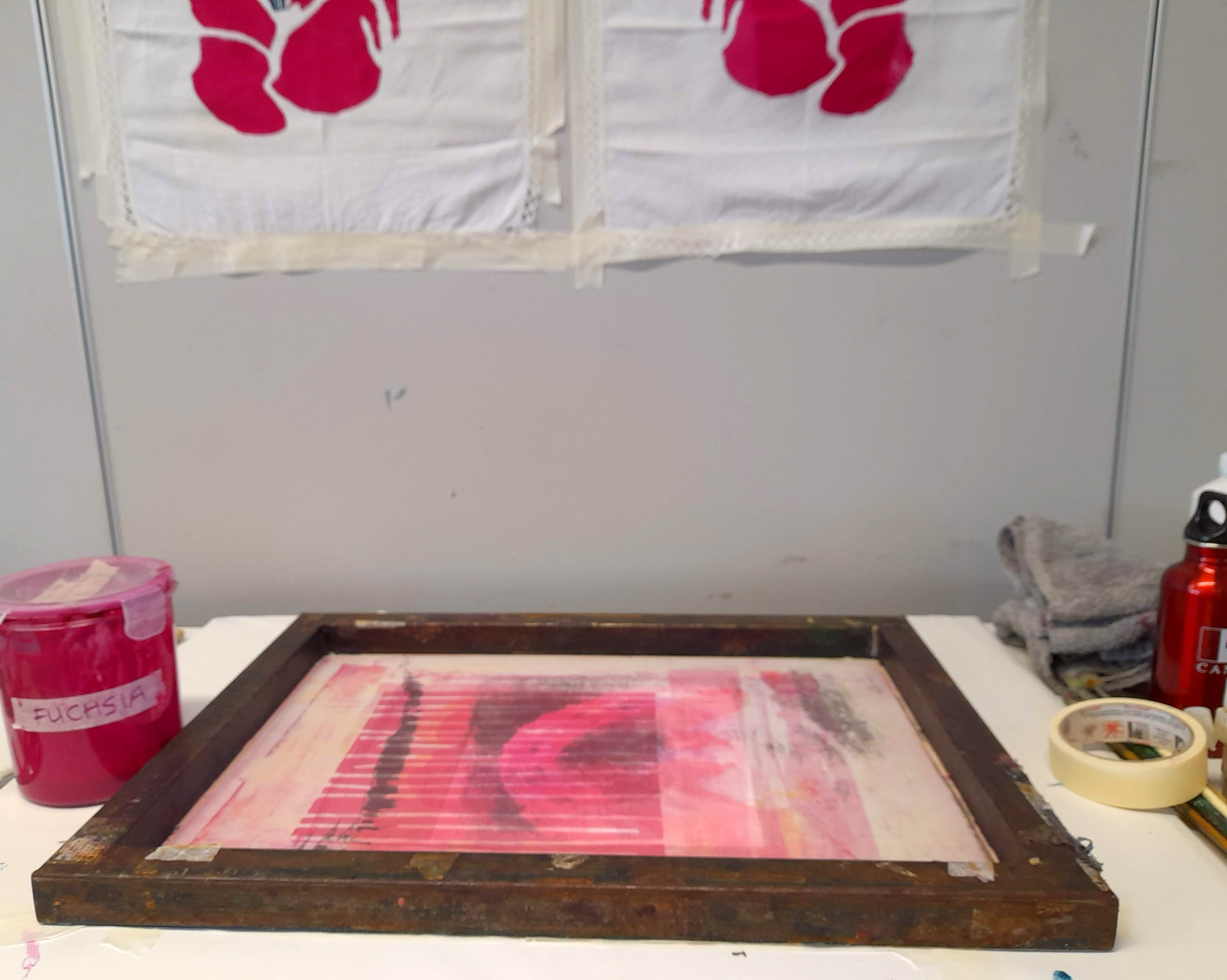
When I got to the class on Tuesday morning, Mel and her assistant, TrĂ­ona, were preparing workboards for everyone, which was soft on one side and covered with wipeable oilcloth, and hard wood on the other side for cutting. This is my workboard in my workspace before I started working!


I cut out a basic wild rose stencil from Yupo paper to be my basic screen image. I had brought in six linen napkins that I wanted to refresh with textile design and I also brought in four tiny silkscreens of archaeological goddess images from different cultures (for instance, an image of the Venus of Willendorf and  an image of an ancient Egyptian Venus) that I had prepared many years ago.


This is the wild rose silkscreened onto the first linen napkin. As you can see, the cloth must be taped down to the soft part of the workboard before screening.


Here are two napkins with both the image of wild rose and goddesses screened on them, hanging on the wall to dry completely before I do anything else to them.


Midweek I brought a few acetate rose leaf stencils into the class thinking I might use them. My husband had made these stencils when he was painting his suit jacket for our wedding in 1995. Here I used a hard round brush to stipple ink onto the linen through the stencil, but decided this process took too long and it wasn't actually what I had in mind for the napkins. Though I knew already that the heat press process and inks would not be as intense on natural fibres (such as linen) I decided that it was this process that I was most interested in and planned to spend the last two days with working on foliage to get all six napkins completed by the end of the course. I'll continue with the results on the next blog!

Wednesday, 6 April 2016

BrĂº na Boinne

My 92 year old mother had never been to Newgrange, so another visit there was a necessity!


A UNESCO World Heritage Site, BrĂº na Boinne is a collection of ancient passage graves north of the Boyne River, i.e., an ancient cemetery. The largest of the passage graves are found at Newgrange, Knowth and Dowth. Newgrange and Knowth are accessible only via an impressive visitor centre, and the visitor must take the buses provided to the site in order to see them. It is a visit totally worth taking, but arrive early as tickets are limited and sold on a first-come first-serve basis. (The only way tickets can be reserved in advance are if you go on an officially organised tour.)


The entrance to Newgrange (above) is fronted by the most amazing megalith. 

The chief archaeologist at Knowth did not subscribe to Professor MJ O'Kelly's take on the quartz and river-rolled rocks found in front of the largest mound there. As can be seen below, the rocks were left as they were found at Knowth (below) in comparison to O'Kelly's speculative reconstruction design of Newgrange's facade.


The entrance megalith to Knowth isn't as impressive as that at Newgrange (though impressive nonetheless!) and unfortunately due to building in another historical era, the passage is not accessible as it is at Newgrange. 


Knowth is an amazing site, and I highly recommend that a visitor see both it and Newgrange, as there are different things about each that are unique. Knowth's mound is larger and has many satellite grave mounds beside it. Knowth alone holds 30% of all megalithic art found in Europe.


The large mound at Knowth has an impressive amount of visible decorated stones. Here are three!


Before heading back to our base in Drogheda, we stopped by Dowth, where we had never been. My Mum stayed napping in the car, which was just as well as the mound is surrounded by a flock of sheep and the resulting mine field of their droppings! But without other tourists this place is extra special -- this burial site pre-dates the pyramids and Stonehenge. The mound is quite large, with some evidence that there has been an internal collapse of some sort. Only a few of the megalithic kerbstones are visible but following their trajectory one can imagine the location of the others below ground level (raised by time's sediment).


Post passage grave builders at Knowth and on this site, built souterrains for food storage and for protection.


A souterrain at Knowth precludes development of the passage grave for visitors, but the souterrain at Dowth is in a different spot from its entrance. It is barred however (presumably for public safety as Dowth is an open site) but one can peek through the bars at the structure of the passage grave. Having been inside Newgrange, it is easy enough to imagine the end chambers to which this would lead.


Wednesday, 11 March 2015

Rome 3 - Basilica San Clemente

Before my first visit to Rome in 1999, I had read about Basilica San Clemente and put it on my "must see" list. It was not a disappointment and a return visit definitely a requirement of my recent trip. In the late 1600s the basilica was granted to the Irish Dominican order because of religious persecution in Ireland, and this still seems to be a Roman pilgrimage site for the Irish to this day. Further information on the basilica and its history can be found here. The upper level, "modern" church is beautiful and has an outside garden area. There are several frescoes or beginnings of frescoes -- elegant line drawings on a wall towards the back of the church. Photography is not allowed in the church and my postcard of one of these drawings will not show up in a scan. I was unable to find images of these under drawings online  (there are 2) so please do take my word for it!


Below the newer basilica is the older 4th century basilica! It is very thrilling to walk back through time by walking downstairs. Much of this hallway was familiar to me from my previous visit, but I was amazed at how much had been newly excavated in 16 years.


I love the walls where finds were placed willy-nilly after excavations in the 1800s. I am sure this earlier way of dealing with finds horrifies contemporary archaeologists, but I think it makes for a fascinating display.


In 2005 apparently, a number of frescoes were restored in the old basilica so they were totally new to me. There is now better lighting (still atmospherically dim), footpaths and didactics to explain what is on view. This is a depiction of the Descent of Christ into Limbo/The Harrowing of Hell and is believed to be a portrait (left) of St Cyril. The tomb with which this fresco is associated is believed to be St Cyril's tomb.


The didactic to this fresco told a very complicated and funny story of a Christian visiting a home and the master of the house (who was later converted and became a saint) was infuriated at this religious transgression and called the Roman guards to remove him from his home. Everyone got confused and the soldiers struggled to arrest a column. The master of the house told them to "put their backs into it" while the Christian made his escape. There was another fresco with an equally amusing story of a hermit who returned home to work as a servant for his family who did not recognise him till he died. Meanwhile, he made his home with them for many years, living under the stairs.


On the level below the old basilica lies the Mithraeum. One is not allowed in this room so viewing is from a window structure. It would be nice to get a closer look at the altar and the sculpture behind it. The Mithraic temple's footprint is smaller than the basilica, but there is also wall evidence of other buildings and in one of the "rooms" one can hear the water running from a still-working Roman aqueduct.


Wednesday, 28 January 2015

Roman Ruins

This is the last week of my Future Learn astronomy course "Exploring the Night Sky" and I had to whiz ahead to get it all finished because it was the first week of another Future Learn course "Archaeology of Portus: Exploring the Lost Harbour of Ancient Rome". This will be my fourth FL course, and I have signed up to another three! Perhaps I am crazy, but they are so interesting, and you can participate as little or as much as you want, learning at your own pace. The course is online, and accessible 24/7 with material still available indefinitely after the course is over. The Portus course continues my interest in Ancient Rome which was well whetted by the Hadrian's Wall course last autumn. In advance of getting stuck into Portus I was looking at some previous, relatively recent, Roman ruin site visits I have made. In 2013 while vacationing in Antibes, I made a side trip to Nice to see some Roman ruins. Unfortunately the ruins were only accessible to visitors by viewing from the park outside the archaeological museum, near the Matisse museum. Although I would have loved to actually walk among the runs, they were impressive nonetheless!


In the spring of 2012 I was in Barcelona. Prior to the trip I discovered that in ancient times Barcino was part of the Roman Empire (this is probably common knowledge, but it was news to me at the time!) and I made it my business to see what remains I could. I started my first day by taking a taxi from my hotel to the necropolis. There was a bit of confusion when the driver suggested I wanted to go to the museum and I insisted I didn't. It turned out that part of the necropolis is in the museum and can be viewed from outside and above...


The old city of Barcino is obvious: as well as the bronze letters spelling out its heart, the ancient walls which outlined the old city are evident.


Even where new buildings pop up, as with the inside of this civic office, the Roman heritage is preserved. These columns date from the 1st c AD.


Wednesday, 21 January 2015

Ancient Interests

By my request, Santa brought me the Shahnameh (The Book of Kings) the 1000  year old Iranian national epic by poet Abolqasem Ferdowsi. I have the Penguin deluxe edition of the book with deckled pages and it is a very readable translation. So far it is reminding me of The Mahabharata (the ancient Indian epic which I only saw in Peter Brook's serial televised form), in that it is very bizarre group of stories. I am struck by the use of the word farr to describe a radiance emanating from a true king's face to illustrate that he has a divine rule. The book to me represents a literary parallel to various pieces of ancient art and architecture which I have always associated with Ancient Persia (that is, the Achaemenid Empire, c. 550-330 BCE). Please forgive me if I am incorrect in my association, I don't mean to step on any toes with my ignorance!


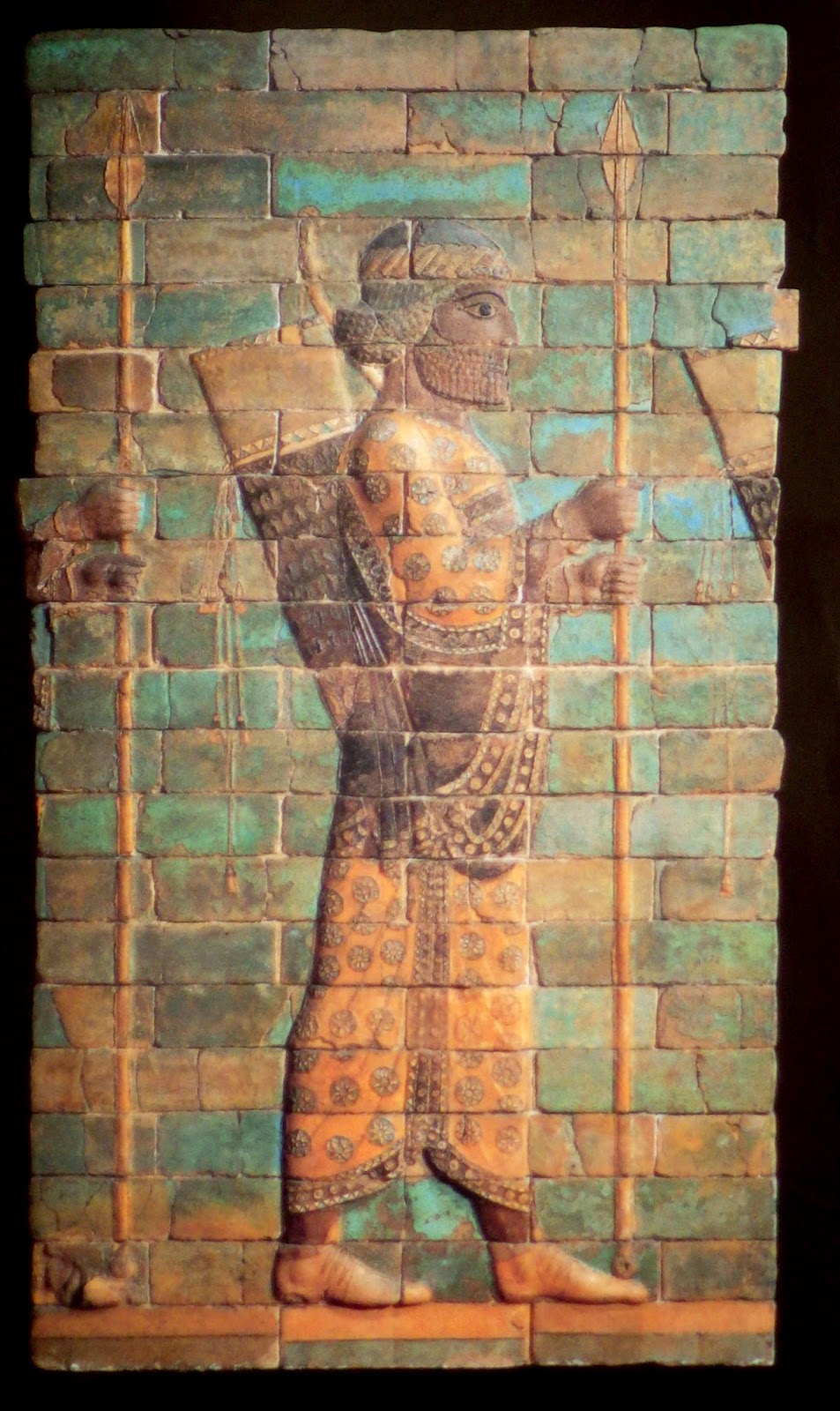
Three days was a short time to spend on Museum Island in Berlin in 1992, but I made the most of it. The Pergamon & Bode Museum was amazing and it was there I beheld the reconstruction of the Ishtar Gate. The gate hails from 6th century BCE Babylon, shortly before the Persians invaded that part of the world. The wall sculpture below, also at the Pergamon, identified as being from the Persian palace at Susa and being a depiction of a "Spear-bearer of the bodyguard of Darius I (521-486 BC)" shows how stylistically similar Persian work was to other art in the area.


Other work which I have confused in the past for Ancient Persian, are wall reliefs and sculpture from the earlier empire of Assyria (c. 7th century BCE). The British Museum has a beautiful collection of  artifacts from Assyria, including a dedicated long room full of wall carvings.


Whenever I visit the British Museum (every couple of years), I must stand in fascination in this room. The carvings are stunning.


These photos are from a visit in February 2011. Unfortunately, my young daughter felt uncomfortable with the animals being speared and shot with arrows (depictions of a lion hunt), so we did not spend as long in the room as I would have liked!