Showing posts with label carborundum. Show all posts

Wednesday, 15 January 2020

Home Project - Memory is My Homeland

Last spring I finalised a title for the body of work, which I had been alternately thinking of as "The Home Project" and "Stories of Home". I finally settled on "Memory is My Homeland", a phrase which I extrapolated from a quote by artist Anselm Kiefer. The beginnings of this work can be seen in previous blog posts here and here. The third small piece in this series is based on the view from my window, from the first time I moved from the family home - I lived here for one month, and almost would not even include it in thinking of my various homes, but for the number of stories that I associate with this one month. I think this work gives an indication of some of these stories!

Dunn Ave, oilstick & graphite on wood, 25.4 cm x 25.4 cm, 2019


In July I did a sketch for a larger work related to the house that I grew up in. I would describe it as being about "growing up, leaving home, and trees & flowers". Kingswood, in the east end of Toronto.


I finished the large painting before the end of 2019, but that will provide a blog post on its own. I used the image from the corner of this painting (a memory of my Communion Day, though for the painting I removed the veil) to feature in some prints.


I previously blogged about going to the Trinity Arts Workshop to learn about carborundum (which can be found here) and it was after printing out the carborundum prints that I decided I wanted to include some linework in the final print. I returned to the TAW to etch a corresponding copper plate and was shown how off-setting a print from the carborundum would facilitate a perfect correspondence. I had never encountered this process before, so it was like magic!


While I was resident at Signal Arts Centre at the end of last year, I did a few more test prints of the carborundum plate. I still have access to a small press and plan to finish the copperplate in drypoint before combining the plates for a final print edition.


I used the Communion image again for a monoprint, but unfortunately I think I applied too much pressure when running through the press, and the ink stuck to and ripped the paper. This is the actual plate before I put it through the press.


Wednesday, 18 December 2019

Signal studio - wind down

My residency at the Signal Arts Centre studio came to an end recently -- don't know if it would have been possible to keep up such a supremely productive pace! I previously blogged about this year's residency here and here. I also had a residency last year, which I blogged about here, here, and here. I am booked in for next Oct, Nov, and Dec too!

In my last few weeks I had borrowed a press and printed up all the lino blocks I had cut. This is a test print, showing also the "window" I made from a heavy cardboard in order that the paper would be lifted off the press base. I adjusted the press roller for the depth of the lino blocks, but the cardboard had the effect of raising the press base such that printing a relief block was not awkward.


I printed all the lino blocks for my intended bound portfolio of prints, "A Short Walk To Fort Carré"


In those last few weeks I also completed a number of blank sketch/notebooks using my modified version of medieval tacket binding. I have blogged about how to do this type of binding here and here.


I also prepared nine pocket size blank sketch/notebooks to include in Signal's annual xmas craft fair. The photo below shows them before using the Japanese stab binding technique. Three have leather covers, three have vinyl covers, and three have acrylic sponge covers. Earlier in the residency I had also made a number of "handbag" books using this binding technique. Several years ago I blogged full instructions to make this type of book, which can be found here.


Once I had all the lino prints done, I wanted to make use of the press during the last couple of days of my residency. I had some oils and one of the carborundum plates I had created during a printmaking workshop I attended in September. I blogged about that workshop here.


As I was cleaning up and clearing out the studio, one of the final "clean" things I wanted to do was cut and create the covers for the series of lino prints I now realised I would not bind until the new year, but I at least wanted to get them made. I always get nervous about measuring and cutting (it's so final!) so I took it pretty slow.


The covers are made of a heavy duty, 100% acid-free blotting paper, and will fold around the print series, bound together using the simple Japanese stab binding technique. The portfolio of prints will be in an edition of three.


On my second last day of the studio, I decided to create a monoprint. Using undiluted alkyd paints on a square acetate plate, I painted the familiar figure. Unfortunately I did not blot my paper dry enough, and it ripped in the press. Rather than daunt me, it just made me realise a few things for next time, as I want to work more with that image.


This is the studio shortly before I moved out: almost everything off the walls, and a lot of work brought home already. On the table near the window, prints are being weighed down to flatten. After a final tidy, I said goodbye to an inspiring workspace and returned the key.


Wednesday, 25 September 2019

Carborundum

Since moving to Ireland in 1988, I became aware of a printmaking process that I had never heard about (printmaking was one of my courses in art school). My curiosity has peaked about the process of carborundum since I have become re-interested in printmaking over these past few years. I have looked at a number of courses and workshops, but usually they entail a night class or weekend workshop on the north side of Dublin -- something that would be difficult for me to travel to. So I completely jumped at the chance to attend a workshop being held by Trinity Arts Workshop, near the DART, and not starting till 10 am on a Sunday morning. The facilitator, Daniel Lipstein, outlined a course that would cover whatever aspects of printmaking prospective participants were interested in. I wrote to him, secured a place and he had a variety of plates ready for me to work on when I arrived.


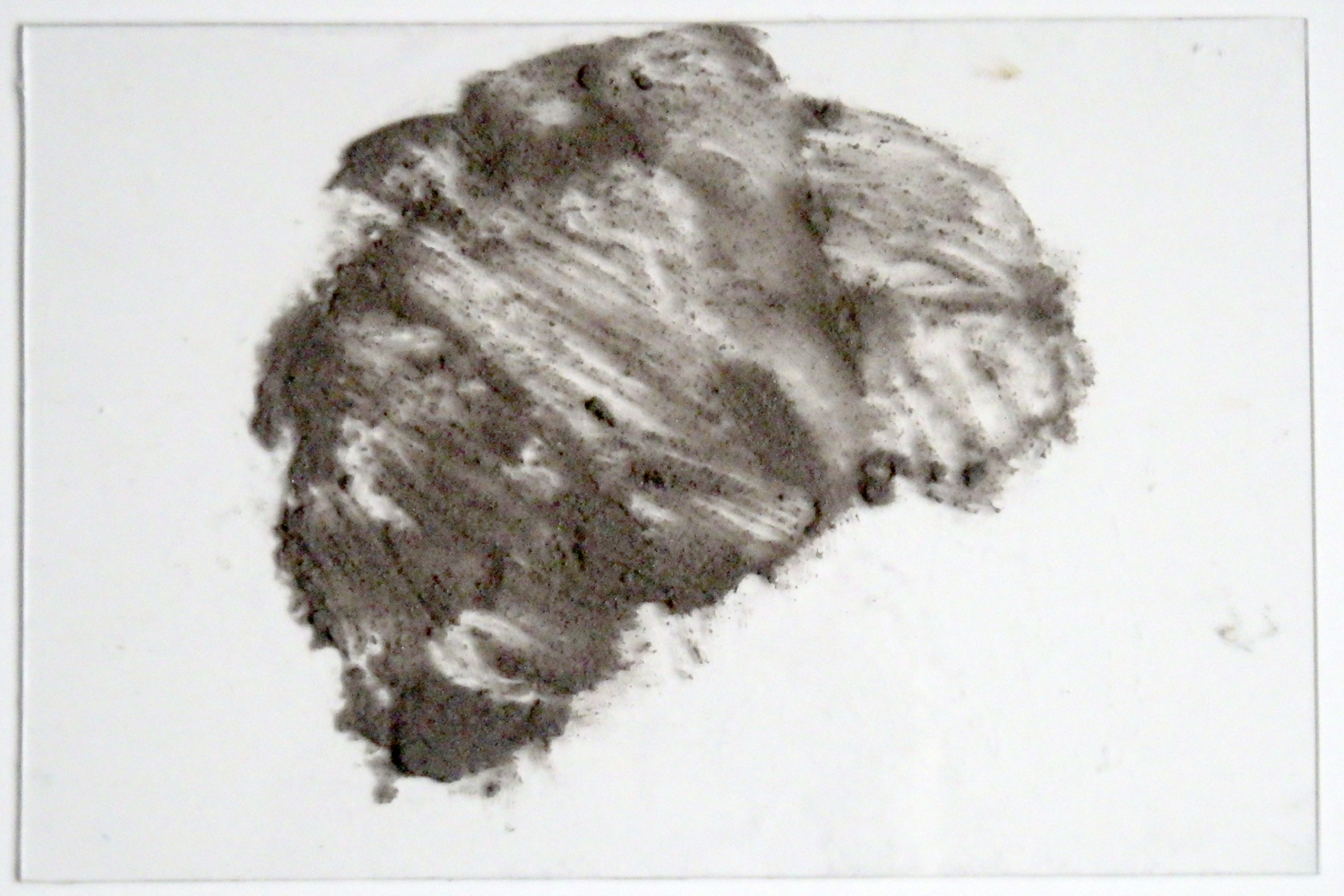
Lipstein explained the process to me with the pre-prepared plates. A mixture of carborundum, a sandy powder, was mixed with pva glue and painted onto a plate (the plates were completely de-greased first with ammonia, water, and chalk powder). After thoroughly drying plates, a design was painted on with either oil paint or oil printing ink. The process was similar to monoprinting, and the first print pull would look simply like a monoprint. The second print would show off the carborundum texture.


The printing process is fairly quick, so I worked on a few of the ready-made plates during the class. The direction of the carborundum on this plate reminded me of the field in front of a house in which I used to live in Kerry, so I made Knockeen the subject of this print.


But I also had a go at mixing the carborundum with pva myself and


preparing my own plate by painting the carborundum/glue mix. It does need to dry thoroughly before painting with oils or ink, and unfortunately this plate only finally dried by the end of the workshop. However, I got a very thorough understanding of the process from the few hours, and look forward to another workshop in a couple of moths, where I can ink this up and print it as well as work on a few other processes that I want to re-visit.