Showing posts with label acrylic. Show all posts

Wednesday, 12 April 2023

Rooftop archive 11 late 1990s

For previous posts from the so-called "rooftop archive" look at the most recent here, which gives links to all the others.

In the late 1990s there was a major fire at a printing company near to where one of my sisters lived. She told me that there was a big skip outside the establishment and reams of paper were being thrown into it. My husband (also an artist) and I drove over to check things out and came away with an abundance of grey heavy stock card, 88 cm x 50 cm, and large sheets of all-purpose cardboard. Because of this supply windfall, I felt very free to sketch on a large scale. In 1998 I had an exhibition planned for the following year, but was still unsure of what a new body of work would look like. I was fondly remembering my time living in rural Kerry, which had come to an end in the fall of 1996. One of the most amazing memories of this rural time was my sighting of Comet Hyakutake from the field in front of my house, Knockeen. On a clear night the stars in Kerry were magnificent. 


I must apolise for the sheen on these drawing/paintings, I was using gloss medium to thin the acrylic. I gessoed the grey card first and worked in thin layers of colour to build up a certain (unphotographable!) luminosity. In front of the house, there was a gate leading to a large field beyond and it was from this field that I viewed the comet above the outbuilding ruins beside my house.


I thought the gate itself was an important image and began combining it with other familiar imagery from my work. The figure here was the outline of a life size cut out I had made of my body using the all-purpose cardboard.


Again, this is an example of how I was combining past imagery with the image of the gate (which for me echoed the trellis that had appeared in earlier paintings and drawings).
 

Once I had started using flowers in my work, however, there was no stopping me. Grounding the heavy card with gesso, I decided to do some drawing with oilstick and graphite -- a combination that I still enjoy. I realised how much I like drawing and painting flowers and decided that this would be the subject of my next exhibition. I suspect that due to the size of this piece I could not afford the framing so it did not make it into Blessings, which showed first at Signal Arts Centre, Bray, in 1999 and then Cavan County Museum, Ballyjamesduff, in 2000.


The exhibition Blessings consisted of large acrylic paintings on canvas, medium sized oilstick & graphite drawings on paper and very small monoprints of both wild and cultivated flowers. This is an oilstick & graphite drawing from that exhibition. “Honeysuckle”, 43 cm x 37 cm, 1999, is framed and hanging on the wall in my bedroom.


Wednesday, 5 April 2023

Rooftop archive 10 - mid 1990s

I showed some of the drawings from 1992 that began my obsession with windows and the stonework ruins in the rooftop archive post, here. In that post I also give links to previous rooftop archive posts. When I moved to Ireland in 1993 I brought with me a series of large paintings that I had completed in Toronto the previous year and had full intention of creating more in this series. This series became the exhibition My Tower of Strength and toured arts centres throughout the island of Ireland 1994-1998.   

Early in 1994 I relocated to rural Kerry where I was reunited with my favourite castle ruin, ie, Ballycarbery Castle near Cahersiveen.


I was offered an exhibition at St John's Art Centre in Listowel first and thought it was the perfect place to display My Tower of Strength (a former church, open stonework walls) but I wanted more paintings in the exhibition and got to work on these window drawings, which were studies for the Ballycarbery paintings. 


There were five Ballycarbery paintings altogether, but I'm not sure which of these six drawings did not make it into my final decision plans for what I would paint! It may have been this one, but I'm not sure...


The Ballycarbery paintings, which were the brightest (predominantly yellows, greens and pinks) works in the series and all completed in early 1994 before the touring exhibition began. Although St John's  was the first to offer me a show, the touring began in Siamsa Tire, Tralee, who also wanted the exhibition at a slightly earlier date.


Ballycarbery Castle had a great many intact windows to choose from and I enjoyed drawing them. 


All of these sketches are acrylic on paper and 76 cm x 56 cm.


When I moved to rural Kerry, I thought the phenomenon of drying peat hanging out of ruined outbuilding windows was most interesting. Surprisingly, I never took this concept further than sketches and photographs, especially as I moved to a house near Portmagee in 1995 and my husband stacked peat in ruined windows of our own abandoned outbuildings! As with previous window ruin drawings, this is acrylic on paper, 76 cm x 56 cm.

Wednesday, 22 March 2023

Rooftop archive 9 - early 1990s

Yes, this rooftop archive is pretty big, but it has served a purpose to go through everything that was there taking measurements and photographing past work, and best of all PURGING work that I don't need hanging around to haunt me! I have recently blogged about the archive (installments 7 and 8) here and here. In installment 6 - here - I have also given links to all the previous installments.

As this piece is undated, I am relying on memory and circumstances to suggest that it was either from 1989 or 1990. It was created after my first solo exhibition in Dublin while I was living with my parents in Bray. It is of course based on dream imagery except for the crazy complicated lightning bolts – lightning configurations that I actually saw during a storm in Ontario  in the 1980s! This untitled work hung on my Mum’s bedroom wall (which had been my room when I lived there) for many years and was returned to me after her death in 2016. This untitled, mixed media work is 157 cm x 150 cm.


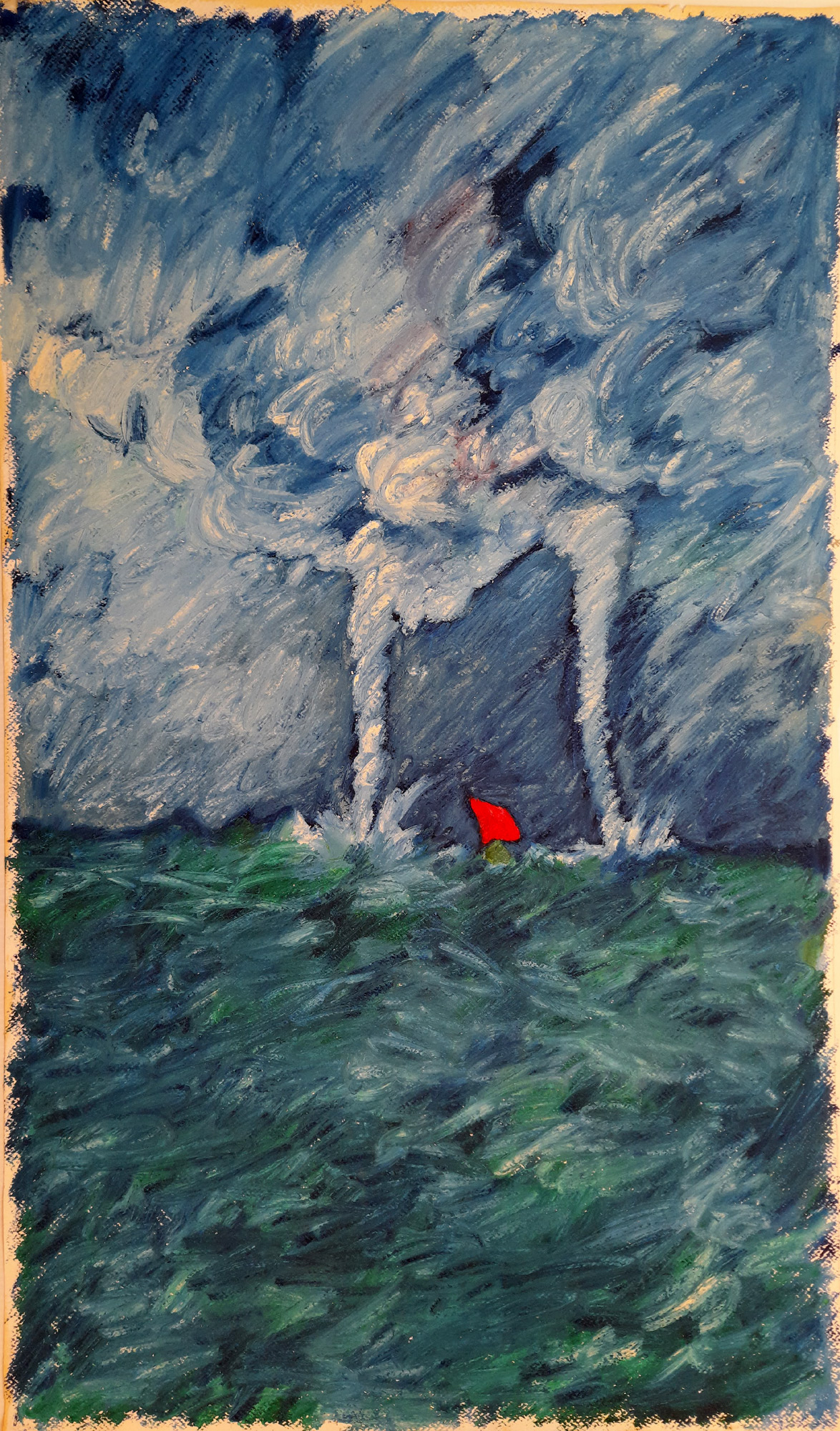
In either the spring or summer of 1990, I returned to Toronto to be in a group show with nine other young artists. I created the sculptural element of a work to exhibit while I was in Ireland (a trellis table holding a house with a fimo figure dancing among stars who could be viewed through a bay window on the second floor of the house). Behind the sculptural element was this oilstick drawing, Two Waterspouts. Amazingly, I still had the huge roll of Strathmore paper my mentor professor (sculptor Hugh Leroy) gave me while an impoverished art student at York University, Toronto, some years before. I gessoed the paper before drawing the waterspouts, 107 cm x 63 cm. The sculptural element had live roses added to it for the exhibition; that part of the artwork was sold and I do not have any pictures of it! 

I was living in Toronto, perhaps in turmoil, when I drew this work on Oct 20 1991 (very specific date written on the back of the drawing!). Tornado, graphite on paper, 102 cm x 66 cm.


Two mediums I still enjoy a lot are combined in this drawing that I created while living in Toronto in the summer of 1992. Foxglove, oilstick & graphite on paper, 76 cm x 49 cm.


 In the early 1990s I was quite obsessed with stonework and windows in both ecclesiastical and secular ruins around Ireland. I think this obsession started when I was on holiday here in 1992 and visited a friend who had moved to rural Kerry and ruins nearer to where my parents lived on the east coast as well as ruins in Clones, close to where one of my sisters was living at the time. I did large, loose sketches of a number of windows using monotones from acrylic black paint and I later used these sketches as research for a new body of paintings that I entitled My Tower of Strength (taken from the motto on my family coat-of-arms). These painted drawings are all untitled, acrylic on paper, 76 cm x 56 cm (or 56 cm x 76 cm), the specific ruins that they are based on can be found in Clones (a church ruin), 


Kerry (outer wall of Ballycarbery Castle)


and Wicklow (Killadreenan near Newcastle). 


It is only the stonework in the drawing of the church window at Clones that I recognise as making its way into a future painting. 

Wednesday, 6 October 2021

Florence Road: Butterfly Wall

As with the Kingston Road painting (here) I had a pretty clear idea of what image I wanted to represent my home when I moved back to the town of Bray from rural Kerry in 1996. Prior to giving all the walls a makeover paint job before moving in, I was horrified to find the stairwell was home to dormant but still living butterflies. My fear of butterflies comes from many years of seeming to be a target for both swarms and singular colourful insects in Toronto as they dive-bombed my curly head. My husband carefully collected the butterflies and set them free - once outside they shook off their stasis. So creating this painting was a bit cathartic for me and I am happy with the resulting overall image of rebirth. I started the painting at the end of August with composition outlines.


Finding images of 1950s style wallpaper was simple enough, I just had to choose something that suited my memory. At first I thought of using images of Monarch butterflies, but these were a type of butterfly that were more common to my childhood in Toronto. Here in Ireland it is the Small Tortoiseshell Butterfly that is very common and I expect that that was the likeliest species that I found on the stairwell wall of Florence Road.


While I set about making each buttefly unique I also wanted them to obviously be the same type.


I gave enough three dimensionality to the bannister railing to make it visually stand in front of the butterfly wall.


Florence Road: Butterfly Wall; acrylic on pressed cloth; 60 cm x 75 cm; 2021


Wednesday, 15 September 2021

Kingston Road: Waiting - painting finished!

I thought that the large Knockeen was going to be the last painting in this series, but then I had some ideas to do a few more, so got to work. The first of the new paintings was also going to be the largest, but considerably smaller than Knockeen and Kingswood. I decided I wanted the works to be stretched and in doing so discovered that pressed cloth is a lot more difficult to stretch than canvas! However, I do like the  unpredictability of painting on this material and think it is appropriate to the concept of memory as being sometimes blurry and unreliable, so I carried on.

I started painting, as usual, by working out the composition in yellow. I fully expect some of the yellow lines to show through in the final work and like the idea of revealing the process as I go along.


In the mid 1980s, when I lived in Toronto, I had a bachelor apartment on Kingston Rd, not far from where I grew up. Though this apt was technically in Scarborough, it was only several blocks away from Toronto, and about a 20 minute walk downhill to Lake Ontario. I was in my final years of university at the time. For an installation I was working on I painted sheer curtains, and it is those painted sheers that are hanging up in the windows (as they did) behind the figure.


The figure is, of course, a representation of the younger me, and the red checked table-cloth over my all-purpose folding card table had to make an appearance.


What I refer to as a "small" painting is relative, as is obvious by this working picture. That's Kingswood on the wall behind; I unrolled it and hung it over Knockeen, then covered the two with plastic sheeting so they wouldn't get spattered accidentally while I worked on the smaller easel paintings.


The painting in its final days. The xmas lights were a year-round thing, just as they are now in my house, though fairy lights are much smaller.


The finished painting -
Kingston Road: Waiting, acrylic on pressed cloth, 76 cm x 102 cm, 2021 


For all previous works from the Memory Is My Homeland series, please do a simple search within this blog (I have made many posts of the works in progress and completed). Also, the origins of this project may be found under the label The Home Project, as I called it when I hadn't yet decided on a name for the work.

Wednesday, 1 September 2021

Pluid - The National Comfort Blanket

This week I had intended to write about the other exhibition, Pathos, at Rathfarnham Castle, but after seeing the Pluid exhibition on Sunday, I decided it was a priority because it is a fundraiser in which all of the works may be viewed here and many are available for auction in aid of Pieta House, a charity with a mandate for suicide prevention. I blogged about the Pluid Project back in April of this year when I decided to get involved; you can see that post here. While the initial intention of the project was to create a National Comfort Blanket where the individual contributions would be sown together into one giant work, it soon became apparent to the organisers, Claire Halpin and Madeleine Hellier, that both the variety of media and the number of artworks involved would make this an impossible task. Instead, the numbered works were laid out on a long platform and visitors to the exhibition could make their way around the table to view the squares.


Looking up the tables at the multitude of contributions! Admittedly it was a little overwhelming but also gorgeous to see. The two monoprints I submitted, Rosehips and Wild Rose (#81 & #82), are visible towards the bottom centre.


The brief was completely up to the contributing artist to interpret: so a 6 inch square encompassed both 2D and 3D work and any medium that could be thought of was used! I was particularly drawn to Ciara O'Connor's stitch-drawing image of a parent and child making pasta together.


There were three primary schools that took part in this project: Fairview NS (Dublin), Holy Family NS (Monkstown) and Gaelscoil Nás na Ríogh (Naas). This picture also shows a variety of textile-based work: knitting, crochet, felting, beadwork and quilting. 


Jenny Mahony's limestone sculpture (centre) is a beautiful example of a fully 3D artwork in the exhibition. As #56 - an early piece to arrive at Pluid headquarters - it certainly shows how impossible it would have been to stitch the works together as a literal blanket!


2D work took the form of painting, drawing, photography, sculpture and various types of printmaking. There were a few examples of sun-printed cyanotypes. The print at centre-right is by Val O'Regan.


I was thrilled to see a ceramic piece in the exhibition by Orla Kaminska (upper left), whose work I had seen at the annual Ceramics Ireland exhibition at Rathfarnham Castle in June (I blogged about that exhibition here). I was delighted to discover that Fungi (centre right), the beautifully debossed and gold leaf embellished hand-bound book by Fiona O'Grady, was a blank sketchbook! As someone who enjoys bookbinding myself it is such a treat to see what techniques another artist is using.


This picture again shows a variety of works in different media and techniques: painting, felting, photography, crochet and stitching. The gold embroidery on denim is an extremely delicate drawing of wild garlic by Mairéad Harrington, which to her were a comforting sign of spring. As I have wild garlic growing annually below the fuschia hedge in my front yard (from which I make pesto each spring), I delighted in this piece.


In many of my own art pieces I have referred to my "dream boat": an image of a red-sailed boat in the ocean that first appeared to me in a dream and which I have come to associate with my self. Seeing this marker drawing of the red-sailed boat (centre) by Laura Geragerthy brought a true smile to my masked face, like meeting an old friend.


Human touch, both painted and photographed, like these photos (top, black and white) by Joshua Sullivan, has such strong associations during this time of "social distancing". Hugging and holding hands, when possible, have become far more important and nuanced than at any other time in our lives. I was also delighted to see the mokuhanga print of Kate McDonagh. Stillness (centre) "reflects the solace [she] found in the quiet skies throughout the Pandemic particularly [during] the first lockdown when no planes were flying." I became acquainted with McDonagh's practice during one of Graphic Studio Dublin's "Artist Beyond the Studio" series of lockdown remote artist talks a few months ago. A recording of it can be watched here.


Comfort in nature was another theme found in various forms throughout the "blanket". I was particularly drawn to the bog cotton works by Pamela DeBrí. I used to live rurally in Kerry and the field next to me was where I first saw bog cotton, a sight which I thought wonderful and beautiful. It was a joy to see both the photograph of a cotton field and the real things immortalised on rag paper.


This picture shows varying 3D works by different artists. I enjoyed Grant McEwen's stainless steel Jigsaw Time (reflecting the overhead beams of the cowshed) and it gave my family the opportunity to do a squishy masked selfie. In front of McEwen's piece is the blue origami and graph paper work, Blue Pavilion, by Helen Barry and beside that is Nourishment, a driftwood and copper piece by Helen OBrien. Nearby I was struck by the altarpiece quality of Michelle Boyle's The Sun Rises in Spite of Everything, a mixed media work that includes gold leaf, granite and découpage elements to create something mystical. To the right of Boyle's work is a blue glass abstract landscape work, Bay, by Barbara Keneally.


There were a surprising number of glass works submitted and I was particularly drawn to the colourful works (centre) of Maresa Edwards, which were based on her daily walking routes.


Obviously it is impossible for me to feature every worthy artwork here - there are more than 1200 works! - so please look at the auction website, here, to view individual works and find out more about the artist's response to the theme of comfort. Altogether it is quite amazing how much thought and work and expression can go into a six inch square. Each artwork is so individual and so human - this is truly a project that has shown the depth of feeling that individuals are willing to show during this extraordinary time and to share their comfort with others. Brava Claire and Madeleine for intiating this project! Thank you.

Wednesday, 18 August 2021

Knockeen - finished painting!

I think it was the first week of August that I declared (to myself) that Knockeen was finished and I signed it without further ado. It is a painting that I have been working on for most of this year and I blogged progress reports fairly regularly; you can see the painting's development here, here, here and here.


So here is a picture of the whole painting! Knockeen, acrylic on pressed cloth, approx 228 cm x 200 cm, 2021. I made some changes from the original composition sketch, which you can see here. The red and blue calla lilies reference a dream I had shortly before the death of my father in 1995. While I had not seen real calla lilies till I moved to Kerry, on rural lawns the flowers were always white. I talk about painting those dream flowers here.


Here is a detail from the left side.


This is another detail from the left side. I had decided very early on that I wanted to include a section of the night sky, because the sighting of Comet Hyakutake in 1996 in a completely clear Kerry night sky was amazing! I had also seen René Magritte's painting, Empire of Light, at the Peggy Guggenheim gallery in Venice a couple of years ago, and loved this possibility of painting day and night at the same time. I have previously painted Hyakutake in Knockeen and posted images here and here. (NB in the first link I mis-identify the comet as being Hale-Bopp, which saw in Bray.)


This is a detail from the right side of the painting. I have also used the image of the house and field gate at Knockeen in prints, which you can see here and here. The small gate divided the house from the field in front of it. Sometimes the cows were in it, but more often they were in the field behind or around the house, where they trampled our garden attempts, ate half the straw welcome mat and, no doubt, getting up to mischief in the cramped space behind the shed...


Although only at Knockeen for a year and a half, it was a very creative time for both my husband and myself.


Here is a detail at the bottom of the painting - fuchsia and wild roses are quintessientally Kerry to me.